
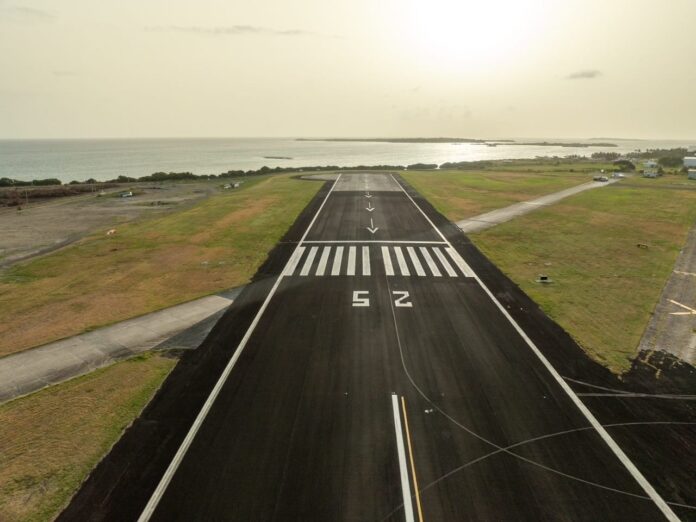

The first phase of the Airfield Rehabilitation Project at the VC Bird International Airport has now been completed.
It represents a significant milestone in the US$50 million upgrade, one of Antigua and Barbuda’s largest and most transformative infrastructural projects in recent history.
With work on the first phase completed, the full operational length of the runway is now once again being utilised to take international flights. The various upgrades also ensure an increased level of safety performance and compliance with international civil aviation regulations.
Minister of Tourism, Civil Aviation, Transportation and Investment, the Hon. H. Charles Fernandez, who was taken on tour of the project this week, expressed his full satisfaction with the level and quality of work. He noted that it clearly signals that Antigua and Barbuda is on the right track as a leader in the aviation industry in the Caribbean.
Fernandez stated, “The successful completion of the first phase of the Runway Rehabilitation Project on time and within budget is a testament to the strategic collaboration between our designers, contractors, operational teams, and all key stakeholders.”
“Importantly, this critical infrastructure upgrade has progressed without disrupting airport operations, even during one of our busiest airlift seasons. This project strengthens safety, enhances resilience, and ensures that V.C. Bird International Airport continues to operate as one of the most dynamic and forward-moving aviation gateways in the region,” the Minister added.
Construction of a new, expanded Runway 25 turnpad (approximately 7,250 m²), designed using the Airbus A350-1000 as the reference aircraft
Installation of new runway end lights, runway edge lighting, and turnpad edge lighting
Establishment of a dedicated blast pad
Implementation of a compliant Runway End Safety Area (RESA)
Construction of a perimeter service road along the aerodrome boundary
Addition of ICA O-recommended surface markings, including blast pad chevrons and transverse striping on turnpad shoulders, enhancing conspicuity and improving pilot situational awareness
According to Joseph, one of the most pivotal improvements that the first phase achieved was the repurposing of Runway 25 to accommodate larger aircraft.
“While aircraft such as the Boeing 777-200 were able to operate safely , the redesigned infrastructure now aligns with both current compliance expectations and future widebody operational requirements,” Daly further explained.
The Runway End Safety Area (RESA) is another significant development. Not unlike many airports in the Caribbean, the V C Bird International sits close to the coastline so space for expansion has always been limited. To create a proper Runway End Safety Area (RESA), about 130 metres of runway pavement was removed during the project and operational distances adjusted.
“While this slightly shortens the runway , it greatly improves safety by providing more protection at the runway’s end and brings the airport fully in line with international aviation safety standards,” Daly added.
Work on the next phases of the airfield upgrade continues on schedule. Phase 2 is expected to conclude by Saturday night, paving the way for Phase 3 to begin on Monday night. This next stage will involve construction of the alternate turnpad and the temporary closure of the existing Runway 07 threshold to facilitate reconstruction works.
At the same time, Phase 5 will proceed alongside Phases 3 and 6, focusing on paving the Runway 07-25 overlay to enhance overall runway performance and safety.
The project remains on track, with substantial completion targeted for 6 July 2026 and full completion scheduled for 6 September 2026.