
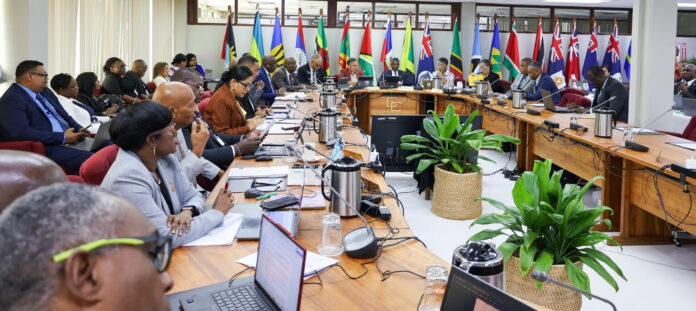

Antigua and Barbuda will help assess whether Caribbean producers can meet regional demand for cement and paints, with the findings set to inform CARICOM trade ministers’ decisions on future tariffs for those products.
The country is represented on two of four assessment teams scheduled to meet between Oct. 12 and 27, according to a CARICOM Secretariat statement issued Friday. The other teams will examine glass bottles and petroleum bitumen.
The reviews will compare products traded within the Caribbean with imports from outside the region, examining tariffs, other trade barriers and transportation costs. Teams will also review the rules used to determine whether products qualify as originating within CARICOM.
Antigua and Barbuda will join Barbados, Guyana, Jamaica and Trinidad and Tobago on the hydraulic cement team. Its partners for the paints and varnishes assessment include those countries, along with Dominica, Grenada and the Organisation of Eastern Caribbean States Commission.
The teams were established by the Council for Trade and Economic Development, known as COTED, at its June meeting.
CARICOM Assistant Secretary-General for Single Market and Trade Wayne McCook said the council had instructed the teams to carefully examine supply and demand while considering stakeholders and consumers who depend on stable, predictable supplies.
The teams are expected to seek input from the public and private sectors, consumers and civil society. Their reports will guide future tariff deliberations by COTED, which comprises trade ministers from CARICOM’s 15 member states.
Four CARICOM assessment teams are to meet between 12 and 27 October to examine whether the Region can meet its own demand for paints, hydraulic cement, glass bottles and bitumen. Their reports will be critical inputs that regional trade ministers will consider in deciding on future tariff treatment for the products.
The groups were established by the Council for Trade and Economic Development (COTED) at its Sixty-second Regular Meeting in June this year.
“The Council has directed the assessment teams to be rigorous in examining the regional supply and demand for products and give careful consideration to the sensitivities of all stakeholders and consumers who rely on a stable and predictable supply of the products being assessed,” said Ambassador Wayne McCook, Assistant Secretary-General, CARICOM Single Market and Trade.
The teams, which are coordinated by the CARICOM Secretariat, comprise technical representatives from several Member States. The Organisation of Eastern Caribbean States Commission and the CARICOM Private Sector Organization have been invited to participate in the meetings.
The groups will examine the competitiveness of intra-regional trade against extra-regional imports, including the effect of the Common External Tariff, non-tariff barriers and logistics costs, and review how the Community’s Rules of Origin criteria apply to the products. They are expected to enlist support and input from stakeholders in the public and private sectors, consumers and civil society as they prepare for their meetings.
The Assessment Teams
Petroleum bitumen: Barbados, Grenada, Guyana, Jamaica, Suriname and Trinidad and Tobago.
Other Hydraulic Cement: Antigua and Barbuda, Barbados, Guyana, Jamaica and Trinidad and Tobago.
Glass bottles: Barbados, Grenada, Guyana, Jamaica, Suriname and Trinidad and Tobago.
Paints and varnishes: Antigua and Barbuda, Barbados, Dominica, Grenada, Guyana, Jamaica and Trinidad and Tobago, the Organisation of Eastern Caribbean States Commission.
COTED is the CARICOM organ responsible for trade and economic development, and comprises ministers responsible for trade in the Community’s fifteen Member States.
This article was originally published by Antigua News Room. Read the original article here: Antigua and Barbuda to Help Assess Regional Cement and Paint Supplies Ahead of CARICOM Tariff Decisions.