

When heavy rain falls across Antigua and Barbuda, weather forecasters can usually predict when the showers will begin, how long they might last and how much rain is expected.
What they cannot always say with certainty is what that rainfall will do once it reaches the ground.
Will water collect quickly on major roads? Which communities are most likely to flood? Could overflowing drains cut off access to emergency services? Will schools or businesses need to close?
Those questions are at the centre of a major effort now underway to modernise flood forecasting in Antigua and Barbuda, shifting the focus from predicting rainfall to predicting its impacts before disaster strikes.
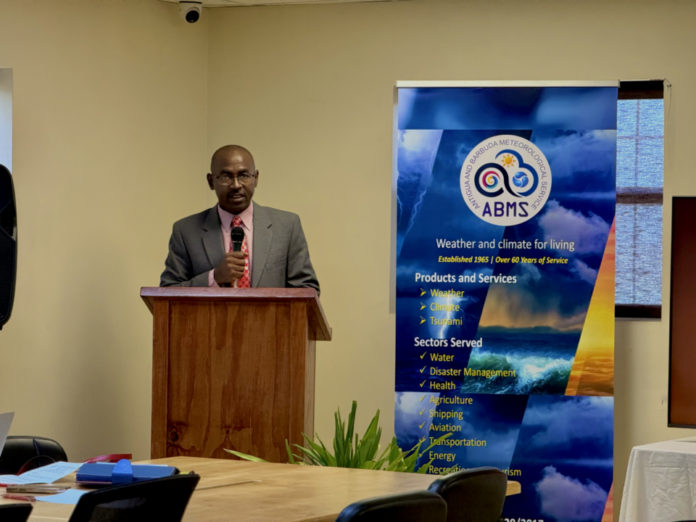
Over two days in June, meteorologists, engineers, emergency managers, utility officials and government agencies met at the National Office of Disaster Services to begin developing the country’s first comprehensive Standard Operating Procedures for flood forecasting and warning. The workshop, organised by the Antigua and Barbuda Meteorological Service (ABMS) in collaboration with the World Meteorological Organization (WMO), forms part of a broader project aimed at strengthening the nation’s flood early warning capabilities.
The initiative supports the development of the Urban Flash Flood Information System, known as UFFIS, an advanced forecasting and decision-support platform that officials say will eventually help authorities anticipate flooding before roads become impassable and communities are cut off.
Unlike traditional weather forecasts, which primarily describe atmospheric conditions, UFFIS is designed to combine weather forecasts with information about soil moisture, drainage systems, river basins, terrain and previous rainfall to estimate where flooding is most likely to occur and how severe the impacts could become.
For residents, the difference may appear subtle. For emergency managers, it represents a fundamental change in how warnings are issued and decisions are made.
Instead of telling the public that 100 millimetres of rain are expected, forecasters hope to provide information that answers more practical questions: which roads are likely to flood, which communities face the greatest risk, and when emergency responders should begin preparing for possible rescues.
The approach, known as impact-based forecasting, has become an increasingly important part of modern meteorology as climate change contributes to more frequent and intense rainfall events around the world. Rather than focusing solely on weather conditions, it seeks to forecast the likely consequences of those conditions so governments and the public can take action sooner.
ABMS Director Dale Destin told workshop participants that forecasting alone is no longer enough.
“Flood warnings must be more than forecasts—they must be actionable guidance that leads to timely decisions and protective action,” Destin said, describing the workshop as a critical step toward building “a truly integrated, impact-based flood early warning system for Antigua and Barbuda.”
He said bringing agencies together was essential because effective flood warnings depend not only on weather forecasts but also on how institutions coordinate before, during and after an emergency.
That coordination was a major focus of the workshop.
Representatives from the Antigua Public Utilities Authority, the National Office of Disaster Services, the Ministry of Works, the Department of Environment, the Survey Department, the Development Control Authority, the Ministry of Agriculture, emergency response agencies, academia and the private sector worked through existing procedures, mapped how information currently moves between agencies and identified areas where responsibilities need to be clarified.
Participants also examined how warnings are communicated, who is responsible for making operational decisions at various stages of a flood emergency and how new forecasting technology can be integrated into existing emergency response systems. The ultimate objective is to produce national Standard Operating Procedures that clearly define roles, communication pathways, escalation triggers and decision-making responsibilities before severe weather threatens the country.
According to the workshop’s concept note, the effort builds on several days of institutional consultations involving the Meteorological Service, APUA, NODS, the Ministry of Works and the Department of Environment. Those discussions examined everything from rainfall monitoring and groundwater data to emergency communication systems, warning dissemination, flood verification and post-event reviews.
The new system also reflects a broader shift in the science of forecasting.
During presentations delivered at the workshop, ABMS outlined how flood forecasting increasingly relies on combining multiple sources of information rather than weather data alone. Forecast models, weather radar, satellite imagery, automatic weather stations, rain gauges and reports from communities all contribute to building a picture of flood risk. UFFIS is expected to expand that capability by incorporating hydrological modelling and basin characteristics to improve forecasts of urban and flash flooding.
Officials say that means future warnings could be based not only on how much rain is expected, but on how vulnerable a particular community is to flooding under those conditions.
Another important component of the system is the use of risk matrices that combine the probability of an event occurring with its likely impacts. Rather than simply classifying weather by rainfall amounts, forecasters assess the potential consequences for people, infrastructure and essential services, helping emergency managers determine whether communities should be advised to prepare, take action or evacuate if necessary.
Destin said the work forms part of the ABMS Meteorological Renaissance 2030 initiative and supports the United Nations’ Early Warnings for All programme.
“This initiative is also an important component of the ABMS Meteorological Renaissance and Antigua and Barbuda’s implementation of Early Warnings for All,” he said. “Every dollar invested in the Meteorological Service strengthens public safety, protects critical infrastructure, supports economic development, enhances climate resilience, and reduces disaster losses.”
While the Urban Flash Flood Information System remains under development, officials believe the work now taking place behind the scenes could significantly strengthen the country’s ability to respond to one of its most common natural hazards.
For most residents, flood warnings may continue to arrive as brief advisories on the radio, television or social media.
But if the project succeeds, those warnings could eventually answer the question people ask most when dark clouds gather overhead—not simply how much rain is coming, but what that rain is likely to mean for the road outside their home, their community and their safety.
This article was originally published by Antigua News Room. Read the original article here: Antigua Moves Toward a New Era of Flood Forecasting.