
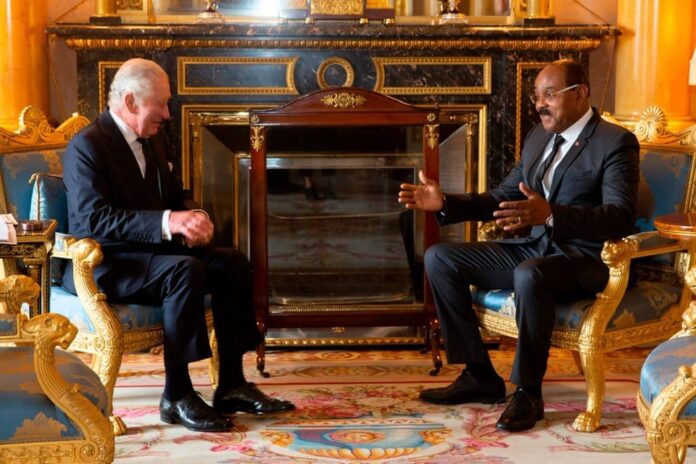

Antigua and Barbuda’s Prime Minister Gaston Browne has argued that the Commonwealth could form the foundation of a new alliance of “middle powers” as countries adapt to a shifting geopolitical landscape.
Writing in an opinion article published in The Telegraph , Browne said recent global developments have underscored the importance of cooperation among countries that are not superpowers but still seek to maintain influence and stability in international affairs.
He pointed to recent remarks by Canadian Prime Minister Mark Carney about the role of middle powers, suggesting that nations outside the world’s dominant geopolitical blocs must work together to protect their interests.
“With the unfolding events in the Middle East, Canadian prime minister Mark Carney’s recent speech on middle powers takes on a new relevance,” Browne wrote.
The prime minister said countries must ensure they remain influential in global decision-making, rather than becoming marginalised in a rapidly changing international system.
“How should countries that are not one of the world’s superpowers best navigate, prosper, and keep themselves – to paraphrase Carney – ‘at the table, so they are not on the menu’?” he wrote.
Browne said it would be “dangerously naïve” to assume the international system will revert to its previous structure, warning that the geopolitical order is undergoing lasting change.
“The geopolitical order is changing, and that change is here to stay,” he wrote.
The prime minister suggested that the Commonwealth of Nations — a grouping of 56 countries with shared historical ties and political traditions — already provides a ready-made framework for deeper cooperation among middle-sized economies.
He said longstanding cultural, institutional and political links among Commonwealth members create an advantage that could be expanded into stronger economic and diplomatic partnerships.
“What makes our Commonwealth relationships so valuable is that they are not caused by geography but made through choice and underpinned by the values we share,” Browne wrote.
The prime minister also cited the so-called “Commonwealth Advantage,” which studies have shown can reduce trade costs among member states compared with trade between non-member countries.
“Already we benefit, by nature of our common histories and political systems, from a ‘Commonwealth Advantage’ where the cost of trade between us is, on average, 21 per cent lower than between non-members,” he said.
Browne argued that Commonwealth countries could deepen cooperation by reducing non-tariff trade barriers, aligning regulatory standards and improving customs systems to facilitate trade across the network of member states.
He also highlighted opportunities for collaboration on global challenges such as climate change, democratic governance and the preservation of a rules-based international system.
“We are also similarly united on the other great issues of our times. The need to adapt to and mitigate for climate change, to enhance the cause of democracy, and to defend a world where rules – not might – are right,” he wrote.
Browne said small island states in particular have benefited from the rules-based global system because it protects countries that lack the military or economic weight of larger powers.
“Small island states have all benefited immeasurably from the existence of the rules-based international system because, self-evidently, we would not have the capacity to wield power freely in a dog-eat-dog world,” he wrote.
The prime minister also noted Antigua and Barbuda’s upcoming role in the leadership of the Commonwealth. The country will assume the organisation’s rotating Chair-in-Office following the Commonwealth Heads of Government Meeting (CHOGM) to be hosted in St. John’s.
Browne said the meeting presents an opportunity to consider how the organisation could play a stronger role in international cooperation among countries with shared political systems and economic interests.
“In a world of shifting global power structures, there is an obvious need for a coalition of compatible middle and small nations together magnifying their influence globally,” he wrote.
He concluded that while such an alliance might otherwise need to be created from scratch, the Commonwealth already offers a ready-made platform for cooperation.
“Indeed, if in the world today there were not such a group of like-minded, predominantly English-speaking free-trade-supporting rules-based nations, one would need to be created,” Browne wrote. “Fortunately, with the Commonwealth, we already have one. The question now is what we do with it.”