
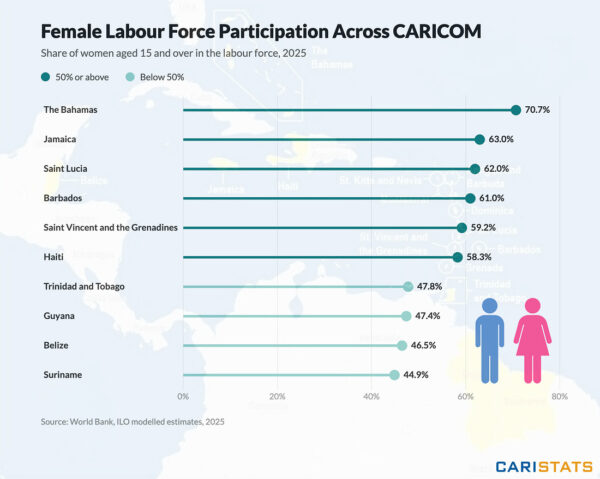

Women’s participation in the labour market is a core driver of economic growth and household income, and across CARICOM, it varies more than almost any other economic measure. In 2025, the share of women aged 15 or older who were working or looking for work ranged from 44.9% in Suriname to 70.7% in The Bahamas. In Suriname, that is fewer than half of all women. In The Bahamas, it is closer to seven in ten.
Six members sit above 58%, led by The Bahamas, Jamaica and Saint Lucia. The other four cluster in the mid-to-high 40s. Guyana, near the bottom of the group, has risen to 47% from the high 30s in 1990.
The distance between women and men varies just as much. In The Bahamas and Barbados, women are nearly as likely as men to be working or looking for work. The World Bank notes that in both, the gap is smaller than across the world’s wealthiest economies as a group. At the other end, men in Belize are far more likely to be working.
The Bahamas manages both: female participation among the region’s highest, and one of its smallest gaps between women and men.