

CARICOM’s Laws on Women’s Economic Rights Are Ahead of the Systems That Deliver Them
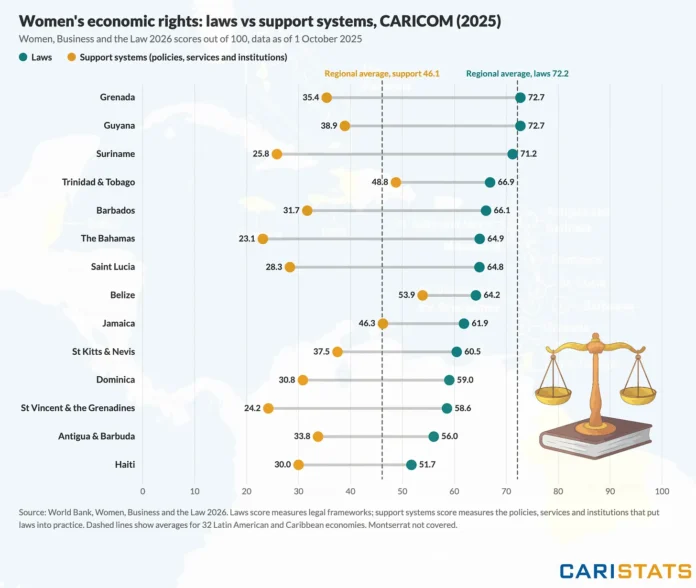
In every member, the law scores higher than the services and institutions that put it into practice.
Women’s participation in work and business shapes how fast Caribbean economies can grow. That participation depends partly on what the law allows, and partly on whether the systems exist to make those laws usable in daily life.
Using data as of October 2025, the World Bank’s Women, Business and the Law 2026 report scores countries out of 100 on 40 legal protections, such as equal pay for work of equal value. Ten of 14 CARICOM members had at least 60% of these protections in place. Grenada and Guyana scored 72.7, just above the Latin American and Caribbean average of 72.2.
A second score, also out of 100, covers 40 measures that put laws into practice, such as support for childcare or a body that handles workplace discrimination complaints. Every member scored lower here, and 11 of the 14 had fewer than 40% in place. Belize, Trinidad and Tobago and Jamaica were above the regional average of 46.1.
Laws can be passed relatively quickly. However, childcare programmes and complaint bodies need sustained budgets, staff and data, which small states may find harder to maintain. Until they exist, much of the support women need to stay in work is likely to fall on families and employers.
This article was originally published by Antigua News Room. Read the original article here: World Bank Data Shows Gap Between Women’s Economic Rights and Support Systems in Antigua and Barbuda.