

— Prime Minister Gaston Browne has defended the government’s decision to deposit dredge spoil along the coastline at Peace Beach near Barnacle Point, saying the move saved taxpayers millions of dollars that would otherwise have been spent transporting and dumping the material at sea.
Speaking Saturday on the Browne and Browne Show, Browne pushed back against criticism over the use of the dredged material to create the beach next to property owned by his son, Gaston Andron Browne III.
The prime minister said his son has owned the adjoining property for about 10 years and argued that the dredged material, rather than being treated simply as waste, has been put to productive use.
“What we have done here now, we have saved the government millions of dollars,” Browne said.
He said dredge spoil generated from previous work in St. John’s Harbour had traditionally been transported offshore and dumped at sea, a process he said came at significant cost to the government.
Browne said the proximity of his son’s Barnacle Point property to the area being dredged provided a less expensive alternative.
“All they had to do at the time was to run a pipe from the dredge area and dump the sand there,” he said. “We reduced the government’s costs by millions of dollars.”
Earlier in the programme, Browne similarly described the dredged material as something that otherwise would have had to be discarded.
He said that instead of taking the material miles offshore, workers were able to run a pipeline from the dredging area to the coastline and pump the spoil directly ashore.
Browne compared the arrangement to taking a discarded item and turning it into something useful, arguing that there should be no objection if material that otherwise had to be disposed of could instead create economic and environmental value.
He said the family has since used its own heavy equipment, including an excavator, backhoe, trucks and bulldozer, to level and develop the area.
The prime minister said about 42 coconut trees have already been planted, along with other greenery and flowering plants.
The beach itself is approximately 300 feet long, according to Browne, while the adjoining property covers just over an acre.
The development has attracted scrutiny because the dredged material resulted from public marine works while the property immediately behind the beach is privately owned by the prime minister’s son.
Browne has maintained that the arrangement benefited the government by avoiding disposal costs and has said the beach itself remains public, although the adjoining land is private.
Recent public reporting has also raised questions about how dredge spoil generated through government-backed projects is allocated when it can potentially enhance privately owned property. Browne has rejected suggestions that his family received improper preferential treatment and has said public entities and other private landowners have also received dredged material.
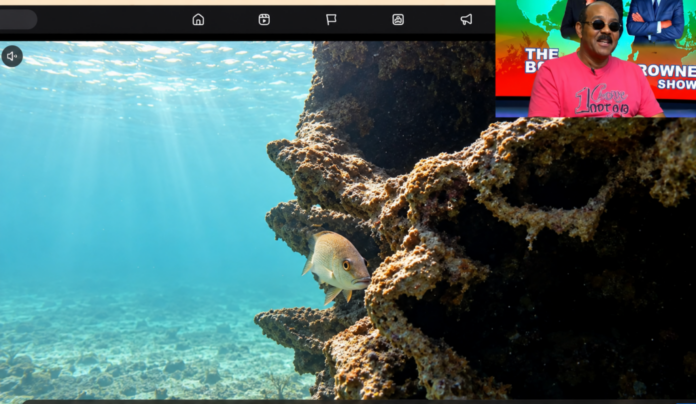
Browne also used Saturday’s programme to provide an update on the artificial reef installed offshore at Peace Beach, saying marine life began gathering around the structures less than 24 hours after they were placed in the water.
The prime minister said underwater video taken at the site showed fish already using the reef modules as habitat.
“We had a lot of fish life literally teeming around the reef system,” Browne said.
He predicted that as the reef develops, it could provide habitat for snapper, lobster, octopus, sponges and other marine organisms.
Browne said marine scientist Dr. Deborah Brosnan provided technical expertise for the project and that officials from the Department of Environment were also involved.
He urged people using the area, particularly fishers, not to damage the artificial reef structures with spears or other equipment.
The prime minister said the Peace Beach project includes about two dozen reef modules and that coral is expected to be planted on them.
He also said technology incorporating artificial intelligence is expected to be used to monitor marine life around the reef, including the movement, migration and spawning patterns of different species.
Browne said the government now wants to replicate the artificial reef concept at other public beaches in Antigua and Barbuda, identifying Fort James and Ffryes as two potential locations.
“What we intend to do is to replicate those reef systems,” Browne said.
He said he intends to have the issue placed on the Cabinet agenda within the next several weeks so resources can be considered for additional installations.
“There’s no reason, for example, why we can’t put one at Fort, one at Ffryes, especially in public beaches,” Browne said.
Long Bay was also mentioned during the discussion, although Browne noted that it already has a natural reef system and therefore might not be as high a priority.
He said an artificial reef had previously been established in Barbuda, making the Peace Beach installation the first of its kind in Antigua and the second in the twin-island state.
Browne said the initiative should not be viewed solely as an environmental or recreational project.
He argued that expanding artificial reefs could eventually contribute to food security by providing breeding grounds for marine life, increasing fish populations and, over time, potentially increasing catches available to local fishers.
The government has previously identified artificial reefs as part of its wider coastal and environmental strategy, including plans to expand reef systems in Barbuda.
Browne said the impact would have to be monitored over the long term to determine whether the artificial habitats result in measurable increases in fish populations and fishermen’s catches.
For Peace Beach, however, the prime minister said he was encouraged by how quickly marine life had begun congregating around the newly installed structures.
He said the project demonstrated what he described as the potential for human intervention to improve an existing coastal environment while putting dredged material that otherwise required disposal to another use.
This article was originally published by Antigua News Room. Read the original article here: PM Browne Says Using Dredge Spoil at Peace Beach Saved Government Millions.