
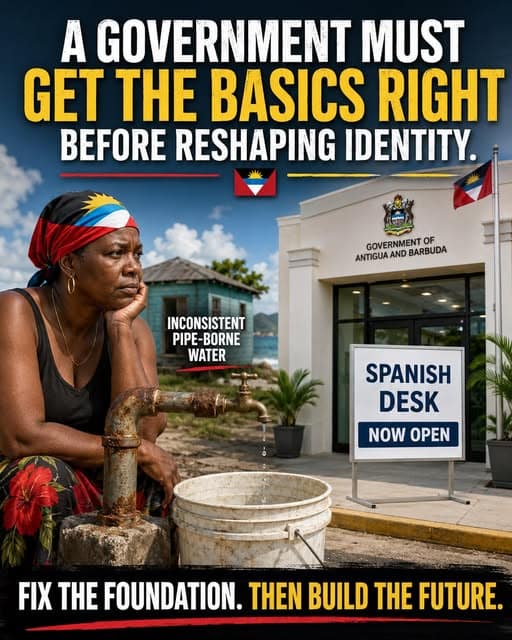

BY Yves R. Ephraim – The Government’s decision to move toward making Spanish the “official second language” of Antigua and Barbuda should be opposed, not because Spanish is unimportant, and not because the Santo Dominican community or any Spanish-speaking resident should be disrespected.
It should be opposed because official language status is not a simple education policy. It is a constitutional, cultural, administrative, and symbolic act that can permanently alter the identity of a small nation, forever.
Antigua and Barbuda is already a small society under enormous demographic, economic, and cultural pressure.
English is the established official language, while Antiguan and Barbudan “dialect” is a recognised national vernacular expression of the people’s HISTORY, humour, worldview, calypso music, and identity.
To elevate Spanish to official status without a deep national conversation risks sending a dangerous message: that the language and culture of the historically rooted Antiguan and Barbudan people are no longer the center of the national story.
The timing also matters.
The ABLP has just returned to government with a major parliamentary landslide, winning 15 of 17 seats in the April 30, 2026 snap election. The ABLP won with only 38% of the total registered voters.
When such a sweeping victory is immediately followed by a major identity-shaping policy, the public is entitled to ask whether this is truly a national development measure or whether it is also a political reward to a strategically important voting bloc.
The Cabinet statement itself shows why citizens should be concerned.
It does not merely propose better Spanish education. It links Spanish official-language status to a Dominican Republic Integration Programme, structured support for Dominican nationals residing locally, and a Spanish Desk inside the Office of the Prime Minister.
The Cabinet decision to make Spanish the country’s official second language, with Spanish becoming a core subject and a Spanish Desk serving the Spanish-speaking community is much more than teaching children a useful foreign language.
It is a state-backed reorientation of national identity, public administration, and diplomatic symbolism toward ONE immigrant community and one foreign state.
What about our Guyanese, Jamaican brothers and sisters and those from Dominica who were here long before our Spanish brothers and sisters?
Fundamentally, official language status is a power move. This suggest that those speaking Spanish have no obligation to speak English and to assimilate into the Antigua and Barbuda way of life.
A language taught in schools gives citizens a skill. A language made official gives that language a claim on the courts, public documents, government offices, signage, education, hiring, and public legitimacy.
Once Spanish is official, citizens may reasonably ask:
Must public servants speak Spanish?
Must government forms be translated?
Must courts accommodate Spanish?
Will Spanish-speaking applicants gain an advantage in government employment?
Will children who struggle with English and mathematics now face another compulsory academic burden?
These are not anti-Spanish questions. These are governance questions.
Another problem is that small nations can lose themselves gradually.
Cultural displacement rarely arrives as an announced attack.
It often arrives dressed as modernisation, integration, opportunity, inclusion, and competitiveness.
Each step appears reasonable on its own. But over time the local language, local memory, local humour, local speech patterns, local priorities, local music and local people become secondary in their own homeland.
Real-world examples warn us to be careful:
Ireland shows that once a native language loses its central place in public life, revival can become extremely difficult.
Historical sources note that Irish remained dominant for centuries, but the island shifted toward English as the common vernacular in the nineteenth century after complex political and socioeconomic pressures.
Singapore offers another caution.
Its “Speak Mandarin Campaign” was promoted as a unifying language policy among Chinese Singaporeans, but researchers and commentators have observed that the push toward Mandarin contributed to the decline of Chinese dialects in families and communities.
These examples serve to show that making Spanish an official language is no small matter.
This matters because the danger is not only that Spanish may become more common, the danger is that state policy can unintentionally push aside older, smaller, more fragile ways of speaking and belonging.
Antigua and Barbuda should not wait decades before discovering that a policy described today as “integration” would be experienced by future generations as cultural displacement.
This Cabinet decision is especially difficult to justify when the Government has not yet convincingly solved basic national-development problems that citizens experience every day, including reliable pipe-borne water.
A government that cannot consistently deliver water should be cautious about declaring a new official language that may create new administrative costs, new curriculum burdens, new translation obligations, and new public expectations.
National development must begin with essentials: water, education quality, public health, crime reduction, housing affordability, infrastructure, and economic opportunity for citizens.
My central objection is this:
SPANISH COMPETENCY IS USEFUL; SPANISH OFFICIAL STATUS IS UNNECESSARY AND DANGEROUS!
Antigua and Barbuda can accomplish every legitimate objective named by Cabinet without making Spanish an official language.
A better alternative would be a National Multilingual Competency and Cultural Protection Policy built on five principles.
1) Teach Spanish as a foreign-language competency but not as an official-language conversion:
Spanish can be made a compulsory subject at appropriate grade levels, with practical emphasis on tourism, trade, diplomacy, hospitality, and regional communication.
That gives Antiguan and Barbudan children a useful skill without changing the symbolic ownership of the state.
2) Protect Antiguan and Barbudan identity in the curriculum at the same time:
If Spanish is strengthened, then Antiguan and Barbudan history, civics, literature, folklore, Dialect, local music, local heroes, Barbuda’s distinct heritage, and constitutional identity must also be strengthened.
UNESCO’s 2025 guidance on multilingual education emphasizes mother-tongue-based learning and meaningful engagement of local communities, including Indigenous Peoples, in designing multilingual education.
A policy that teaches Spanish while neglecting Antiguan and Barbudan cultural transmission is not multilingual education; it is cultural imbalance.
3) Create language-access services without official-language status:
Government can provide Spanish translation in hospitals, immigration, police matters, social services, tourism offices, and emergency communications where needed. That is practical inclusion. It does not require declaring Spanish an official language.
Many countries provide public-service interpretation for minority or migrant communities without making every major immigrant language an official language.
4) Make the Dominican Republic Integration Programme reciprocal and citizenship-centered:
Integration must mean that newcomers are welcomed into Antigua and Barbuda, not that Antigua and Barbuda is redesigned around newcomers.
Santo Dominican residents should receive support to learn English, understand local laws, respect local customs, and participate constructively in national life.
At the same time, Antiguan and Barbudan citizens can be offered Spanish training for trade, tourism, and diplomacy. Integration must be two-way, but the host nation’s identity must remain primary.
5) Require national consultation or a referendum before any official-language change:
A Cabinet decision is not enough for a policy that touches national identity.
At minimum, there should be public consultations in Antigua and Barbuda, input from educators, historians, churches, trade unions, youth, Barbudans, cultural workers, immigrant communities, and constitutional experts.
If the Government wants to alter the official language architecture of the state, the people should directly approve or reject it.
A possible alternative policy statement could read:
“The Government of Antigua and Barbuda shall strengthen Spanish-language education and provide appropriate Spanish-language access services where necessary for public safety, tourism, trade, education, and social inclusion. However, English shall remain the official language of the state, and Antiguan and Barbudan dialect, history, culture, music and civic identity shall be actively protected and promoted as central expressions of the national heritage.”
This approach gives the Government everything it says it wants: better communication, improved tourism competitiveness, deeper trade with Latin America, smoother engagement with the Dominican Republic, and more inclusive access to services.
But it avoids the dangerous step of making Spanish an official language and thereby altering the identity of the state.
The issue is not whether Antiguans and Barbudans should learn Spanish.
They should!
The issue is whether a small Caribbean nation should place a global language, tied in this case to a politically significant immigrant community, beside English as an official language while its own inherited cultural expressions remain under protected.
To oppose this move is not xenophobia. It is cultural self-defense.
A confident nation can welcome Dominicans, Guyanese, Santo Dominicans, Jamaican, Syrian, Lebanese, European, Chinese, and other communities without surrendering the center of its identity.
Antigua and Barbuda can be hospitable without becoming culturally hollow. It can be multilingual without being politically naïve. It can teach Spanish without making Spanish official.
The Government should therefore withdraw or suspend the official-language element of the policy and replace it with a national language-competency strategy that strengthens Spanish education while explicitly protecting what it means to be Antiguan and Barbudan.