

How Much Freshwater CARICOM Actually Uses
Most members sit far below the level the UN counts as water stress
Water stress measures how much of a country’s renewable freshwater is withdrawn each year for farming, industry and everyday use. A higher share signals sharper competition for a finite supply. The United Nations treats any level above 25% as the point where stress begins.
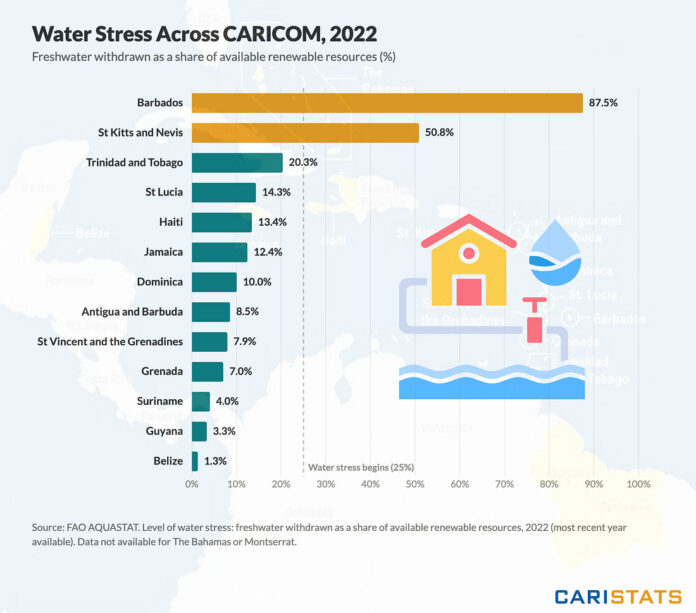
In 2022, the most recent year its water-monitoring programme was published, most CARICOM members sat comfortably below that line. Belize, Guyana and Suriname each drew under 4% of their renewable freshwater. Jamaica, Haiti and Trinidad and Tobago stayed within the no-stress band, the last of these at 20.3%.
Two members sit apart. Barbados withdrew 87.5% of its renewable freshwater, placing it in the high-stress category. St Kitts and Nevis drew 50.8%. Both are among the region’s smaller islands, drawing on a more limited resource base.
The split falls between land and water. The members drawing the least hold large territories and abundant rivers. Barbados, a flat coral island with no surface rivers, leans on groundwater, so its withdrawals claim most of what it has.
Source: FAO AQUASTAT. Freshwater withdrawn as a share of a country’s available renewable resources. National reporting runs on a multi-year cycle, so figures appear two to three years after their reference year. That makes 2022 the most recent available. Data not available for The Bahamas or Montserrat.
This article was originally published by Antigua News Room. Read the original article here: Antigua and Barbuda Among CARICOM Countries Below U.N. Water-Stress Threshold.