
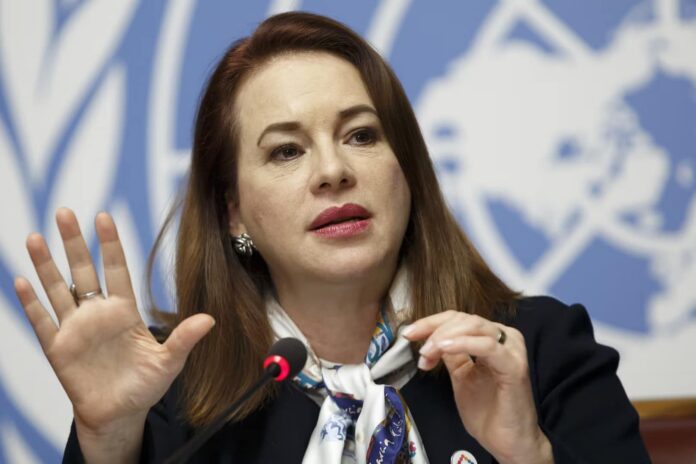

Maria Fernanda Espinosa Garces, former president of the UN General Assembly, speaking at a press conference in Geneva, on 23 October, 2018. (Keystone/Salvatore Di Nolfi)
Five-pillar transformation agenda sets out plan for a more effective, accountable, and credible United Nations
The Government of Antigua and Barbuda has formally nominated Her Excellency María Fernanda Espinosa Garcés, former President of the United Nations General Assembly and former Minister of Foreign Affairs of Ecuador, as its candidate for Secretary General of the United Nations. The candidacy was transmitted to the President of the General Assembly and the President of the Security Council in accordance with the joint letter of 25 November 2025 setting out the process for the selection and appointment of the next Secretary-General.
In a letter formally presenting the candidacy, Prime Minister Gaston Browne of Antigua and Barbuda said his Government submitted the nomination “with deep conviction to the purposes and principles of the Charter,” and described H.E. Espinosa as possessing “the experience, judgment, independence, credibility and legitimacy” required to lead the Organization with “balance, integrity, strategic vision and crucially, with impact.” He pointed to her ability to “engage constructively with all regional and political groups,” and to a record of “innovation and delivery, including in transforming large bureaucracies.”
H.E. Espinosa is stepping forward to serve at one of the most consequential moments in the United Nations’ eighty-year history. With multiple crisis across the globe, more than one hundred armed conflicts, forced displacement at record levels, and the organization confronting the most severe liquidity crisis it has ever faced, she is offering her candidacy as a call to action for a renewed United Nations that delivers, with discipline and accountability, on the promise of its Charter.
In a vision statement released to Member States, H.E. Espinosa argues that the challenge before the Organization is fundamentally a crisis of credibility, not of principle, and proposes a transformation agenda built on five pillars: peace and prevention; sustainable development; digital and energy transformation; closing the delivery gap; and resourcing results. The agenda focuses the Organization on what it was set up to do, and on the outcomes that people expect to see in their lives
“The world does not need a larger United Nations. It needs a more effective one,” H.E. Espinosa said. “The UN must be judged not by the number of convenings it holds, but by how many lives it improves, and how effectively it prevents conflict and contributes to peace and stability.”
Pillar One – Peace and Security: The courage to act early
H.E. Espinosa proposes to place peace and prevention at the centre of the office of the Secretary-General. As Secretary General, she would establish a Prevention and Early Action Hub reporting directly to her office: a consolidated capacity for risk analysis, early warning, and rapid political engagement, designed so that warnings reach decision-makers in time, and so that the UN SG can act before escalation narrows the available space. She has signalled that prevention, peacemaking, peacekeeping and post-conflict peacebuilding must be staffed, funded and politically supported as a single continuum, and called for stronger United Nations responses to transnational organized crime, a major driver of instability that was not envisioned in 1945 and has proundly negatively impacted her region. She has emphasized that the Organization must work in close coordination with regional organizations, national leaders and diplomatic coalitions engaged in peace efforts, while remaining the final custodian of universal legitimacy, international law, and protection for the most vulnerable.
Pillar Two – The Development Imperative: The duty to deliver
On development, H.E. Espinosa champions a “local first” approach designed to strengthen national and local capacities to lead implementation of the Sustainable Development Goals through the final stretch to 2030, shifting the United Nations system from direct implementation toward strategic guidance, coordination, resources and capacity-building. She has called for stronger domestic resource mobilization, expanded South-South cooperation, and renewed investment, jobs and economic diversification, alongside a more coherent international response to the structural debt pressures facing highly indebted and climate-vulnerable countries. As Secretary-General, she has committed to address the special needs and unlock the potential of Africa, Least Developed Countries, Landlocked Developing Countries, and Small Island Developing States, working in close partnership with regional organizations and political platforms including the African Union, CARICOM, ASEAN, CELAC, the League of Arab States, and with key partners such as the European Union, whose engagement and support remain essential to building credible and effective multilateral solutions.
Pillar Three – Energy and digital transformation: The ability to convene
H.E. Espinosa would use the convening power and political neutrality of the United Nations to bring governments, scientists, civil society and responsible private-sector actors to the same table on the technologies and energy systems that are reshaping economies and security alike. She would propose a Global Energy Security coordination mechanism to help Member States manage the consequences of energy and supply-chain shocks, particularly on the most vulnerable, where energy insecurity quickly translates into food insecurity, inflation and social instability, and would launch a sustained Secretary-General’s Dialogue on Emerging Technologies, building on the Global Digital Compact adopted under the Pact for the Future. The role of the United Nations, she argues, is not to govern these transitions, but to ensure that the conversations shaping them are genuinely global, inclusive and consequential — and that the digital divide is closed alongside the development gap.
Pillar Four – Closing the Delivery Gap: The determination to reform
H.E. Espinosa will treat the Pact for the Future as the reference for a system-wide delivery mandate, and will support Member States in making mandate review a permanent discipline of the United Nations rather than a one-off exercise driven by financial crisis. Drawing on the General Assembly’s landmark resolution of 23 March 2026 on mandate creation, implementation and review, and on her experience chairing the Open-ended Working Group on the Revitalization of the General Assembly, she will pursue predictable relevance reviews, sunset clauses, and stronger prioritization across the system. She has called for the UN80 Initiative to be understood as “modernization for results, not austerity disguised as reform,” embedding shared country strategies, joint delivery platforms and common services as standard practice, and ensuring that accountability is built into governance as a continuous, results-based discipline rather than an afterthought.
Pillar Five – Resourcing Results: the skill to rebuild trust
H.E. Espinosa proposes a differentiated, mandate-aligned approach to financing the United Nations, recognizing four distinct streams: the regular budget, which is the institutional backbone of the Secretariat; peacekeeping financing, which is integral to upholding the credibility of the UN’s peace and security mandate; the voluntary and often earmarked operational resources that sustain development, human rights and field activity; and humanitarian continuity, which she has said is “not discretionary, to be turned on and off with callous disregard for immediate human consequences.” She also signals that more costly peacekeeping operations should be subject to continuous evaluation and corrective measures aimed at consolidation, drawdown and eventual withdrawal where appropriate. Underpinning all of this will be three interlinked institutional reforms: a stronger accountability architecture for results; better stewardship that does not confuse austerity with reform; and the realignment of the United Nations’ financial base with its mandates.
“Resources require credibility, and credibility requires results,” H.E. Espinosa said. “The deeper objective is to restore confidence and a new compact between Member States, the United Nations Secretariat, and the people we serve.”
An honest broker, with the independence to lead change
H.E. Espinosa has emphasized that, while she knows the United Nations intimately from her years at the highest intergovernmental level, she has never served within the Secretariat or the United Nations system, giving her the independence required to lead change without institutional hesitation or bureaucratic reflex.
“I do not approach this candidacy from the vantage point of any single bloc, region, or geopolitical alignment,” she said. “The Secretary General must be an honest broker — impartial in perception and in practice, consistent in the application of the Charter’s principles, and equally attentive to the priorities of North and South, East and West.”
A candidate of experience and conviction
Having served in various leadership roles that have interacted closely with the UN but never a position where she was paid the UN, H.E. Espinosa calls herself “an insider , outsider” Espinosa understand the promise of the UN and how much it is needed by humanity at this crucial time but also understand what is not working and the credibility crisis the organization faces.
If elected, H.E. Espinosa would be the first woman to serve as Secretary-General of the United Nations. She served as the fourth woman, and the first from Latin America and the Caribbean, to preside over the United Nations General Assembly (2018–2019); twice as Minister of Foreign Affairs of Ecuador; and as Minister of National Defense, the first woman to hold that office in her country’s history. She also served as Permanent Representative of Ecuador to the United Nations in both New York and Geneva. She is fluent in English, Spanish and French.
“The world does not need a perfect United Nations,” H.E. Espinosa said. “It needs a trusted, capable Organization that can bring States together, act earlier, respond better, and deliver where it matters most.”
# # #
About H.E. María Fernanda Espinosa Garcés
María Fernanda Espinosa Garcés is a diplomat, scholar and former senior public official with more than three decades of experience in multilateral negotiations, peace and security, sustainable development, climate governance and human rights. She served as the fourth woman in history, and the first from Latin America and the Caribbean, to preside over the United Nations General Assembly (2018–2019). An award-winning poet and published essayist, she has lectured and written widely on multilateralism, UN reform, geopolitics, sustainable development, climate change, human rights, Indigenous peoples and women’s leadership.