
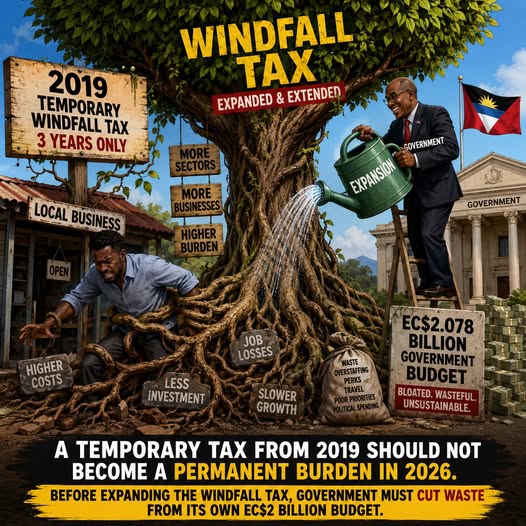

IS EXTENDING AND EXPANDING THE WINDFALL TAX THE CORRECT ANSWER?
In an Op-Ed on June 17, 2026 in the Antigua News Room, Prof. C. Justin Robinson suggested that the idea to extend and expand the Windfall Tax “deserves national consideration.”
That I most definitely agree!
Being in decision-making roles for over 35 years, I have found that BEING right should never be the objective of resolving a problem but rather making the RIGHT decision should be.
This means that before you can DECIDE the best course of action, you must start by defining the required outcome or problem, first. You then must move on to understanding why things are not currently working as intended and then next look at the trends and innovations in this area that may inform your decision-making.
Once we have collected all of these data points, we can then deliberate and decide the best course of action.
My first issue with this “national consideration” is that it is framed as a done deal.
We are presented with a fix before we are even clued into the problem. We are immediately presented with: extend and expand the Windfall Tax.
This sounds like a foregone conclusion.
In as much as I am somewhat in agreement with some of the outcomes that Prof. Robinson envisions, I however disagree with the means for funding and delivering those outcomes.
Very little effort was spent justifying HOW those outcomes will be achieved while most of the time was spent to persuade us on WHY more people should pay more, forever.
It is worth noting that, through no fault of his, it is not in Prof. Robinson’s interest to support any course of action that would potentially diminish or remove the source of funding for the UWI. Therefore, you cannot reasonably expect him to be completely objective.
There is a natural presumption that “Education” is always a social good, therefore no one wants to risk being that person who questions this sacred cow.
However, I contend that before any investment of scarce resources is decided, the issue ought to be considered dispassionately, regardless.
We must first ask WHAT is the expected MEASURABLE return on the public’s investment in “Education”?
Is the expected tangible outcome of our educational system about producing more lawyers? Is it about more workers for the tourism industry? Or is it about producing IT and AI specialist? Or is it all of these? Or am I completely wrong?
What is it exactly?
Being clear about the intended measurable outcome is very important, since this will allow us to be strategic about our spending.
Since the framing on this “national consideration” is about extending and expanding the Windfall Tax, I will limit my response to the funding aspect.
For the benefit of all readers, the Windfall Tax was introduced in 2019 for a temporary period of three years to fund the establishment of the UWI Five Islands Campus. This tax was levied only on businesses in the Banking, Telecom, Insurance, petroleum distributors industries. This tax is 10% on net profit. This, I might add is in addition to the 25% corporation tax already in place.
Since the introduction of this temporary Windfall Tax, the government has conveniently and dishonestly extended the tax again and again.
Here are some questions requiring reasonable answers:
1. How much money does the current Windfall Tax yield annually and how exactly is it being spent?
2. How much more money is required to fund these new plans?
3. What is the funds from the Education Levy doing?
4. With a recurrent and capital spending budget of over a EC$2.0 billion, can we not re-allocate funds? I ask foolishly.
5. We know there is waste in the system, how is the government addressing waste to release additional funds?
6. How long can the Windfall Tax be sustained before it starts putting companies out of business particularly when they have to compete with government owned entities and exogenous shocks?
7. What is the government’s plan to make these new plans self-sustaining after the Windfall Tax is rescinded?
8. When will the state own enterprises (SoE) that fall into the bracket of the Windfall Tax going to pay in their contribution into the fund? And is it fair that the SoE are expected to compete with the private sector and allowed to default on the payment of the Windfall Tax?
9. How will this approach to Education ensure that there is a high quality? We do not want to merely pay for “Education” at any cost and quality.
I do not agree with Prof. Robinson that we should simply concentrate on “what the tax can buy” and ignore other things like opportunity costs and the level of hardship on businesses that are already straining.
We have not even considered how this widening of the tax net may affect the cost of living generally. Per capita, everyone already carries a $20,000 per year burden of the government’s recurrent and capital spending.
Can Antigua and Barbuda afford to increase these welfare programs without going bankrupt?
If extending and expanding the Windfall Tax is to be a truly “national consideration”, the nation must be provided with information so that objective feedback can be provided.
“No taxation without representation!”