
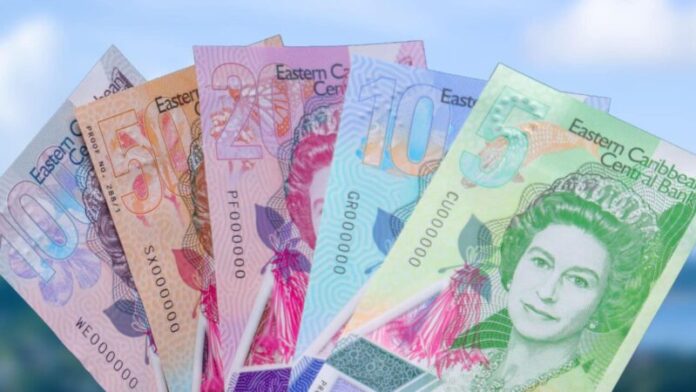

The Eastern Caribbean Central Bank (ECCB) is commemorating the 50th anniversary of the establishment of the fixed exchange, one of the most significant milestones in the economic history of the Eastern Caribbean Currency Union (ECCU).
On 7 July 1976, amid a period of considerable global economic uncertainty, the governments of the Eastern Caribbean fixed the value of the EC dollar to the United States dollar at EC$2.70 to US$1.00. The new parity came into effect following regional consultations and international approval involving the British government and the International Monetary Fund (IMF).
What began as a prudent policy response has become one of the world’s longest-standing and most resilient fixed exchange rate agreements. For five decades, it has provided the foundation for economic confidence and stability across the ECCU.
Commenting on the milestone, Governor of the Eastern Caribbean Central Bank, Timothy N.J. Antoine, stated: “The past 50 years have demonstrated our capacity to deliver stability; now we must prove for the next 50 years that we can leverage that stability for transformation and shared prosperity for every citizen of this Currency Union, which is what the Big Push is all about.”
Over the past 50 years, the fixed exchange rate has helped to keep inflation low, strengthen confidence in the EC dollar, support trade and investment, and create a stable environment for sustainable economic growth and development throughout the Currency Union.
The EC dollar has maintained its parity without devaluation or revaluation. This remarkable achievement reflects the strength of the ECCU’s monetary framework, prudent fiscal and monetary policies, and the steadfast commitment of ECCU governments and the ECCB to preserving the value and credibility of the common currency.
The stability of the EC dollar has also been reinforced by the strong governance framework established under the ECCB Agreement. Article 24(2) requires the Bank to maintain external reserves of not less than 60.0 per cent of its demand liabilities and currency in circulation. Article 17(2) also requires the unanimous approval of both the Monetary Council and the Board of Directors before any change can be made to the exchange rate parity. Together, these safeguards have helped maintain the stability and credibility of the EC dollar for the past 50 years.
As the ECCB marks this milestone, the Bank reaffirms its commitment to maintaining the trust and confidence it has inspired across the Currency Union for five decades. The fixed exchange rate and the stability of the EC dollar remain a cornerstone of the ECCU’s monetary and financial stability and a foundation for the region’s continued resilience, prosperity and sustainable development.
The Eastern Caribbean Central Bank (ECCB) was established in October 1983. The ECCB is the Monetary Authority for: Anguilla, Antigua and Barbuda, Commonwealth of Dominica, Grenada, Montserrat, Saint Christopher (St Kitts) and Nevis, Saint Lucia and Saint Vincent and the Grenadines.
This article was originally published by Antigua News Room. Read the original article here: ECCB Commemorates 50 Years of EC Dollar Fixed Exchange Rate.