
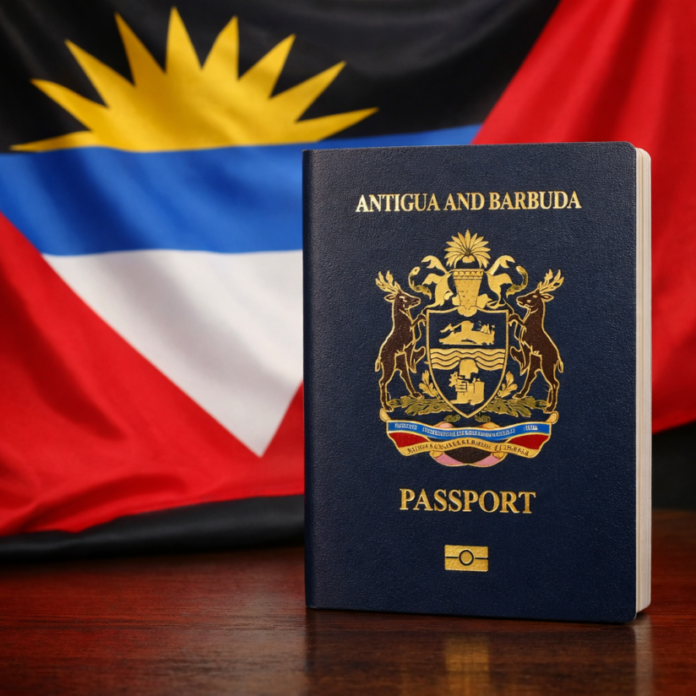

Nevis Premier Mark Brantley is calling for Eastern Caribbean countries to be given five years to transition away from Citizenship by Investment revenue, arguing that the European Union’s proposed two-year timeline is insufficient for governments to develop replacement industries.
The EU has reportedly instructed Antigua and Barbuda, Dominica, Grenada, St. Kitts and Nevis, and St. Lucia to discontinue their CBI programmes by June 1, 2028.
During an interview on the Caribbean Business Review, Brantley said the affected countries should negotiate for more time while urgently restructuring their economies.
“I believe, as I said, we should negotiate for more time,” Brantley said. “I think five years is far more reasonable than two years.”
Brantley warned that CBI income has become an important part of the economies of all five participating Eastern Caribbean countries, although their levels of dependence vary.
“When we look at St. Lucia, we look at Antigua and Barbuda, Dominica, Grenada, and St. Kitts and Nevis, we see varying degrees of dependence, but in every country there is a high degree of dependence on citizenship-by-investment inflows,” he said.
“And we have, in my humble opinion, a crisis on our hands because the question then would be, what do we do to substitute for that loss of revenue?”
Brantley described the possible loss of CBI income as an “existential threat” to Eastern Caribbean economies.
“You say that it represents some strategic threat. I would say it goes further,” he said. “I think it’s an existential threat to the economies of the Eastern Caribbean.”
Antigua and Barbuda Prime Minister Gaston Browne has rejected the EU’s demand, maintaining that his government will not end the programme unless the bloc helps the country identify alternatives to the revenue it would lose.
Brantley referred to Browne’s position during the interview and said the remaining CBI countries have been less vocal.
“In the case of Antigua and Barbuda, we’ve heard PM Gaston Browne, who has come out quite forcefully, to say to the EU that Antigua will not discontinue its program, absent some indication from the EU as to how they would substitute or assist Antigua to substitute for that foregone revenue,” he said.
“St. Kitts and Nevis, St. Lucia, Dominica, and Grenada have, for their part, been relatively silent on this matter.”
Brantley said additional time alone would not resolve the problem. He called for the remaining years of CBI revenue to be used to create industries capable of delivering lasting economic benefits.
“In the interregnum, as you’ve put it, I feel that the OECS countries must move to a different model of citizenship by investment where we are now looking at value added as opposed to simply talking about new entrants into these programs,” he said.
The Nevis premier said governments must also broaden their economies so they are not overly dependent on one sector or revenue stream.
“The best thing that you can do is to prepare and by preparing you must have various strings to your economic bow,” Brantley said. “It can’t be a one-size-fits-all. You can’t be a one-horse town now. You need to be able to do other things.”
He identified renewable energy as one area in which Eastern Caribbean countries could invest to reduce their dependence on imported fossil fuels and limit their exposure to international economic shocks.
“I do think we need to accelerate our renewable energy thrust,” he said. “I do think we need to start to reorient our economies and allow economies to be insulated from some of these conflicts that we see around the world.”
Brantley pointed to efforts to develop geothermal energy in Nevis, saying the resource could eventually provide electricity to St. Kitts and neighbouring countries, including Antigua and Barbuda.
“You can imagine, if Nevis had accessed its geothermal, vast geothermal potential, if we were supplying St. Kitts, if we were supplying some of our neighboring islands like Antigua, which has said that they want power from us, that we would have a different perspective insofar as what’s happening in the Strait of Hormuz, or what’s happening in Iran, or what happens in Venezuela, because we would not be as dependent on fossil fuel for our electricity generation,” he said.
Brantley also identified tourism, financial services, diaspora investment, technology and other productive sectors as potential components of a wider diversification strategy.
He said Caribbean governments must create the conditions needed to attract investment and expertise from nationals living overseas.
“How do we get our vast diaspora engaged?” Brantley asked. “How do we get Jamaicans living in Brooklyn and Queens and Washington, D.C., to say, ‘Hey, maybe I could start a business in Jamaica. Maybe I could take my wealth and my experience and lend that to the Caribbean and to developing the Caribbean.’”
Brantley said the EU deadline should prompt the region to examine how temporary CBI proceeds can be converted into permanent sources of economic strength.
He also renewed his call for the Organisation of Eastern Caribbean States and the Caribbean Community to develop a collective response rather than leaving individual countries to negotiate separately.
“I feel that what we should see is the OECS having a position in relation to this,” he said. “What we should see is CARICOM saying, ‘Hey, EU, this represents an existential threat to some of our members, and we need to talk about it.’”
Brantley said Caribbean countries would have greater negotiating influence if they approached the EU together.
“A collective approach is a far better approach, particularly when we’re dealing with the middle and large powers,” he said.
“So we need to engage as a group. I started by saying that, I end by saying that, that our leverage is much, much better when we engage together.”
This article was originally published by Antigua News Room. Read the original article here: Brantley Calls for Five-Year Transition Before CBI Programmes End.