

By Yves Ephraim – The 1st of August, marks 192 years since the abolition of African Slavery by the British Empire.
Unfortunately, the significance of that milestone is overshadowed by the frolic and reveling of Carnival, where little is said to remind Antiguans and Barbudans of an epoch that should never be allowed to happen again.
Ask any first former what is the significance of August 1st, and you will get a blank stare.
There is a quote that says that if we forget our history we are most likely to repeat it. That is, repeating the bad experiences of history.
Days before this 1st of August milestone, Antigua and Barbuda finds itself targeted as a “failed state” worthy of a permanent ban from entering the United States.
We are also under threat of a revocation of visa-free access to the EU. Not to mention that right now, most Antiguans and Barbudans are effectively banned from entering the USA.
The Bridgetown US Embassy is accepting applications, making you visit, only to be given a letter, denying you a visa. Moreover, before you are eligible you may need to commit nearly US$15,000 as a cash bond which is only refundable when you return as stipulated.
I can tell from the buzz on social media that these series of events are quite disturbing to most Antiguans and Barbudans and rightfully so.
But the unspoken truth about why these exogenous events have so significantly affected us, is that having access to these developed countries has been our excuse for not holding our leadership to account and for not demanding more from the Antigua and Barbuda leadership.
Fleeing to the US, Canada or even the UK has been the way to deal with the victimization, incompetence, corruption, and lack of progress at home.
Fleeing helps to avoid expending the enormous energy required to “push” for that positive change that this country needs to be transformed into a safe place to live; to work; to raise and educate your children; to achieve your potential; to retire and die.
The travel ban crises we find ourselves in is the best opportunity for all Antiguans and Barbudans to stop the feting and ask some serious questions about the direction in which this nation is going.
We must dispassionately evaluate the outcome of our government’s policies to date and determine whether they are moving us in a direction where we have ownership of our own country and economy.
Do you feel that your way-of-life is being preserved and not threatened?
Do we feel that your rights as a citizen are respected by your government?
Do you feel like Antiguans and Barbudans are central to the growth and development of Antigua and Barbuda?
Do you feel like your government is working for you in order to help you and to empower you to surmount the handicaps that colonialism has created for our people?
To properly evaluate our nation’s progress, we must understand the primary motivation of African Slavery.
Before the enslavement of Africans was a race issue, it was first an economic imperative. It was a means unto an end.
What is often missed from the discussions on African slavery, is its predominant economic motivation.
We are so absorbed in pursuing reparatory justice, that we have not paid any attention to understanding the deeper end-goal that made African slavery a thing in the first place.
It is my belief that should we be given the full compensation we request, in a short space of time, we will lose everything we gained and revert to being an dependent country because we fail to understand the economic game.
The first step in this “economic” process of the colonizers was first to declare the “discovery” of the “new” world. We know the story of Columbus and the subsequent fights among these world powers for ownership of the lands.
Once land was acquired, the next step was to find out how that land could generate wealth and fortunes. In the case of the Caribbean, it was sugar cane. In other parts of the world, it was gold, silver, minerals, etc.
Once it was known what would drive wealth and fortunes, then came the labour question.
How can they find abundant, cheap to free labour that could withstand the working conditions? After some experimentation, with prisoners and indigenous peoples, they discovered that Africans were ideal.
Initially, the colonizers capitalized on the tribal wars to supply a stream of captured Africans that they could now traffic to our islands to provide free labour.
In order to justify the immorality of slavery, these supposedly Christian colonizers convinced themselves that Africans were savages in an attempt to dehumanize them to assuage their own consciences.
After the profits were drying up and demand for Caribbean sugar declined, and trade unionism took root, then there was no longer any interest in the land. In the case of Antigua and Barbuda, most of the colonizers abandoned their local estates and returned to their homeland, the UK.
It was in the period that followed, where Antiguans and Barbudans began to prosper, in my humble opinion. Being born in the mid 1960’s, I grew up in an era, where compared to today, I witnessed a renaissance of Antiguan and Barbudan ownership and entrepreneurship.
This new spirit of entrepreneurship in agriculture provided most of the food we ate. I recall the vegetable and meat markets bustling on Saturdays with hucksters with homegrown produce.
Today you can run a mouse through the market.
We have lost businesses like Delos J. Martin and a litany of other indigenous Antiguan and Barbudan businesses in St. Johns’.
Fast forward today and witness an almost reversal to those conditions.
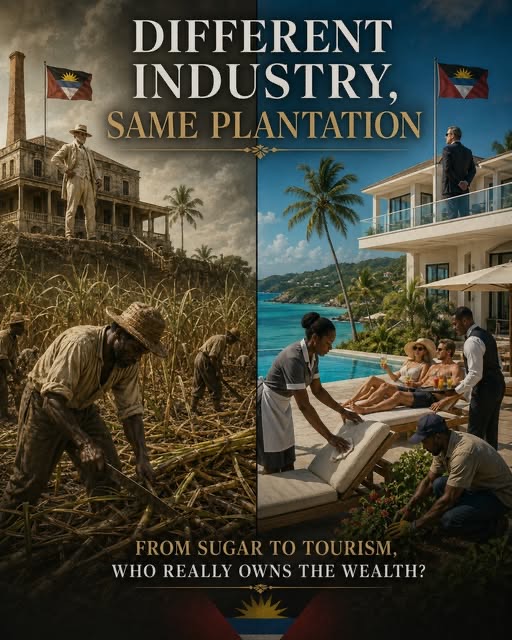
Let’s talk about how the conditions of Tourism/Real Estate industry today compare to the sugar days.
THE LAND ISSUE
Barbuda, the Syndicate Estates, the surrounding islands like Long Island, Maiden Island, etc., are all gone or are going back into the hands of wealthy citizens of the countries that formerly colonized us. Instead of leasing these finite land resources, we have given these “investors” freehold forever. Plus, concessions.
In the case of Barbuda, the profit motive has so blinded the eyes of our leadership, that it is not recognised that we have effectively transformed the Barbudan community from being able to sustain itself from the land and the sea to a community that must now be completely dependent on minimum wage jobs and who increasingly cannot afford the cost to live on Barbuda due to the gentrification.
What we observe is that our leaders, enticed by the specter of national wealth, have facilitated the recolonization by the wealthy sons and daughters of the same countries that once colonized us.
Lands that were earned through suffering, death, sweat and tears and paid for with the taxes from the descendants of enslaved people are now gifted to these investors, in total disregard and contempt for the desires of the people of Barbuda.
THE WEALTH GENERATOR
With the death of the sugar industry in Antigua and Barbuda, tourism started to show great signs of economic value and promise.
The early days of the Tourism industry was owned by Antiguans and Barbudans: Sugar Mill, Barrymore, etc.
Once the potential was realised, our government pursued this industry with vigour. Very little attention was spent on creating an environment that would stimulate continued local ownership by ordinary Antiguans and Barbudans.
Unfortunately, we cannot boast today of one significant property that is owned by private, indigenous Antiguans and Barbudans.
This industry in now fully dominated by foreign ownership. It is a shame that we as a people have to rely on others to build our own economy.
The tourism industry is too volatile. The governments of our primary tourism markets namely, the US, UK and EU can simply publish an advisory and shutdown our tourism industry, tomorrow.
May be in the short term, it may make sense to pivot to Spanish and South American tourists. However, this is not sustainable as we have begun to see.
THE LABOUR ISSUE
Tourism, like its sugarcane antecedent, thrives on large numbers of low skilled, manual and cheap labour. This is not sustainable for building a thriving nation of skilled citizens that can build this country.
Once again, we are experimenting with various ethnic groups of labourers from the Dominican Republic, China, Philippines, etc. Our own leaders have frowned on our Antiguan and Barbudan young people with disdain regarding their work ethic and suggest that we must look outside.
CONCLUSION
From my own analysis, it is clear that Antigua and Barbuda has returned the vast amount of land back to the ownership of the descendants of our former colonizers who now see great profits in the tourism industry and the sale of land to the ultra-wealthy.
Just like sugar, this new found profit generator has allowed foreign entities to repatriate most of their profits to their homelands or offshore accounts, leaving locals with only low skill, low paying jobs, which are slowly being taken away by imported labour.
The conditions under tourism today are almost identical to the sugar industry in terms of ownership and those who profit.
Just like the old plantation regime, Antiguans and Barbudans can expect to find that more and more of the land and beaches will be off limits to them.
WHERE SHOULD WE BE GOING?
I can say that after the first period of colonization, we had locals who were skilled stone builders, blacksmiths and workers who started a kind of renaissance where many indigenous Antiguans and Barbudans owned most businesses then. This included the village shops.
Quite a few of the original hotels in Antigua shortly after the death of sugar were Antiguan and Barbudan owned. Compare that to now!
Forty-four years of Independence has effectively undone what emancipation had created.
The current leadership wonders why the young Antiguan and Barbudan generation do not want to work. Why would you work when the political climate is about giving handouts? If all your needs can be met by visiting and begging a minister, what sense does it make to work?
Just wait for the representative to come to the constituency and get a few dollars!
I think that we need to pivot to building our human capital in IT skills which we can offer remotely to developed countries where such skills are scarce.
This is very doable. We already have the assets: UWI Five Island Campus and ABIIT (ABCAS). However, this will require a more open, deregulated business and telecom environment.
No country can become an economic powerhouse if its OWN citizens do not become wealthy through productive ownership of their economy. In other words: wealthy citizens make wealthy nations.
If our country is to forge an independent path of progress in the midst of all of the stifling restrictions these larger countries are putting on Antigua and Barbuda, we need to change the way we view our land resources, the development of our labour force and wealth generation.
I have yet to hear any articulation by our leadership as to how they propose leading us through this travel ban crisis, particularly if the worst case materializes.
Are our leaders clueless and should we all be concerned?
Is there hope?
This article was originally published by Antigua News Room. Read the original article here: OPINION: Is Antigua And Barbuda A Hopeless Case?.