
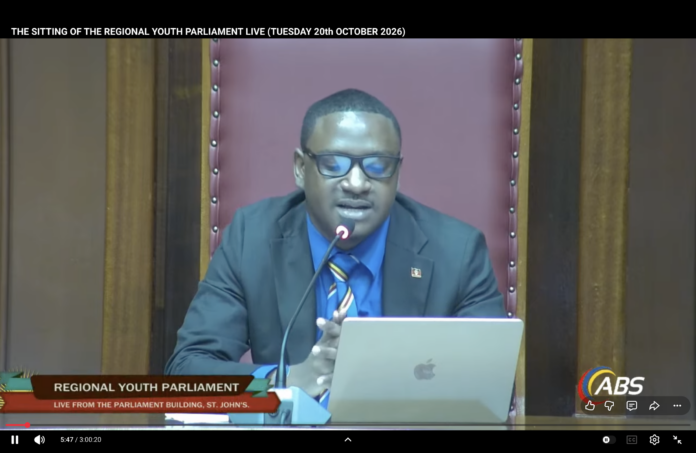

The Eastern Caribbean Youth Parliament Network Assembly approved a resolution Tuesday calling for coordinated action to reduce excessive dependence on tourism, following a debate over financing, regional transport costs, youth employment and whether its accompanying action plan could deliver meaningful results.
The resolution passed with 15 votes in favour, one against and one abstention at the sitting in Antigua and Barbuda on October 20. The youth opposition leader supported the measure despite challenging its implementation timetable, lack of costing and approach to consultation.
The resolution calls on Eastern Caribbean governments, regional institutions, businesses and educational institutions to develop comprehensive diversification strategies covering agriculture, fisheries, agro-processing, manufacturing, digital services, creative industries and renewable energy.
It also urges investment in infrastructure, education, technical and vocational training, research and technology; wider access to financing and mentorship for young entrepreneurs; and improvements in regional trade, transport and logistics.
The Organisation of Eastern Caribbean States, Eastern Caribbean Central Bank and Caribbean Development Bank are identified as institutions through which coordinated investment, technical assistance and development financing should be pursued.
Measurable targets, regular progress reporting and inclusive consultation form part of the resolution’s accountability provisions.
Moving the resolution, the youth prime minister argued that the region’s experience during the COVID-19 pandemic demonstrated the danger of relying too heavily on international travel.
“We cannot depend on tourism alone,” he said.
The resolution explicitly states that diversification does not require abandoning or weakening tourism. Instead, it advocates complementary industries that can supply hotels, expand cultural offerings and keep more visitor spending within regional economies.
The youth prime minister said the accompanying action plan would run from October 2026 until the next regional youth parliamentary sitting in 2027. Delegates would return to their territories and present the proposals to their respective governments.
He also identified restricted access to bank financing and expensive inter-island travel as barriers to economic expansion, calling for regional airlines to receive concessions comparable to those granted to larger international carriers.
The youth opposition leader, representing the St. Kitts National Youth Parliament Association, agreed that diversification was necessary but challenged the feasibility of the timetable.
“It cannot take one year for economic diversification to be implemented,” he said, arguing that different territories had different economic conditions and practical constraints.
He questioned the absence of implementation costs and asked how the plan would change young people’s circumstances once its activities were completed.
“Where is the customer? What will production cost? And can we deliver competitively?” he asked.
Rather than broad commitments to cheaper travel, he recommended a costed, time-limited review and pilot involving selected regional travel charges. He also questioned how young entrepreneurs would qualify for grants, meet any matching-fund requirements and sustain their businesses after initial assistance ended.
The youth member for Barbuda South supported diversification while identifying gaps in financing, shipping and institutional commitments.
The member proposed a regional youth enterprise fund backed by the ECCB and CDB to guarantee low-interest loans for ventures in agro-processing and digital services, alongside an inter-island maritime freight link to reduce transport costs.
Another recommendation was tax incentives for hotels sourcing about 40% of their inputs locally, connecting tourism expenditure more directly to farmers and other regional suppliers.
The youth minister of trade, industry and commerce proposed a Young Enterprise and Export Ready Initiative combining business mentorship, financial and digital literacy, guidance on product standards and opportunities to showcase products.
The minister argued that stronger links between local producers, supermarkets and hotels would retain more economic value within the region, citing hot sauce, honey and processed agricultural products as examples.
The youth minister of ICT and the digital economy called for closer alignment of digital laws across territories and challenged barriers including mobile roaming charges and limited access to content monetisation.
Meanwhile, the youth minister of sports and creative industries advocated a regional creative hub for musicians, artists and theatre practitioners, arguing that talent could generate income beyond the traditional tourism market.
Education and the availability of jobs also featured prominently.
The youth representative for Constituency Four in St. Kitts questioned whether training plans were sufficiently connected to employer demand, warning against preparing young people for industries unable to absorb them.
“A completed survey is not a job. A policy brief is not a funded business. And a meeting requested is not an agreement secured,” the representative said.
The member also noted that implementation would depend on governments and regional institutions choosing to act on the assembly’s recommendations.
The youth minister responsible for education, technical and vocational training and social transformation advocated structured, paid apprenticeships and closer cooperation between educators and employers.
“Young people are often told they need experience to get a job. But they need that job to get experience,” the minister said.
In his closing contribution, the youth prime minister defended the plan’s regional approach, saying the proposed working group would include a designated representative from each participating youth parliament.
He said engagement had already taken place with the OECS and the central bank, and maintained that cooperation, shared resources and sustained advocacy would be essential to advancing the proposals.
This article was originally published by Antigua News Room. Read the original article here: Youth Parliament votes 15–1 for economic diversification in Eastern Caribbean.