
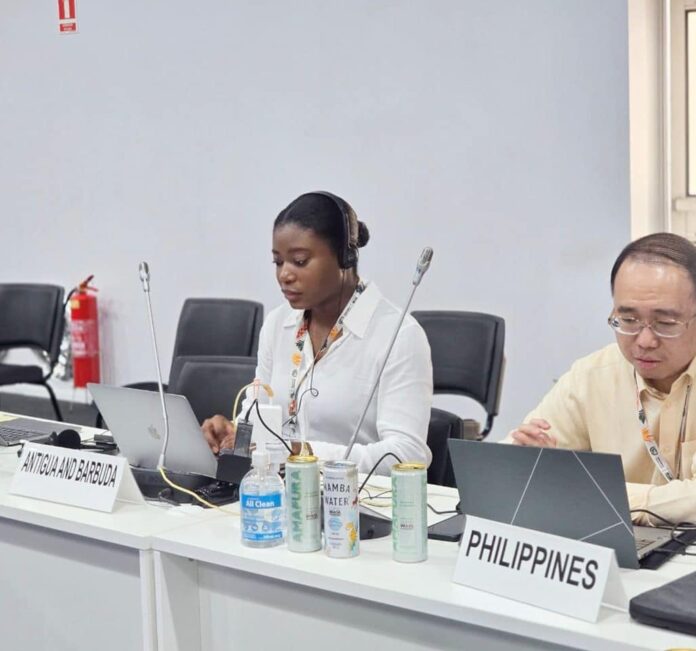

Antigua and Barbuda’s commitment to shaping global climate action in ways that reflect the needs and vulnerabilities of Small Island Developing States (SIDS) is central to its engagement in the Just Transition Work Programme (JTWP) at the 30th Conference of the Parties (COP30) in Belém, Brazil. The JTWP provides a formal framework for countries to cooperatively design pathways toward low-emission, climate-resilient development while safeguarding workers, frontline communities, and vulnerable groups.
Gita Nicholas, Technical Officer at the Department of Environment, represents Antigua and Barbuda within this negotiation work stream and advocates for outcomes that place people at the heart of climate action. Her focus includes strengthening access to finance and technology, integrating traditional and local knowledge into adaptation planning, and ensuring that just transition efforts reflect the unique circumstances of small island states. For Antigua and Barbuda, the concept of just transition is inseparable from the global effort to keep warming below 1.5°C, a threshold critical for survival.
The nation’s engagement in the JTWP is particularly important given its heightened climate risks: rising temperatures, intensifying storms, and economic exposure linked to dependence on imported fossil fuels. A well-designed just transition opens avenues for Antigua and Barbuda to expand climate-resilient livelihoods, reduce energy vulnerability, and shift toward more secure, sustainable industries. Nicholas emphasizes the need for a fast but fair transition, one supported by robust institutional structures and increased financial flows to the most vulnerable countries.
At COP30, Antigua and Barbuda is calling for the operationalization of the JTWP through clear institutional arrangements that enable capacity-building, knowledge exchange, and equitable access to resources. Ensuring these mechanisms are fully functional will allow just transition commitments to translate into tangible benefits: stronger community resilience, improved access to clean energy, and a more equitable global environment for SIDS navigating the frontlines of climate change.