
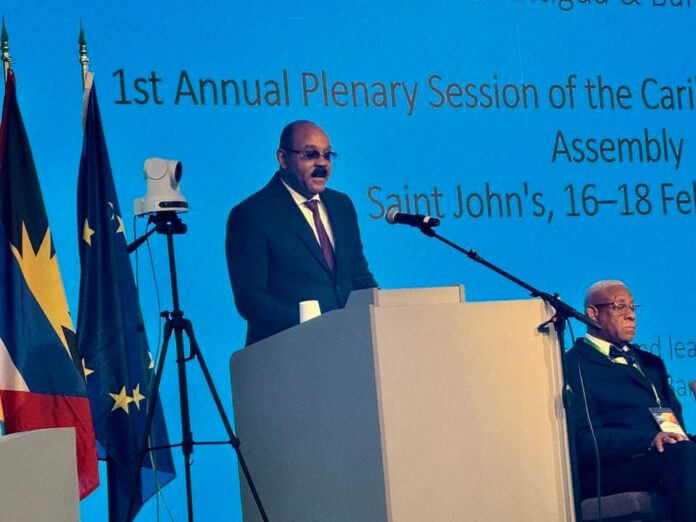

ST. JOHN’S, Antigua — Prime Minister Gaston Browne on Monday called for a stronger and more decisive alliance between the Caribbean and the European Union, warning that global instability and the erosion of rules-based systems pose existential risks for small island states.
Addressing the inaugural session of the Caribbean–EU Parliamentary Assembly in St. John’s, Browne said the gathering represented more than the launch of a new parliamentary body.
“It marks a choice,” Browne told European and Caribbean lawmakers assembled at the Convention Centre. “In a world where pressure is increasingly mistaken for policy, we choose to remind ourselves—and each other—that law, not leverage, is the only durable foundation of peace and prosperity.”
Browne argued that multilateralism is not an abstract concept for the Caribbean but a practical necessity for survival. “Rules are our shield. Law is our insurance. Predictability is our lifeline,” he said, noting that small, open economies are often the first to feel the impact when international norms weaken.
He urged the EU and Caribbean states to stand together in defending international law and strengthening institutions at a time when some global powers are “retreating from cooperation” and “substituting leverage for law.”
Climate change, he said, remains the region’s defining challenge, citing rising sea levels, droughts and the growing burden of sargassum affecting tourism and fisheries. While welcoming the European Union’s Global Gateway investment initiative, Browne said ambition must translate into faster delivery.
“Finance must move faster. Access must be simpler. And vulnerability—not outdated income classifications—must guide eligibility,” he said.
The Prime Minister also called for improvements to the EU–CARIFORUM Economic Partnership Agreement to make trade rules more workable for small and medium-sized Caribbean businesses, and advocated for deeper cooperation in renewable energy, digital services and the blue economy.
On security, Browne highlighted shared concerns over transnational organized crime, urging stronger intelligence-sharing and judicial collaboration between the regions.
He also addressed Caribbean citizenship-by-investment programmes, describing them as lawful and transparent development tools that have financed hurricane recovery, infrastructure and fiscal stabilization. While acknowledging EU concerns, Browne said the programmes have been strengthened and remain a sovereign policy matter.
“Citizenship policy remains a sovereign responsibility. But sovereignty does not preclude dialogue,” he said.
Turning to Haiti, Browne said the security situation must be stabilized to allow free and fair elections and the restoration of democratic institutions, while reaffirming Caribbean support for a Haitian-led solution backed by international engagement.
In closing, Browne urged Caribbean parliamentarians to approach the new Assembly with seriousness and coordination, proposing regular meetings and structured follow-through to ensure commitments translate into national policies.
“We choose rules over uncertainty. We choose law over pressure. We choose partnership over fragmentation,” Browne said.
The Caribbean–EU Parliamentary Assembly runs through Wednesday in Antigua and Barbuda.