
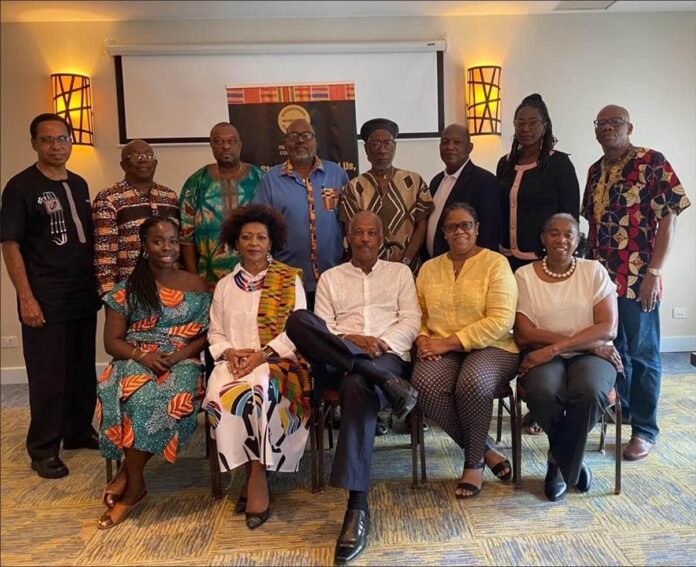

On the International Day of Remembrance of the Victims of Slavery and the Trans-Atlantic Slave Trade, the CARICOM Reparations Commission pays tribute to the 15 million African men, women, and children who endured the horrors of chattel enslavement for over three hundred years in the Americas. We remember the untold suffering caused by the trauma of the Middle Passage, the brutality of slavery and the despair of being denied their humanity, their freedom and their dignity.
However, we also remember their countless acts of courage and defiance against a racialised system of European domination. We honour their relentless resistance towards ending one of the greatest injustices in human history, which was perpetrated against African people.
We honour their memory by carrying forward their fight for freedom and justice in accordance with the CARICOM Ten Point Plan for Reparations, which outlines the Region’s collective vision for justice in the context of regional development priorities. We renew our call for restitution and compensation through comprehensive programmes of repair and the implementation of sustained measures to dismantle structural and institutional racism.
The Commission reaffirms that the crimes against humanity of racialised chattel enslavement, the trafficking of enslaved Africans and genocide, were carefully orchestrated to fuel the growth of Europe and systematically underdevelop Africa and the Caribbean. The legacies of these deeply entrenched historical systems of exploitation continue to shape global inequality until today.
We welcome the declaration of the African Union Decade for Reparations (2026 – 2035), as a historic commitment that strengthens the global reparations movement and provides a framework for deeper collaboration between Africa, the Caribbean, and the wider diaspora. Together, we are forging a unified front to ensure that reparatory justice is recognised as a matter of rights, historical truth, moral and legal accountability.
As we reflect, we also recommit to continued dialogue, advocacy and public education. The struggle for reparatory justice is at a defining moment, with growing global awareness and an expanding coalition within Global Africa.
The Commission recognises and celebrates the resilience of our ancestors to slavery and transatlantic trafficking in the face of crushing adversity. The Commission further calls on the international community to take decisive action to repair the harmful legacies, recognising that justice for the victims of African enslavement is justice for humanity.
About the CARICOM Reparations Commission (CRC)
The CARICOM Reparations Commission is a regional body created to establish the moral, ethical and legal case for the payment of reparations by the governments of all the former colonial powers and the relevant institutions of those countries to the nations and people of the Caribbean Community for the crimes against humanity of native genocide, the Trans-Atlantic slave trade, and a racialized system of chattel slavery.
About CARICOM:
The Caribbean Community (CARICOM) was established on 4 July 1973 with the signing of the Treaty of Chaguaramas, which was revised in 2001 to allow for the establishment of a single market and economy. CARICOM comprises fifteen Member States and six Associate Members and is home to approximately sixteen million citizens, 60% of whom are under 30 years old. CARICOM’s work rests on four main pillars: economic integration; foreign policy coordination; human and social development; and security cooperation.
The members of CARICOM work together to create a Community that is integrated, inclusive and resilient; driven by knowledge, excellence, innovation and productivity; a Community which is a unified and competitive force in the global arena, where every citizen is secure and has the opportunity to realise his or her potential with guaranteed human rights and social justice, and contributes to, and shares in, its economic, social and cultural prosperity.
CARICOM remains one of the best examples of integration in the developing world.
The CARICOM Secretariat, the principal administrative organ of the Community, is headquartered in Georgetown, Guyana.