

The Pitch Is the Map
_A multiracial, multipolar world is playing out at the World Cup
_on the soil of a power trying to hold both at the gate._
By Professor C. Justin Robinson
Pro Vice-Chancellor and Principal, The UWI Five Islands Campus
The 2026 World Cup is under way. Before a ball is struck, before the anthem ends, the camera performs a kind of cartography. It glides across the line-ups and reveals what stump speeches and border walls try to conceal. Nations are no longer bloodlines, and power is no longer arranged around a single pole. The football pitch is the early twenty-first century’s most honest map
The football pitch is the early twenty-first century’s most honest map.
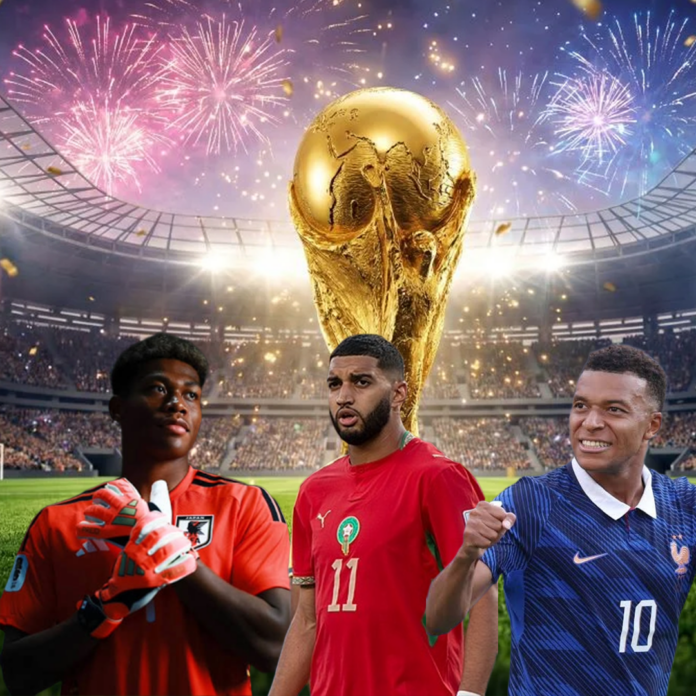
Start with the mixing because it stands in the goalmouth. Japan’s goalkeeper is Zion Suzuki, born in Newark, New Jersey, to a father of Ghanaian descent and a Japanese mother, raised in Saitama, claimed by Japan, yet still made to carry the burden of other people’s racial arithmetic. He has been abused for the colour of a skin that is, by any serious accounting, entirely Japanese, entirely Ghanaian, entirely American, and entirely his own.
He is not the exception but rather he is the rule the tournament keeps proving. France’s captain, Kylian Mbappé, is the son of a Cameroonian father and a mother of Algerian descent. Spain’s young geniuses, Lamine Yamal and Nico Williams, carry Morocco, Equatorial Guinea and Ghana into a team once imagined more narrowly. Switzerland leans on Breel Embolo, born in Cameroon. Germany, England, the Netherlands and Portugal all carry the histories of migration, empire, labour and return. The old fiction of the nation as a pure bloodline dies on the grass, a little more with every pass.
That is the first truth the pitch reveals. The second is harder to swallow as influence itself has shifted. Look at who is good at the world’s game. Here the map of twentieth-century dominance begins to dissolve. Football’s aristocracy is not the G7. Brazil, a multiracial giant of the Global South, sits near the summit while Argentina holds the crown. Morocco, the first African and Arab nation to reach a World Cup semifinal, now plays Brazil not as a ceremonial guest but as a peer and on opening night in New Jersey the five-time champions needed Vinícius Júnior to rescue a 1–1 draw after Ismael Saibari had put Morocco ahead. Both advanced, separated only by goal difference.
Senegal, Ghana, Côte d’Ivoire, Cabo Verde, these are not sentimental additions, they are nations to be feared. Côte d’Ivoire reached the knockout stage for the first time in their history. And Cabo Verde, a nation of barely half a million on its World Cup debut, held the reigning European champions Spain to a goalless draw, then came from behind to draw 2–2 with two-time world champions Uruguay. That fact alone says more about the coming century than many policy papers.
And the supposed poles of this century’s power? The United States hosts the tournament, fills its stadiums, and won its group, yet it is still not one of football’s ruling houses. It can stage the spectacle but it cannot command the sport. China has reached a single World Cup, in 2002, and left without a goal. India, already the world’s most populous nation, has never appeared at all. In the one arena that is genuinely global, where wealth, population and weaponry guarantee nothing, American, Chinese and Indian scale shrinks. The world’s game has been multipolar for a generation. It was telling us where history was going long before the diplomats caught up.
It was telling us where history was going long before the diplomats caught up!
That is the paradox. The United States is staging, on its own soil and before the largest audience on earth, a vivid demonstration of the very world its politics is trying to resist, already mixed, already multipolar.
The contradictions are not theoretical. As the tournament opened, country-specific entry restrictions were reinstated and widened. Haiti and Iran, both World Cup nations, under full bans with Senegal and Côte d’Ivoire under partial ones. Its language is screening, vetting, national security. Its effect is plainer; the players are written into exceptions but the people who raised them and would have filled the stands behind them are left outside the gate. Iran’s squad was forced to base itself in Mexico, several staff denied visas, allowed into the United States only to play and then made to leave. Journalists from affected nations have faced single-entry limits that make following a team across three host countries difficult.
Consider Omar Artan, one of Africa’s finest referees and the only Somali on FIFA’s list, denied entry at Miami despite a valid visa and diplomatic passport after an eleven-hour interview. Officials produced no public evidence, alleging only, anonymously, “association with suspected members of terror organizations.” Somalia sits on the banned list; the vocabulary of security did the work the nationality ban wanted done. FIFA, for its part, said host governments control immigration decisions.
To be fair, security concerns are not always fiction and nations have a legitimate interest in who enters. But when the pattern is this precise, the barred so often the very nations whose players the world most wants to watch, one asks whether security is the whole story, or merely the language power has learned to speak.
The grandstands fly the flags of nations whose ordinary citizens may struggle to enter and the host sells a festival of belonging while reminding much of the world that belonging stays conditional. Name it for what it is. The wall of paperwork, the menace at the perimeter, the talent welcomed and its people doubted , this is not a show of strength. It is the behaviour of a power that feels the ground shifting beneath it. You do not slam the door on a world you still command. You slam it on a world you can feel slipping from your grip.
You do not slam the door on a world you still command. You slam it on a world you can feel slipping from your grip.
We in the Caribbean, the world’s oldest laboratory of forced mixture, are not naive about either fact. Mixture does not deliver justice on its own. Brazil is proof enough, a multiracial giant still shadowed by racial hierarchy, still fluent in the old myth of “racial democracy,” still able to turn Black genius into national glory while Black citizens fight for full dignity off the field.
Nor is multipolarity salvation. A world of many poles is not automatically kinder or freer; it may only mean more doors to knock on, more powers to bargain with, more appetites. The old empires do not vanish; they learn new languages. The new powers do not arrive innocent. A world with more poles still requires small nations to know themselves, organize themselves, and build something worth bringing through the door.
That is why this World Cup matters beyond football. It is not entertainment, it is revelation. It shows the world as it is, not as nostalgia imagines it, mixed beyond reversal, plural beyond command, competitive beyond old rankings.
For ninety minutes, the truth that borders deny becomes obvious. A Black goalkeeper named Suzuki rises to claim a cross for Japan. A Cameroonian-Algerian-Frenchman remains the most devastating footballer alive. Spain’s future runs through the children of immigrants. Morocco makes Brazil sweat in New Jersey. Cabo Verde holds Spain and Uruguay. The map redraws itself in studs and sweat.
The visa line is the world as a frightened power wishes it still were, ranked, filtered, suspicious, obedient. The pitch is the world as it insists on becoming, mixed, multipolar, and increasingly indifferent to who used to run it.
This article was originally published by Antigua News Room. Read the original article here: OPINION: The Pitch Is the Map.