
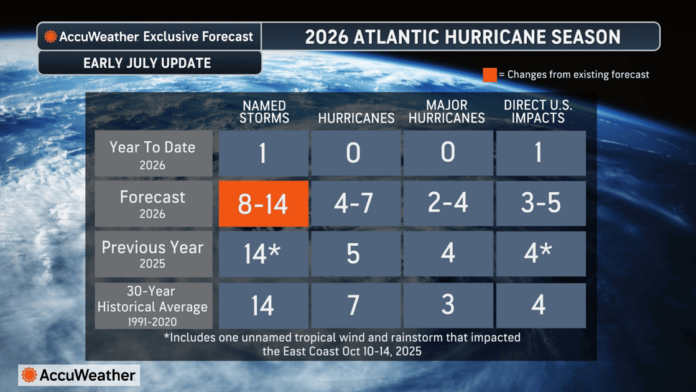

| | Most Likely | Projected Range |
| — | — | — |
| Named Storms | 11 | 8-14 |
| Hurricanes | 5 | 4-7 |
| Major Hurricanes | 2 | 2-4 |
| Direct U.S. Impacts | 4 | 3-5 |
AccuWeather® hurricane experts are slightly reducing the number of named storms expected to develop this season, after the early June arrival of El Niño, and a 70 percent chance of a Super El Niño developing.
AccuWeather® now forecasts 8-14 named storms during the Atlantic hurricane season, a small decrease for the initial AccuWeather 2026 Hurricane Season Forecast, which initially forecasted 11-16 named storms in March.
“El Niño conditions have always been the driver for why we’re expecting numbers near or below the historical average this year,” said Alex DaSilva, AccuWeather lead hurricane expert. “The stronger the El Niño gets, the fewer named storms we’re likely to get. Back in 2015, we had a strong El Niño and got 11 named storms. I think that is the sweet spot again this year.”
“AccuWeather hurricane experts are constantly refining and integrating new data into our predictions. In addition to slightly lowering the named storm prediction, this update also provides a most likely number of named storms, hurricanes, major hurricanes, and direct U.S. impacts – something that other sources do not provide,” said Vice President of Forecasting Operations Dan DePodwin.
AccuWeather released its preliminary Atlantic Seasonal Hurricane Forecast on March 25, well ahead of any other known sources.
AccuWeather experts still expect 4-7 Atlantic hurricanes, 2-4 major hurricanes, with 3-5 direct U.S. impacts expected. The northern and eastern Gulf Coast, the Carolinas, and the northeastern Caribbean remain higher-than-average risk areas, where storms can develop rapidly.
“When tropical storms and hurricanes form close to the coast instead of tracking across the open Atlantic from Africa, there’s a real difference in warning time,” DaSilva explained. “As a result, residents may have significantly less time to prepare. That’s why we stress having a hurricane plan in place before the season starts, rather than waiting until a storm is already offshore.”
El Niño is Driving the Forecast Change
El Niño’s early June arrival and forecasted strength will inhibit tropical development. AccuWeather is forecasting a 70-percent chance a Super El Niño will develop later during the Hurricane season and last into early 2027. El Niño generates more frequent periods of wind shear across the Atlantic Basin, which helps to prevent tropical systems from organizing and intensifying.
The overall pattern this summer and fall favors a lower-than-average risk of significant tropical impacts on the central and lower Texas coast
Warm Atlantic waters near the U.S. coastline could let storms form and rapidly intensify closer to shore, giving residents less time to prepare than storms that track across the Atlantic from near Africa
Impacts can extend hundreds of miles inland through flooding rain and tornadoes, so residents well away from the coast should also monitor the forecast closely
Tropical Storm Arthur Was the First Named Storm of the Season
Tropical Storm Arthur made landfall in Texas on June 17 and brought extensive flooding across the Gulf Region.
Arthur dumped more than 20 inches of rain in spots, causing an estimated $4-6 billion in total damage and economic loss, according to a preliminary estimate from experts at AccuWeather. Flooding, property and infrastructure damage, hundreds of flight delays, financial losses from extended power outages, and business interruptions contributed to the economic impacts from the storm.
“Arthur is another reminder that tropical systems do not need to reach hurricane strength to cause significant, expensive and even deadly damage and economic losses,” said AccuWeather Vice President of Forecasting Operations Dan DePodwin. “Flooding, travel disruptions, power outages and business interruptions can quickly add up to billions of dollars in impacts for families, businesses and communities.”
AccuWeather RealImpact™ Scale for Hurricanes
In contrast to the Saffir-Simpson Hurricane Wind Scale, which classifies storms by wind speed only, the AccuWeather RealImpact™ Scale is based on a broad range of important factors. In order to better communicate a more comprehensive representation of the potential impact of a storm to lives and livelihoods, the scale covers not only wind speed but also flooding rain, storm surge and economic damage and loss.
About AccuWeather, Inc. and AccuWeather.com – AccuWeather, recognized and documented as the most accurate and most used source of weather forecasting and warnings in the world, has saved over 12,000 lives, prevented injury to over 100,000 people, minimized reputational harm, and saved companies tens of billions of dollars.
A billion people around the world rely on AccuWeather’s proven Superior Accuracy™ across our consumer digital platforms. AccuWeather.com is the #1 weather destination and one of the top 100 most-visited websites in the world, and our award-winning AccuWeather app delivers detailed real-time forecasts to millions of smartphones.
AccuWeather forecasts also appear on digital signage, in 700 newspapers, are heard on over 400 radio stations, and viewed on 100 television stations. The AccuWeather Network and AccuWeather NOW® reach an audience of over 125 million on cable and streaming platforms.
AccuWeather For Business serves more than half of the Fortune 500 companies and thousands of other businesses and government agencies globally who pay to subscribe to the best and most accurate weather forecasting service.
This article was originally published by Antigua News Room. Read the original article here: Early onset El Niño triggers slight downward adjustment to the total number of named storms.