
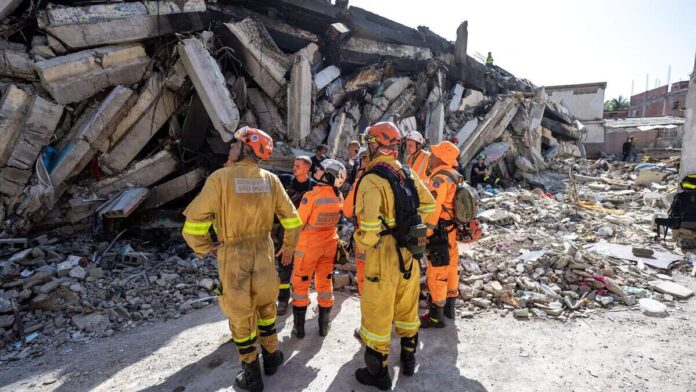
Members of the 7th Civil Security Training and Intervention Regiment exchange information with Brazilian rescue workers next to a damaged building in Catia La Mar, La Guaira state, Venezuela, on June 29, 2026. Hopes were fading on June 29, 2026 of finding survivors more than four days after powerful twin earthquakes struck Venezuela, as residents grow increasingly frustrated with the government’s response to the disaster that has killed at least 1,450 people and left tens of thousands unaccounted for. (Photo by Miguel MEDINA / POOL / AFP via Getty Images)
Two weeks after Venezuela’s earthquakes, PAHO highlights ongoing health needs as response shifts to recovery
Fifteen days after the earthquakes struck Venezuela, the Pan American Health Organization (PAHO) says that while the initial surge of trauma cases has begun to stabilize, the health response is entering a new phase focused on stabilization, continuity of care and early recovery.
“Two weeks later, our message is clear: the emergency response continues, and the needs of affected communities remain urgent,” said PAHO Director Dr. Jarbas Barbosa during a press briefing today.
According to Venezuelan authorities, the earthquakes caused 3,811 deaths and 16,740 injuries as of 8 July. Authorities also reported that more than 6,400 people were rescued alive.
Since the first hours after the disaster, PAHO has been working alongside Venezuela’s health authorities, United Nations agencies and humanitarian partners to coordinate and strengthen the health response. Building on its longstanding presence in the country, the Organization has mobilized technical expertise, emergency medical supplies and international support to help national authorities respond to the crisis.
“Our support has focused on three immediate priorities: saving lives, maintaining essential health services, and preventing additional health risks in the weeks ahead,” Dr. Barbosa said.
To strengthen health services in the areas most affected by the earthquakes, PAHO has supported the deployment of Emergency Medical Teams (EMTs) and emergency specialists. Twelve teams are currently operational, helping expand access to emergency care, surgery, primary health care and mental health services in the areas most affected by the earthquakes.
PAHO has also delivered six metric tons of emergency medical supplies from its Emergency Strategic Reserve in Panama and has facilitated support for vaccination, helping to protect affected populations and maintain essential health services.
“Coordination between health authorities, response teams, and humanitarian partners is essential to make the best possible use of available resources and to help ensure that assistance reaches those who need it the most, and fast. PAHO has established coordination mechanisms to strengthen this work and contribute to a more effective health response,” Dr. Barbosa said.
As the response evolves, attention is increasingly focused on ensuring continuity of care while laying the foundations for recovery.
Hospitals continue to function despite structural damage, limited surgical and diagnostic capacity, and growing surgical backlogs. More than 17,000 people remain displaced, most of them in 87 transitional camps, where access to primary health care, safe water, sanitation, vaccination and disease surveillance will be essential to prevent further illness.
“The priority now is not only to keep health facilities open, but to ensure safe and timely access to essential health care, including emergency care, trauma services, intensive care, diagnostic imaging, oxygen, essential medicines and other critical services,” Dr. Barbosa said.
PAHO noted that the main public health concerns in the coming weeks are likely to be related to interruptions in health services, overcrowded living conditions, gaps in water and sanitation, and reduced access to vaccination and routine care.
Maintaining immunization, safe water and sanitation, and continuity of care for people with chronic diseases, pregnant women, older adults, children, people with disabilities and those needing rehabilitation will be essential.
“Mental health is also an urgent priority. After a disaster of this magnitude, treating physical injuries is not enough. Thousands of people have experienced loss, displacement, and uncertainty. Health workers are also carrying a heavy burden. Supporting their mental well-being is as important as treating physical injuries,” Dr. Barbosa said.
Dr. Barbosa also paid tribute to Venezuela’s health workers, many of whom have continued caring for patients while coping with their own losses and displacement following the earthquakes.
“To Venezuela’s health workers, I want to say thank you. Your professionalism, courage and commitment continue to make a difference in the lives of people affected by this emergency,” he said.
PAHO is also supporting the safe and dignified management of the deceased, an important component of the humanitarian response and of supporting affected families. However, from a public health perspective, the greatest public health risks following an earthquake are typically linked to disruptions to health services, safe water, sanitation, hygiene and vaccination.
Looking ahead, PAHO stressed the importance of advancing recovery while maintaining the emergency response.
“Recovery cannot simply mean returning to what existed before. It must be an opportunity to build back stronger, safer, more resilient and better prepared health services for future emergencies,” Dr. Barbosa said.
To support these efforts, PAHO has launched a US$24 million emergency appeal to help meet urgent health needs through the end of the year. The funding will support essential health services, strengthen epidemiological surveillance, expand mental and psychosocial health support, support rehabilitation, and restore the functionality of damaged health facilities.
“The international community helped save lives in the first days after the earthquakes. That solidarity must continue. Timely and flexible funding is critical. It allows PAHO and partners to respond where needs are greatest and adapt as the situation evolves,” Dr. Barbosa said.
“No single institution can respond to an emergency of this scale alone. PAHO remains fully committed to supporting Venezuelan authorities and partners throughout emergency response and recovery. Our priority remains clear: to save lives, protect health, and support affected people and communities in their recovery, while strengthening the he
This article was originally published by Antigua News Room. Read the original article here: PAHO says Venezuela earthquake response enters recovery phase.