

I am reminded of the phrase, “that government is best which governs least”.
The above phrase is attributed to Henry David Thoreau, an American philosopher, in his 1849 book, “Civil Disobedience”.
The phrase “government is best which governs least” attempts to convey the idea that a government’s role is not to decide for the people but rather protect the people’s rights to decide for themselves and to resist the temptation of interfering in every affair of ordinary people.
Today, we make government decide what kind of flowers we can put on the graves of our love ones; they can take away your property on a whim; and they can force your children to speak Spanish, among other things.
This Antigua and Barbuda government has been hell-bent on interfering in every facet of our lives, under the pretense of wanting to make our lives better. Every time they “help”, things just get worse.
To bring so-called prosperity to Barbudans, it took away the Barbudan’s lands; its wonton misbehaviour has cost us access to the USA for medical, recreational, or educational purposes; It said that food security was paramount yet it converted prime arable lands to housing and hotels and shutdown Dunbars.
ABST increased from 15% to 17%, vehicular licensing increased by 40%, Entertainment taxes increased, Windfall tax introduced and now its dragnet is to be broadened and made permanent.
This constant interference in all aspects of our lives has only created chaos and disharmony. The entire fabric of our society is on the verge of collapse with violent crime becoming a daily staple.
There is an obvious pattern emerging.
Is this the Renaissance we were promised?
An economy is a very fragile ecosystem and ours has been undergoing continuous bludgeoning from political interference.
We hear the leaders of this government pontificate about “extractive” practices of those businesses they do not favour yet turn around and super-prime the pumps of their favoured investors to suck the life out of this economy at the expense of those who are born and living here.
This recent standoff between the government and the gas station owners is an example of how this government holds homegrown business people in disdain.
Just imagine that this uncaring leadership was swift to chide the gas station owners for taking a stand for their livelihood, implying that they are greedy blood suckers.
This is unfortunate!
There has been so much misinformation on this issue that I feel it necessary to provide a preponderance of evidence to debunk the notion that the gas station owners are mere opportunists seeking to fleece this population.
I hope to show how these beleaguered local business owners have been struggling just to survive in 2026.
This has not been a very good year for gas station owners.
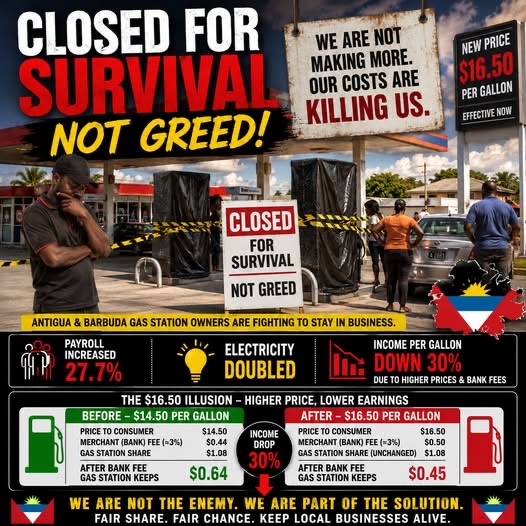
First, the government as part of its electioneering gimmickry, raised the minimum wage from $9.00 per hour to $11.50. An increase of 27.7%, effectively raising the payroll costs for gas station owners by the same percentage.
To give you a sense of what the increase feels like, let us suppose that you are a gas station owner.
Imagine that your monthly payroll cost was $10,000.00 before the increase in the minimum wage. After the increase of the minimum wage your monthly payroll would increase to $12,770.00.
Additionally, as an employer, your contribution to Social Security and Medical Benefits will also increase. Payroll taxes are effectively 12.5% extra.
In this example before the minimum wage increase you would have been paying $11,250.00 per month inclusive of Medical Benefits and Social Security contributions.
Now, after the increase in the minimum wage you would be paying $14,366.25 without earning an extra dollar in your business. This means that you have to find another $3,116.25 per month in this “guava crop” year.
Moreover, gas stations use lots of electricity for their pumps, air conditioning, freezers and various machines. With the fuel variation DOUBLING the service stations have had to absorb this extra cost, again with no increase in income.
As is now public knowledge, for every gallon of gas that is sold, WIOC-affiliated gas stations only get $1.08. It is even less for gas stations affiliated with Rubis.
Gas stations have been reluctant to adopt card services because of the merchant fees of roughly 3.0% on each transaction. However, with banks discouraging the use of cash, gas station owners find themselves in a dilemma: accept cards or go out of business.
At the $14.50 rate, gas stations paid the bank $0.44 for every gallon sold to a card holder. This means that for every $1.08 earned per gallon, the gas station owner only keeps $0.64.
With gas prices going to $16.50 per gallon, the bank fee increases to $0.50 per gallon, leaving the gas station owner with only $0.45 per gallon.
This price increase AUTOMATICALLY results in a 30% drop in income for the gas station owner. This is why the gas station owners refused to open their gas pumps on the first day of the price increase.
To sell gas today without any increase in their share would have been suicidal. The WIOC-owned stations do not have the same financial constraints as the independent owners, so it was business as usual for them.
Can you imagine, that this government did not consider for a moment what the implications of this measure would have been on this business sector?
It clearly did not consult with all the participants.
This administration keeps making rookie mistakes in basic governance.
It is vastly unreasonable to expect gas station owners to pay all of their expenses including wages, electricity, etc from the $0.45 per gallon of gas.
The income from selling gas alone has not been sufficient to keep gas stations going, therefore they have diversified by selling non-price-controlled products such as oils, drinks, snacks, etc in order to stay afloat.
To summarize.
This year, gas station owners have seen a 27.7% increase in their payroll; their electricity bills have at least, doubled; their income per gallon of gas has fallen 30% as a result of the $2.00 increase in gas prices. This last point is the counter-intuitive part that everyone misses. This goes into bank fees.
It would be a conservative estimate to extrapolate that gas station owners with this new price could see their cashflows dropped by 60% compared to the start of 2026.
With the expectation that drivers will reduce their consumption, on account of electricity prices skyrocketing, fuel prices exploding and the general cost of living busting at the seams, the future looks very bleak for gas station owners if no compromise is reached.
If there is no reasonable settlement on this issue, we can either see the loss of pump attendants, contributing to unemployment numbers or some owners may simply choose to shutdown.
I believe the more likely scenario is that pump attendants will be laid off with drivers expected to pump their own gas.
I fully support the gas station owners’ decision to shutdown pending an increase of their share. It would be suicidal otherwise.
The government may want to compromise by giving the gas station owners $1.58 per gallon which will effectively give them the same level of earnings they had before the increase to $16.50 per gallon.
In other words, of the 2.00 increase, I would offer the gas station owners $0.50 extra per gallon as a reasonable compromise. It could even be temporary subject to oil prices falling to a certain pre-determined level.
Government has a 51% interest in WIOC, so what they may lose in subsidy, they get back in dividends.
I think it disingenuous or a sign of gross incompetence to suggest that the gas station owners are being greedy.
The numbers do not lie
This article was originally published by Antigua News Room. Read the original article here: OPINION: Gas station owners are right to strike.