
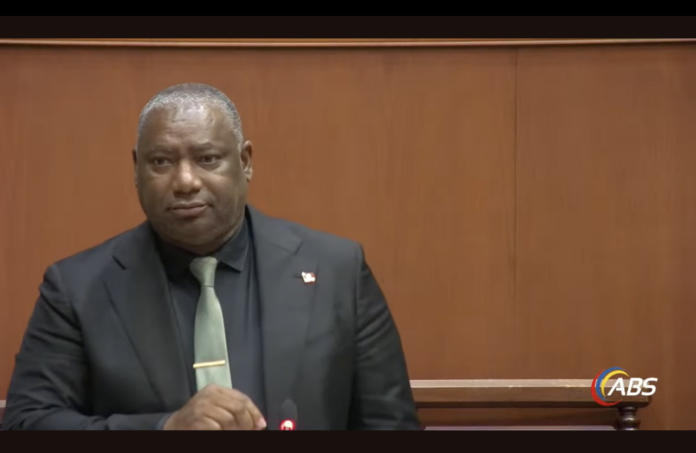

Senate Minority Leader Chester Hughes warned Tuesday that a six-year deadline for bringing proceedings before Antigua and Barbuda’s Industrial Court could deny unfairly dismissed workers access to justice unless the government addresses delays in the labour relations system.
Speaking during debate on the Limitation (Amendment) Bill 2026, the trade unionist called for comprehensive labour reform, better staffing at the Labour Department and computerized case management.
“I personally don’t think that any unfair dismissal case should have a limitation as to when I bring a case against my employer,” Hughes said.
The bill would replace section 7A of the Limitation Act to prohibit any action or proceedings before the Industrial Court after six years from the date the cause of action accrued or the circumstances giving rise to the proceedings occurred.
Its explanatory memorandum says a 2022 amendment applied the deadline specifically to trade disputes, although the court has jurisdiction over other industrial relations matters. The new wording would extend the provision to all actions and proceedings before the court.
Hughes stressed that a six-year limitation period was already part of the legislation. His concern, he said, was the broader reach of the amendment and its implications for workers who encounter delays before their cases reach the court.
“I think six years is a long time if you have an efficient running system,” he said.
He argued that workers should not lose the opportunity to pursue a claim because the institutions through which they must seek redress are slow or inadequately equipped.
Hughes described the Labour Department as understaffed and said difficulties securing hearings, reports and the documentation needed to advance disputes could prolong the process.
He also said some dismissed workers do not immediately understand their rights or know where to seek assistance. Others, he said, approach lawyers before turning to a union, by which time several years may have passed.
Hughes described a situation in which a union begins pursuing a worker’s complaint in the fifth year, only to face further delays at the Labour Department before the matter can reach the Industrial Court.
Under the bill’s wording, he warned, a worker could then find the claim barred despite delays beyond their control.
His remarks distinguished between the deadline for starting proceedings and the separate problem of waiting for a judgment once a case is already before the court.
Hughes said postponed hearings and outstanding decisions had compounded workers’ frustration. He argued that lawyers’ commitments in the High Court could also delay Industrial Court matters, including instances in which workers take time off from another job for hearings that do not proceed.
However, he praised the current Industrial Court president, whom he identified as Samantha May, saying cases had begun moving under her leadership.
Hughes urged the government to bring forward a coordinated package of labour legislation rather than repeatedly making narrow amendments.
He said revisions to the Labour Code had been under consideration since before the United Progressive Party left office, but had still not reached Parliament. He also called for modernization of workers’ compensation legislation to reflect contemporary workplaces.
“We must bring Antigua and Barbuda’s labour protection legislation into the 21st century,” he said.
Hughes ended by calling for practical improvements at the Labour Department, saying staff were still relying on handwritten books to manage and track cases.
“Modernize it, computerize it,” he said, also urging staff training so disputes could be handled more efficiently.
The government’s opening presentation defended the six-year period as sufficient time to bring proceedings and said the amendment would provide certainty for employers and employees. It also emphasized the importance of pursuing disputes while records remain available and witnesses can recall events.
Hughes maintained that those objectives needed to be accompanied by reform of the institutions responsible for delivering justice to workers.
This article was originally published by Antigua News Room. Read the original article here: Hughes warns slow labour system could leave unfairly dismissed workers unable to meet Parliament’s six-year deadline.