
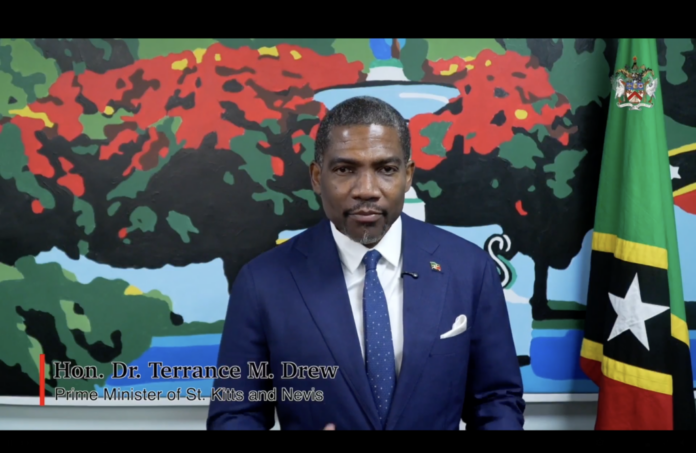

St. Kitts and Nevis will wind down its Citizenship by Investment programme, Prime Minister Dr. Terrance Drew announced Friday, saying the decision is intended to protect visa-free travel and the country’s international financial relationships.
In a national address on Nov. 13, Drew said his government had formally communicated its position to the European Union and was negotiating a transition timetable.
He did not announce a closing date. Applications will continue until an agreed deadline is established, he said.
“I will announce the final date for receipt of CBI applications as soon as it is agreed with the European Union,” Drew said.
The prime minister said the European Commission wrote to his government in June, inviting St. Kitts and Nevis to wind down the programme over a transition period to retain visa-free access to Europe’s Schengen area.
He argued that continuing the programme against international partners’ objections could carry consequences beyond travel restrictions, including risks to the banking relationships that allow money to move into and out of the country.
Those relationships support tourism, overseas transfers and payments for imported goods, he said.
Drew assured people who lawfully obtained citizenship through the programme that their status would remain unchanged.
“Nothing changes tonight for any person who lawfully holds our citizenship,” he said.
During the transition, the programme will operate under its existing requirements and regional oversight, Drew said, ruling out discounted offers to attract last-minute applications.
“There will be no rush, no discounts, and no fire sale,” he said.
Staff at the Citizenship by Investment Unit will be deployed to support a new drive for foreign direct investment, drawing on their experience working with investors.
Drew said the programme, established in 1984, had helped finance government operations, infrastructure, housing and the recovery from the COVID-19 pandemic. However, he acknowledged that reliance on citizenship revenue had left the country exposed to changes in international policy and demand.
According to figures he presented, CBI generated approximately EC$6.5 billion between 2008 and 2025, accounting for about half of federal government cash receipts over that period.
He said its share of government revenue had fallen from as much as 70% in 2022 to less than 20% in 2026.
The government’s economic transition will focus on geothermal energy, tourism, agriculture, digital services and creative industries, Drew said.
Plans include drilling six geothermal wells in Nevis, building a power plant and establishing an electricity link between the two islands. Drew said Antigua and Barbuda and St. Martin had expressed interest in purchasing energy, although he announced no supply agreement.
He also outlined discussions with the EU on support for the transition, including energy infrastructure, another undersea fibre-optic cable and improved regional sea transport.
Drew said the government would expand technical training, scholarships and apprenticeships to prepare residents for jobs in emerging industries.
While acknowledging that lower CBI receipts would require careful spending, he said raising taxes was not part of the government’s transition plan.
“Our plan is to make this change by growing our economy,” he said.
This article was originally published by Antigua News Room. Read the original article here: BREAKING: St. Kitts and Nevis to wind down citizenship investment programme; closing date under negotiation.