
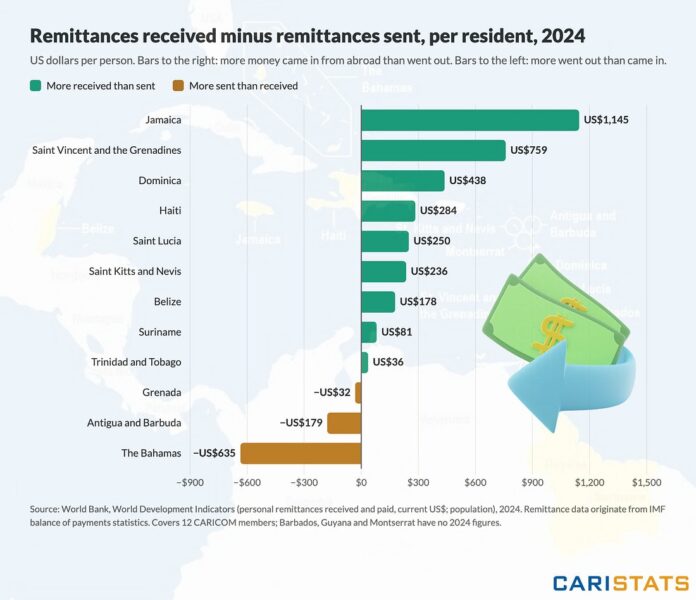

Remittances are usually discussed as money flowing into the Caribbean, from relatives overseas to households at home. Money also flows out, as people living and working in CARICOM, including migrant workers, send part of their pay abroad. For small, open economies, both directions affect how much foreign currency stays in the country.
World Bank data for 2024 covers 12 CARICOM members. In nine, more money came in than went out, and in three, the flow went the other way. The Bahamas received US$66 million and sent out US$321 million. Antigua and Barbuda received US$26 million and sent US$43 million. Grenada was closer, receiving US$48 million and sending US$52 million.
Per resident, the difference in The Bahamas is clearest: about US$800 sent abroad for every person living there, against about US$164 received. Saint Kitts and Nevis also sends out a lot per resident, about US$590, though it still receives more.
Together, the three sent US$276 million more abroad than they received in 2024. This is an outflow their economies cover through earnings from tourism, trade and investment.
This article was originally published by Antigua News Room. Read the original article here: Antigua and Barbuda sent US$43 million abroad in remittances, received US$26 million in 2024.