
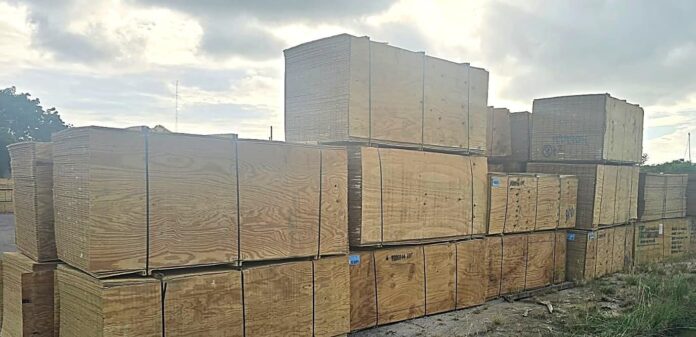

Largest-Ever HAPI Materials Shipment Arrives as Programme Moves to Five Builds at a Time
The Home Assistance Programme for the Indigent (HAPI) has received what officials describe as its largest single shipment of building materials to date, as the initiative prepares to scale up construction and increase the pace of housing interventions.
Eleven trucks of lumber and galvanized materials recently arrived to support the programme’s expansion. Prime Minister Gaston Browne described it as “the single largest amount of building material to be imported in the country at any given point,” adding that “this is just a start” and that additional purchases will continue annually.
Programme Coordinator Inspector Veldon Raggette said the increased supply comes as HAPI moves to accelerate output.
“111,” Raggette said when asked how many homes have been completed since the programme began. “And we have three in progress.”
He added that the team is preparing to expand operations. “We are stepping up… stepping up to five homes at a time.”
HAPI, which targets indigent and vulnerable households living in unsafe or dilapidated conditions, has evolved from a repair-focused initiative into one that also constructs entirely new homes where structures are beyond salvage.
Raggette said the programme is driven by need rather than a first-come basis.
“It goes by priority,” he explained. “The more children involved, the quicker HAPI gets activated.”
Applicants must go through the Social Protection Board, which conducts initial assessments before projects are placed on a priority list. Property ownership is required, or applicants must provide notarized permission from the landowner.
“Part of HAPI, you must own a home,” Raggette said. “If the land is not yours, you need a notarized letter from the owner giving you permission to rebuild or to repair.”
He identified termites and aging structures as the most common issues.
“Most of it is termites,” he said. “Most of those structures are very old.”
Construction is carried out primarily by inmates from His Majesty’s Prison, alongside volunteers — a partnership Raggette described as transformative.
“The programme is two second chances,” he said. “The prisoner gets a second chance because they’re learning a skill, and they’re giving the vulnerable families a second chance.”
He also framed the initiative as economic empowerment rather than simple housing support.
“It is a transfer of wealth,” Raggette said. “You leave from nothing and you have a brand new home value of $200,000… no liabilities.”
He said the homes are built to reinforced standards to ensure longevity and hurricane resilience.
“We build the strongest wooden house in Antigua and Barbuda,” he said, noting that structures are bolted, strapped and clipped throughout to withstand severe weather.
Beyond construction, HAPI works alongside the Social Protection Board to provide counseling and social support to beneficiaries.
“If you give them a brand new home and they don’t receive that counseling, it’s just a new building to be destroyed in two, three years,” Raggette said.
With needs identified in communities including Five Islands, Grays Farm and Villa, Raggette said the programme will continue expanding.
“HAPI is here to stay,” he said.
Families living in unsafe housing conditions are encouraged to apply through the Social Protection Board.