

Prime Minister Gaston Browne is urging Caribbean nations to deepen their economic ties with Latin America, arguing that stronger trade partnerships with countries to the south could help reduce food costs, diversify supply chains and strengthen the region’s economic resilience.
Speaking Sunday during his inaugural address as chairman of the Organisation of Eastern Caribbean States (OECS) Authority, Browne said the Caribbean has failed to take full advantage of opportunities within its wider hemisphere despite being surrounded by hundreds of millions of potential trading partners.
“We must develop a far more proactive strategy throughout our Latin American neighborhood,” Browne told regional leaders gathered in Antigua. “That includes, and I’ll add here, frankly speaking, fluency in Spanish.”
Browne said OECS countries, with a combined population of about 625,000 people, are part of a wider Caribbean community of roughly 17 million through CARICOM, but remain largely disconnected from the much larger Latin American market.
“Our region, for that matter, has 447 million Spanish-speaking neighbors, 40 times the size of all of CARICOM, with whom our commercial ties remain frustratingly thin,” he said.
The Prime Minister pointed to recommendations from the Economic Commission for Latin America and the Caribbean (ECLAC), which have long encouraged Caribbean nations to build stronger trade partnerships with Latin American economies and participate in regional value chains.
“We must develop a far more proactive strategy throughout our Latin American neighborhood,” Browne reiterated.
Central to that strategy, he argued, should be a stronger relationship with Panama.
“Panama demands our particular attention,” Browne said.
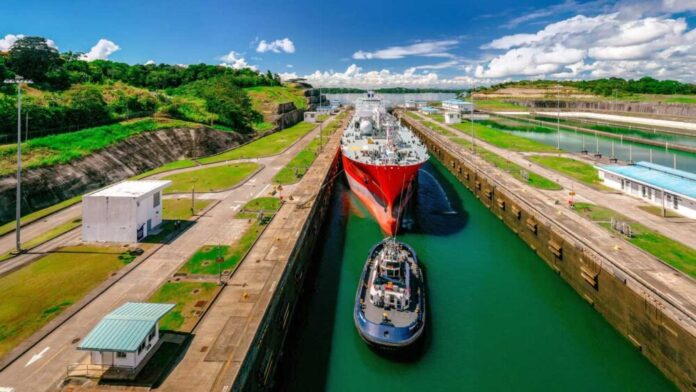
He noted that the Panama Canal handles more than US$33 billion in annual trade while the Colón Free Trade Zone remains the largest free trade zone in the Western Hemisphere.
“The Panama Canal handles more than US$33 billion yearly trade volume. The Colón Free Trade Zone is the largest free trade zone in the Western Hemisphere,” Browne said.
The Prime Minister linked the issue directly to the Caribbean’s food security challenges, noting that regional countries import between 80 and 90 percent of the food they consume.
“Central America offers proximity, agricultural complementarity and established food production chains,” he said.
Browne proposed a regional strategy that would use Panama as a logistics and distribution hub while expanding sourcing arrangements with Central American producers.
“An OECS strategy that builds sourcing partnerships with Central American producers, uses Panama as a transshipment point, and develops shared regional emergency stockpiles could fundamentally reduce our cost of living and transform our resilience,” he said.
The Prime Minister argued that the Caribbean remains overly dependent on a limited number of suppliers and markets, leaving the region vulnerable to external shocks and rising costs.
“If we are serious about reducing our over-dependence on a single dominant input market, then Panama is the natural gateway for alternative sourcing across Central America, South America and Asia-Pacific,” Browne said.
The call for stronger ties with Latin America formed part of a broader address in which Browne urged OECS member states to respond to shifting geopolitical realities by pursuing deeper regional integration, expanding trade networks and building greater economic self-reliance.
He warned that small island states remain vulnerable when acting alone but can strengthen their position through cooperation and strategic partnerships.
“In a fragmented world, OECS countries acting alone are exposed and vulnerable,” Browne said. “Acting together, we are a collective entity.”
Browne assumed the chairmanship of the OECS Authority from St. Vincent and the Grenadines Prime Minister Dr. Godwin Friday and is expected to serve in the role for the next 12 months.