

Antigua and Barbuda Records Lowest Urban Population in CARICOM, New Report Finds
How developed a CARICOM economy is says little about how urban it turns out to be
The share of CARICOM residents living in towns and cities varies more than the region’s shared image suggests.
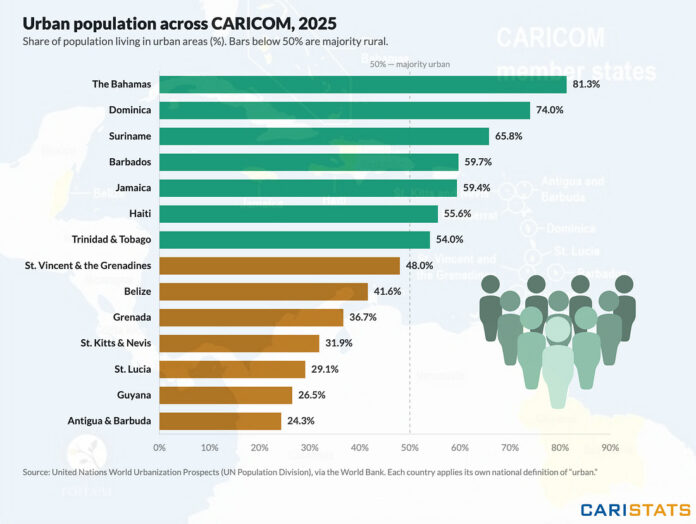
Across the 14 member states with data, urban population ranges from 24.3% in Antigua and Barbuda to 81.3% in The Bahamas. The spread does not track development.
Several small, high-income economies register as majority rural: Antigua and Barbuda, Saint Lucia (29.1%) and Saint Kitts and Nevis (31.9%) sit at the low end, alongside Guyana (26.5%). At the high end, The Bahamas (81.3%), Dominica (74.%) and Suriname (65.8%) hold populations concentrated in a single capital or coastal belt.
Much of the difference traces to definition rather than density.
Each country classifies “urban” by its own national criteria – settlement size, administrative status, or economic activity – so closely built housing on a compact island can still be counted as rural.
In much of the region, then, most people still live outside the areas their own governments count as urban.
Source : Urban population as a share of total, 2025 estimates, from the United Nations World Urbanization Prospects (UN Population Division), via the World Bank.
This article was originally published by Antigua News Room. Read the original article here: Antigua and Barbuda Records Lowest Urban Population in CARICOM.