
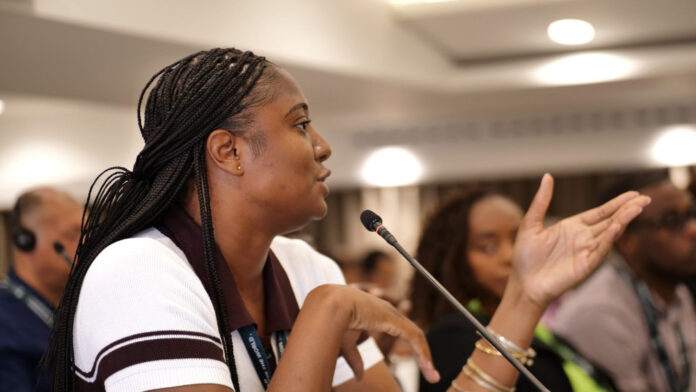

Stronger support for women in tourism transport was among the key priorities coming out of the International Transport Workers’ Federation (ITF) Tourism Services Section Conference, held in London from June 23–24. The conference was attended by Antigua and Barbuda Workers’ Union (ABWU) General Secretary David Massiah and ABWU Shop Steward Briann Russell.
Massiah, who also serves as Chair of the ITF Tourism Services Section, delivered opening remarks, warning that while significant investment continues to be made in tourism infrastructure, the workers who sustain the industry remain at a disadvantage.
“Too often, those same workers are the ones facing the greatest insecurity—informal work, low wages, unsustainable working conditions, and increasing pressure from changing business models,” Massiah said.
The protection and advancement of women in tourism transport emerged as a central theme throughout the conference, culminating in the launch of the ITF–UN Global Report on Women in Tourism Transportation.
The landmark publication, produced jointly by the ITF and UN Tourism, provides the first comprehensive global assessment of women’s participation in tourism transport employment. It examines four major passenger transport sectors: air, road, rail, and water, and highlights women’s contributions, the barriers they continue to face, and the opportunities across the industry.
The report identifies persistent gender gaps in recruitment, career progression, pay, and leadership, while offering practical recommendations to promote more inclusive, fair, and equitable employment throughout the sector.
_Massiah visits UN Tourism Office in Madrid, Spain_
An accompanying action plan outlines concrete measures for governments, trade unions, and the private sector to strengthen tourism’s role in advancing women’s empowerment. Among its recommendations are the enforcement of gender-responsive legislation, stronger corporate policies and social protection measures, comprehensive health and safety standards, and expanded access to education, training, career advancement, and leadership opportunities for women.
Beyond the focus on gender equality, delegates also identified several strategic priorities for the future of tourism transport. These included strengthening Environmental, Social and Governance (ESG) standards, expanding union membership and capacity building, promoting safe tourism destinations, and ensuring a just transition towards greater sustainability.
The conference also sought to deepen collaboration between trade unions and key tourism stakeholders through a dedicated Tourism Industry Event. Representatives from UN Tourism, the University of Surrey, the World Travel & Tourism Council, the World Sustainable Hospitality Alliance, and other leading organisations participated in discussions on the future of the industry.
Addressing industry leaders, Massiah called for stronger collaboration among all stakeholders to ensure a sustainable and inclusive tourism sector.
“The future of tourism cannot be shaped by any one group alone,” he said. “Governments set the framework. Industry drives investment and innovation. Workers deliver the service and the experience.”
He stressed that it is only through genuine partnership that tourism can become a powerful force for development, especially in regions like the Caribbean, where the industry remains central to economic and social progress.
This article was originally published by Antigua News Room. Read the original article here: ABWU Attends Global Tourism Services Conference as Support Grows for Women Workers.