
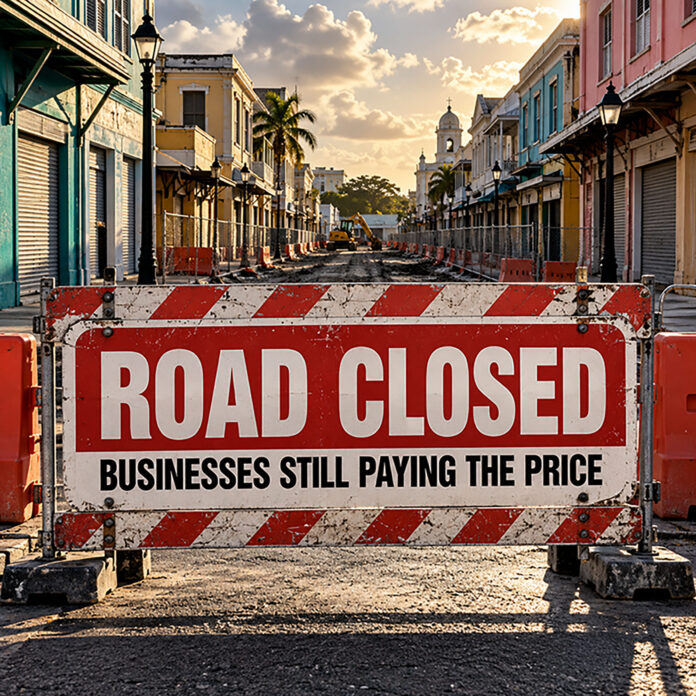

As work on the new Performing Arts Center approaches completion, or so we are told, nearby businesses are struggling and asking why their survival was not considered during the planning and renovation process. Some owners fear that the closure could continue until the Commonwealth Heads of Government Meeting (CHOGM) in November, resulting in almost six months of significant income loss.
Construction around the Ministry of Culture’s Performing Arts Center has disrupted Cross Street intermittently since the beginning of the year. For the past five months, the road has been completely closed. Access across Cross Street, High Street, St. Mary’s Street and Redcliffe Street has been severely restricted, bringing the usual flow of vehicles and pedestrians to a dead halt.
Businesses and street vendors in the area report losing as much as 80 to 90 percent of their gross revenue daily. For some, the closure has become a threat to their survival.
Robert Henry, an entrepreneur selling root drinks and medicinal tonics, once operated directly across from the Performing Arts Center. He was forced to relocate to Independence Drive to protect the income his business had built over the years. Now, even most of his regular customers cannot find him.
Businesses including Nunes Hardware, Mikela Adams Beauty Salon, Pretty Gami Nail Salon, Shereta’s Restaurant, GETCO, Bliss Cafe, Nene Candy’s Waffle House, the Zachariah supermarket on High Street and the car wash opposite Social Security on Long Street have all had to hold on through months of uncertainty.
A renewed performing arts center will be a welcome addition to St. John’s. Culture deserves a prominent place in our city, and we look forward to seeing how this new space will contribute to Antigua and Barbuda.
However, progress should not come at the expense of the people already working, investing, and building their lives in the surrounding community.
Cross Street is an important thoroughfare used by people walking between the East and West Bus Stations, government offices, shops, restaurants, and other services. When that movement was redirected, the customers who would normally stop to shop completely disappeared with it.
These are not simply storefronts. Behind them are parents with children in school and university, families to feed, employees to pay, mortgages and utility bills to meet, and elderly relatives and persons with disabilities who may depend on them.What is most difficult to understand is the complete absence of communication from those responsible for the project.
Business owners say they were not consulted before access was restricted. They were not given clear information about the duration of the work, nor were they presented with a plan for protecting their income.
Some owners contacted the Traffic Department, National Housing, and other agencies to find out how long the closure would last, only to discover that those offices were not provided with directives or answers either. They did not know what was happening. Eventually, the workers at the construction site became the only available source of information.
How does a major public project close a busy commercial thoroughfare for months without anyone first speaking to the people whose livelihoods depend on it and leave the workmen to answer our questions?
There was no coordinated discussion with the Small Business Association, no evidence of a serious assessment or analysis of the inevitable commercial losses, and no plan to reduce the financial burden. No temporary relief was offered for electricity, water, or other operating expenses. Businesses were simply expected to absorb the losses and make do.
That is not proper planning. It is transferring part of the cost of a public project onto private citizens who were given no voice in the process.
This does not mean that the renovation should not have happened. It means that a project of this size, especially one requiring the prolonged closure of a major street, should have included the people who would be directly affected.
A conversation before construction could have identified practical solutions: thoughtful rerouting of traffic, clear signs showing that businesses remained open, safe pedestrian routes, and temporary access points.
Not every loss could have been prevented, but the burden could certainly have been reduced.
We know how to prepare our city when visitors and dignitaries are coming. We clean, organize, improve, and present our best face. That same care should be extended to the people who already live and work here every day.
There is still an opportunity to learn from this experience. The next time a public project affects a business district, the Small Business Association, the minister responsible for the project, the parliamentary representative for the area, the relevant government agencies, and nearby business owners must be brought into the conversation early and develop an impact assessment.
Share the plans. Explain the timeline. Listen to the people whose livelihoods depend on access to those streets. Assess the financial impact. Then create a practical plan together.Those responsible also have an opportunity to act now and repair some of the harm. We are asking them to meet with affected business owners and advocate on their behalf with APUA, lending institutions, and other relevant organizations. Businesses have carried this burden alone for long enough. We await that call.
Progress is not simply reflected in what we build in the end. It is also how we treat people while we are building it. The people who live and work in this country must be considered part of the plan, not ignored and left to “just mek out” while only our visitors receive the royal treatment
This article was originally published by Antigua News Room. Read the original article here: Cross Street Could Have Used a Little Cross Talk.