
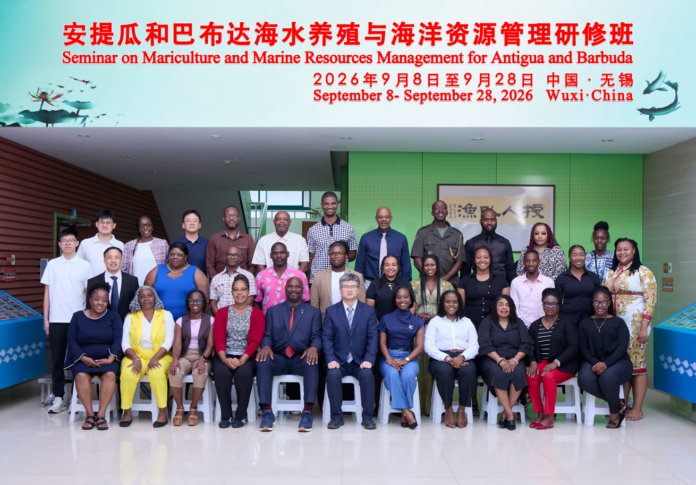

A 29-member delegation from Antigua and Barbuda recently completed the Seminar on Mariculture and Marine Resources Management for Antigua and Barbuda in the People’s Republic of China, participating in lectures, technical exchanges, laboratory and field visits.
Hosted by the Freshwater Fisheries Research Center (FFRC) of the Chinese Academy of Fishery Sciences, the programme brought together participants from the public and private sectors with experience spanning fisheries, aquaculture, hydroponics, aquaponics, seafood production and marine-resource management.
The delegation travelled through Wuxi, Qinhuangdao, Tangshan, Beijing and Shanghai, gaining exposure to China’s fisheries and aquaculture development.
The seminar covered fisheries governance, sustainable capture fisheries, marine-resource management, breeding and seed production, aquaponics, recirculating systems, industrial mariculture, processing, cold-chain logistics, food safety, ecological protection, research and international cooperation.
In Wuxi, classroom sessions were complemented by laboratory and field exposure. Participants examined aquaponics and the relationship among fish, plants, water quality, bacteria, system design and production management. A visit to an integrated fish-and-vegetable production facility demonstrated how controlled production systems can combine technology, environmental management and food production.
The programme later moved into field-based learning. In Qinhuangdao, participants were exposed to the marine seed industry and visited the Beidaihe Research Station. In Tangshan, visits included industrial mariculture operations as well as shrimp and flatfish production facilities.
These visits provided an opportunity to see first-hand the scale at which China has developed aquaculture and mariculture, while reinforcing an important lesson for small island states: technology must be adapted to local environmental, economic and technical conditions rather than simply copied.
In Beijing, the programme included a session on China’s achievements in fisheries science and technology and international cooperation. In Shanghai, the delegation engaged with the East China Sea Fisheries Research Institute, where lectures examined deep-sea aquaculture facilities and equipment and the development of China’s shellfish industry.
The final technical sessions in Wuxi focused on aquatic-product processing, cold-chain logistics and food safety. Participants were introduced to Hazard Analysis and Critical Control Point principles and the importance of identifying risks throughout the handling and processing chain.
This was relevant because increasing value from fisheries is not only about producing or catching more fish. Improvements in storage, processing, food safety, traceability and cold-chain management can reduce losses, improve quality and increase the value retained from what is already produced.
One of the wider lessons from the programme was that technology does not operate in isolation. China’s production systems are supported by research, trained personnel, infrastructure, institutions, markets and continuing technical development.
Another important lesson centred on project design. Before choosing equipment, infrastructure or technology, the starting point should be a clearly defined problem. The framework introduced during the programme was simple but powerful:
Problem → Development Objective → Appropriate Project.
For Antigua and Barbuda, this means first asking what problem needs to be solved. Is the priority increasing domestic food production, reducing imports, strengthening fisheries management, improving seafood quality, reducing post-harvest losses, developing aquaculture or improving resilience? Once the problem and objective are clear, the most appropriate intervention can be selected.
The seminar also gave the delegation an opportunity to reflect on the capacity that already exists at home.
Antigua and Barbuda is not starting from zero.
The country has practical experience in hydroponics and aquaponics, freshwater aquaculture, fisheries, seafood handling and export, system design and construction, marine-resource management and institutional food-production systems.
Future cooperation can therefore focus not only on introducing new technologies, but on strengthening existing producers and institutions, closing identified gaps, expanding specialised skills and testing new approaches under local conditions before they are scaled.
The programme also reinforced the importance of practical training. Classroom instruction provides essential knowledge, but hands-on experience within functioning production systems is equally important if participants are to develop the skills needed to operate, monitor and troubleshoot those systems at home.
The value of the seminar was not simply in seeing what China has achieved. China
This article was originally published by Antigua News Room. Read the original article here: 29-member Antigua and Barbuda delegation completes mariculture training in China.