
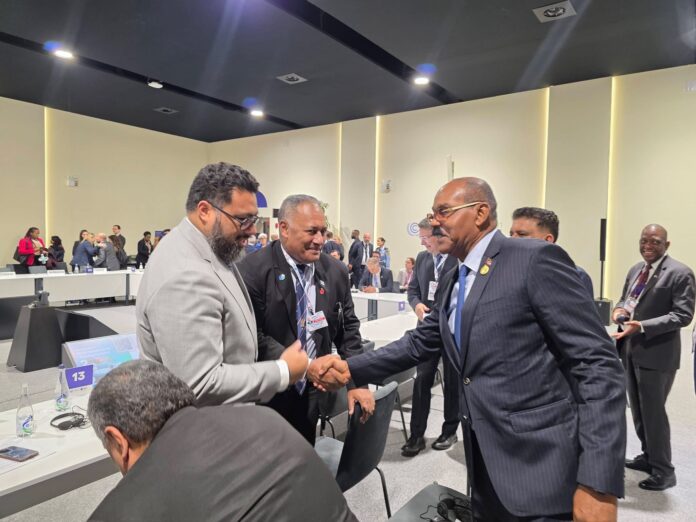

Antigua and Barbuda has called for increased international investment in early warning systems, scientific research and environmental monitoring to strengthen the resilience of Small Island Developing States (SIDS) against the growing threats posed by climate change.
The call was made by Prime Minister, Gaston Browne during his remarks at a high-level engagement on Early Warnings for All, where he underscored the importance of reliable forecasting, timely information and effective disaster preparedness in protecting lives, livelihoods and development gains.
The Prime Minister pointed to the devastating impact of Hurricanes Irma and Maria in 2017, which caused widespread destruction across the Caribbean, including the destruction of much of Barbuda and the evacuation of its entire population. He also referenced the catastrophic impact of Hurricane Melissa on Jamaica and neighbouring countries last year, noting that these experiences demonstrate the critical importance of early warning systems in reducing disaster risks.
With changing El Niño and La Niña conditions presenting additional challenges, Mr. Browne stressed that accurate forecasting and preparedness must remain a priority for vulnerable island nations.
Antigua and Barbuda, he said, strongly supports the United Nations Secretary-General’s commitment to achieving Early Warnings for All by 2027 and is taking concrete steps towards strengthening its national capacity.
The Prime Minister emphasised that effective early warning systems require more than forecasting equipment and communication networks. They depend on reliable data, continuous observation and systematic environmental monitoring.
He highlighted significant gaps in coastal and marine monitoring across SIDS, particularly the lack of sufficient long-term data on storm surges, sea-level rise and changing coastal conditions.
“We cannot adequately prepare for risks that we are not consistently measuring,” the Prime Minister stated, stressing that investments in early warning systems must also support sustained scientific research and environmental monitoring.
Mr. Browne identified regional and international institutions as important partners in addressing these gaps, specifically highlighting the University of the West Indies Centre of Excellence for Oceanography and the Blue Economy, as well as the SIDS Centre of Excellence and its Global Data Hub, established under the Antigua and Barbuda Agenda for SIDS.
He called for these institutions to receive the necessary investment, technology and sustained operational support to strengthen scientific data collection and regional monitoring capabilities.
The Prime Minister also urged international development partners to move beyond commitments and accelerate the delivery of climate financing to vulnerable countries.
He maintained that financing must be predictable, accessible and primarily grant-based, with resources reaching vulnerable countries before disasters occur. He further stressed that international support must extend beyond the 2027 target to ensure that early warning systems remain operational, effective and accessible to all communities.
Concluding his remarks, Mr. Browne said the success of the global initiative must be measured by its tangible impact on vulnerable populations.
“Our success must be measured not by the promises we make, but by the warnings that reach our communities, the lives we save and the livelihoods we preserve,” he stated.
Antigua and Barbuda reaffirmed its commitment to working with international partners to advance the Early Warnings for All initiative and strengthen the resilience of Small Island Developing States in the face of an increasingly challenging climate.
This article was originally published by Antigua News Room. Read the original article here: Antigua and Barbuda Calls for Greater Investment in Early Warning Systems for SIDS.