
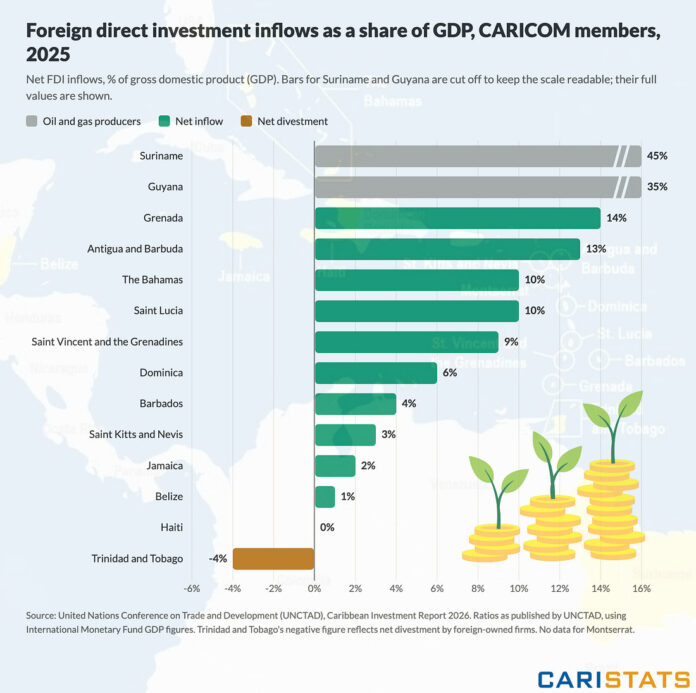

Foreign direct investment (FDI) is usually compared in dollar totals, which favour larger economies. Measured against economic size, a different group stands out. In 2025, FDI was equivalent to 14% of gross domestic product (GDP) in Grenada, 13% in Antigua and Barbuda, and 10% in The Bahamas and Saint Lucia. Grenada’s 14% came from inflows of US$207 million.
A smaller economy does not guarantee a higher share. Dominica and Saint Kitts and Nevis are both smaller than Grenada, yet their FDI was equivalent to 6% and 3% of GDP. The Bahamas, a far larger economy than Saint Lucia, recorded the same 10%. Suriname (45%) and Guyana (35%) sit apart, largely driven by oil and gas.
Year-to-year swings can be sharp. FDI in Belize fell from 5% of GDP in 2024 to 1% in 2025, and in Saint Kitts and Nevis from 6% to 3%, though both were coming off unusually strong years. Trinidad and Tobago recorded net divestment equivalent to 4% of GDP, as foreign-owned firms paid out more than they earned or made losses.
Where FDI is equivalent to around 10% of GDP or more, a rise or fall can ripple into construction, jobs and foreign currency.
Source: United Nations Conference on Trade and Development (UNCTAD), Caribbean Investment Report 2026.
FDI inflows as a share of GDP, 2025. Ratios as published by UNCTAD, using International Monetary Fund GDP figures.
This article was originally published by Antigua News Room. Read the original article here: Antigua and Barbuda Among Caribbean’s Top Countries for Foreign Investment in 2025.