
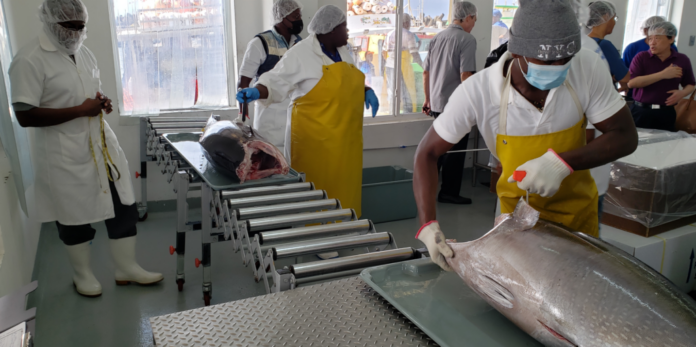

Safe tuna handling at a processing facility in Barbados, demonstrates the importance of best practices.
The Caribbean Community (CARICOM) Secretariat has released a set of new model legislation for the region to improve the safety of aquatic foods by further strengthening the Caribbean’s legislative framework. The regional instruments are the Model Aquatic Animal Health Bill and Model Aquatic Food Safety Regulations, which were approved by CARICOM’s Legal Affairs Committee (LAC) at its Forty-Third Meeting held on 28 August 2026.
The approved instruments were provided to officials from the Member States of the Caribbean Regional Fisheries Mechanism (CRFM): Anguilla, Antigua and Barbuda, The Bahamas, Barbados, Belize, Dominica, Grenada, Guyana, Haiti, Jamaica, Montserrat, St. Kitts and Nevis, St. Lucia, St. Vincent and the Grenadines, Suriname, Trinidad and Tobago, and The Turks and Caicos Islands, as well as other Caribbean jurisdictions to which the model legislation is applicable: Bermuda, The British Virgin Islands, The Cayman Islands, Curaçao, French Guiana, and Martinique.
The Inter-American Institute for Cooperation on Agriculture (IICA) had the privilege of implementing the 10th European Development Fund Sanitary and Phytosanitary (SPS) Measures Project in collaboration with the Caribbean Regional Fisheries Mechanism. Under this project, the Model Aquatic Animal Health Act and Model Aquatic Food Safety Regulations were drafted. The Office of the General Counsel of CARICOM provided expert support to finalize the documents for LAC approval.
CRFM Executive Director, Dr. Marc Williams, said, “Caribbean families should be able to buy and serve fish and other aquatic foods with confidence. These model instruments give governments a common foundation for turning that expectation into protections that work in each country. As Member States consider how to put the legislation into effect, they will need to involve the fishers, fish farmers, vendors, and processors who will apply its provisions every day. The CRFM stands ready to support national authorities in adapting the instruments and to help countries learn from one another as they implement them. The measure of our progress will be safer food for our communities and clear, workable rules for the people whose livelihoods depend on bringing it to market.”
In a statement issued this week, IICA said that the approval of these Model legal instruments by the LAC, for enactment by Member States, represents a significant milestone for the region, since these instruments strengthen the capacity of CARICOM Member States to meet international trade requirements and enhance aquatic animal health and food safety governance.
Dr. Jose Urdaz, Head of IICA’s Agricultural Health, Biosecurity, and Food Safety and Quality (AHFS) Program, noted that the approval of the legislation marks an important step toward improving countries’ ability to comply with international sanitary and phytosanitary standards and facilitate safe trade in aquatic animals and aquatic animal products.
Dr. Urdaz also congratulated the CRFM team for its dedication and commitment in advancing the legislation to this stage and expressed appreciation to the CARICOM Secretariat for its guidance and legal oversight throughout the process, culminating in the successful approval of the Model Bills.
The CARICOM Secretariat has also released the Explanatory Note for the Model Aquatic Animal Health Bill along with the Model Aquatic Animal Health Bill and Model Aquatic Food Safety Regulations.
This article was originally published by Antigua News Room. Read the original article here: Antigua and Barbuda receives CARICOM proposals to improve seafood safety.