
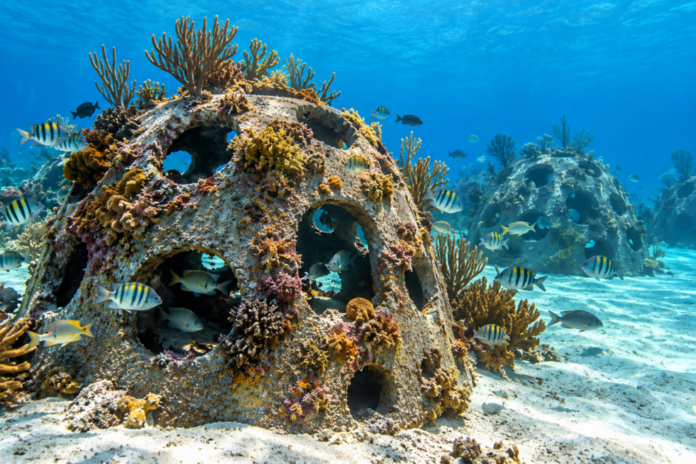

— The Antigua and Barbuda government plans to explore expanding its artificial reef programme to Fort James and Ffryes beaches, with Prime Minister Gaston Browne saying the marine habitats could eventually be monitored using artificial intelligence technology.
Browne disclosed the plans Saturday on the Browne and Browne Show while discussing the recently installed artificial reef system at Peace Beach.
The prime minister said the government wants to replicate the reef concept at other public beaches and intends to take the matter to Cabinet for consideration within the next couple of weeks.
“The government now will have to make some resources available,” Browne said. “There’s no reason, for example, why we can’t put one at Fort, one at Fry’s, especially in public beaches.”
He said Fort James and Ffryes are priorities because of their popularity.
“For the, maybe, next couple of weeks, we’ll put [it] on a Cabinet agenda, and I would like to see one at Fort James for sure and definitely Fry’s because those are two of the most popular beaches in the island,” Browne said.
Long Bay was also mentioned during the discussion, but Browne suggested an artificial reef may be less necessary there because the beach already has a natural reef system.
“Long Bay as well, too. But Long Bay has a natural reef system, so maybe Long Bay may not be necessarily critical,” he said.
Browne said Antigua’s Peace Beach reef follows an earlier artificial reef project in Barbuda.
“We have one in Barbuda already that was done by John Paul DeJoria,” he said. “So that was the first one, this one in Antigua, first one in Antigua, but the second one in our country.”
Reefs aimed at increasing marine life
The prime minister said the initiative is intended to go beyond creating an attraction for swimmers and snorkelers.
He described the artificial reefs as potential breeding grounds that could help increase marine life and, over time, contribute to Antigua and Barbuda’s food security by supporting fish stocks.
“It goes beyond entertainment and leisure,” Browne said. “It’s also part of enhancing our food security.”
Browne said the government would want to track changes in fishermen’s catches over the long term as marine populations develop around the artificial reefs.
“And it will be necessary for us to track the increase in the volume of the fishermen’s catch in, let’s say, 10 years, 20 years, 50 years,” he said.
During the programme, it was stressed that the reef itself should function as a breeding ground rather than a location where fishermen wait to catch fish congregating around the structures.
“Once the population increases, their catch will increase,” Browne said. “The reef is just a breeding ground.”
Artificial reefs can provide habitat and refuge for marine organisms and can create areas where adult fish aggregate to spawn when reefs are properly located, constructed and managed.
AI could track movement and spawning
Browne also outlined plans to incorporate technology into monitoring of the reef system.
He said artificial intelligence could be used to map marine creatures and study their behaviour, including migration and spawning.
“The reef system will be monitored by artificial intelligence,” Browne said.
He further claimed that SpaceX had agreed to make technology available for the initiative.
“In fact, SpaceX has already agreed to make available a system with the AI technology to help us to — and to map out some creatures and how they migrate, how they return, how they spawn,” Browne said.
No independent confirmation from SpaceX of such an arrangement was located in a search Saturday, so the claim is being attributed to the prime minister.
Browne said the monitoring could also create opportunities for people studying marine ecosystems.
“So it’s going to be quite interesting,” he said. “It will be the perfect environment for those who are studying marine life.”
Coral and underwater attractions
The government is also considering using the artificial reefs as both ecological habitats and underwater attractions.
Browne said coral could be planted on the structures and suggested underwater representations of prominent Antiguans and Barbudans could eventually be incorporated into the reef environment.
“We want to also have some underwater, what do you call them now, images of different, maybe our national heroes, for example,” Browne said.
He suggested the figures could be positioned underwater around a table, creating another attraction for people exploring the reef.
“That’s our attraction and also for the fish life,” Browne said, adding that “we’ll be planting corals in them.”
The proposed expansion follows the development of the artificial reef at Peace Beach, where Browne has said structures were placed offshore to provide habitat for marine life. The Peace Beach project forms part of a wider coastal development at Barnacle Point involving dredged material used to create additional beachfront.
The prime minister’s latest comments indicate the government now sees the Peace Beach initiative as a model that could be replicated at other heavily used public beaches.
The Fort James and Ffryes projects have not yet received the Cabinet consideration Browne referenced, and he did not provide estimated costs or a timetable for construction.
However, he said he intends to move the proposal to the Cabinet agenda within the coming weeks as the government considers expanding artificial reefs around Antigua and Barbuda for marine conservation, food security, research, recreation and tourism.
This article was originally published by Antigua News Room. Read the original article here: Antigua and Barbuda Plans Artificial Reefs at Fort James and Ffryes With AI Monitoring.