
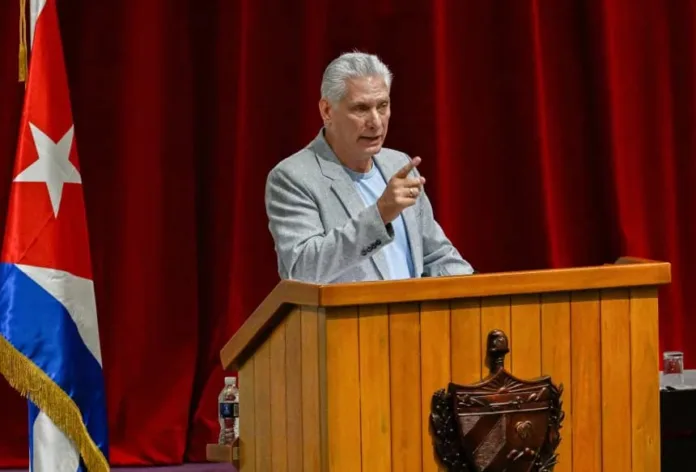

Cuba’s President Miguel Diaz-Canel delivers a speech in March. The president has warned that a US military assault on Cuba would cause a “bloodbath.” Adalberto Roque/Pool/AFP/Getty Images
Cuba has been the subject of an embargo for most of it’s post-revolutionary life but the recent, almost absolute ban on fuel and other imports by their near neighbour, the USA, is a new reality that appears to have not led to political change for a people, long used to deprivation, yet.
The Cuban leadership has tried to project Patria o Muerte, Homeland or Death, to the Americans, a sign prominently displayed for the benefit of Cuban soldiers trapped in the Angolan town of Cuito Cuanavale in 1988 before a later peace treaty. The Cubans then left Angola with their nearly 2,500 or more dead soldiers in refrigerated containers that had accumulated over the conflict. They were buried in multiple cemeteries in many provinces of that island to limit any potential outcry by family and friends. The veterans of that war have seen little or no compensation except a ventilador or fan bought before departure from meagre funds allowed by their government who received thousands for each soldier, every month, from the oil rich Angolan government.
Many Cubans received combat experience on their internationalist missions to Angola and elsewhere. Those aged soldiers are either unwilling, incapable, sick or dead today. That sacrifice generation no longer exists.
History may prove a useful guide to what can be expected if the Cuban military decide to defend their territory, or not.
A brief canvass of the February 1961 memorandum of February 1961 from the U.S. Joint Chiefs of Staff to the Secretary of Defense before the Bay of Pigs invasion debacle would reveal that proposed action as having a fair chance of ultimate success that could contribute to the overthrow of the Castro regime.
They were completely wrong but that was then and this is now.
The Grenada invasion by America in 1983 saw only 24 of the nearly 1,000 Cubans stationed there, killed. The recent commander of those forces, Colonel Pedro Tortolo, fled to the Soviet embassy with 42 others before being evacuated back to a hero’s welcome in Havana. This later turned sour on the easy loss of Grenada, before he and others were despatched to anonymity on the Angola front as mere soldiers, having failed to die to the last man. That inherited Soviet battlefield strategy has now been discarded on a field of social networks that promise a better life outside of war and death.
What do the United States and the Caribbean leadership assess the Cuban military and resistance to be, should there be an invasion?
The migrants, refugees, family members of those abroad, entitled Cubans and others with any available opportunity including sport figures, have fled the island post-revolution for almost a century. They want a future, better economic conditions and an openness to speak. The expatriate Cuban resistance in Florida are as strong today as they ever were, especially with local developments. Exile groups like Alpha 66 may no longer be active under previous administrations, but their roots remain strong.
The older Cubans wish every year on New Year’s Eve, next year in Havana.
The aged military Cuban leadership have been a good preventative during peace time against a restricted, unarmed population. The big question is whether younger Cuban troops will follow their gerontocracy into battle or turn on their generals and middle managers.
If the Cuban elite do not offer up a sacrificial lamb then the unwilling Colonel Tortolo may provide a better read for the Joint Chiefs of Staff.
The jaded slogan Patria o Muerte could become Patria con Plata or Homeland with Money.
No one is prepared to die for an unsuccessful, obsolete ideology also known as you pretend to lead and I will pretend to follow.
That is the Venezuelan paradigm.