
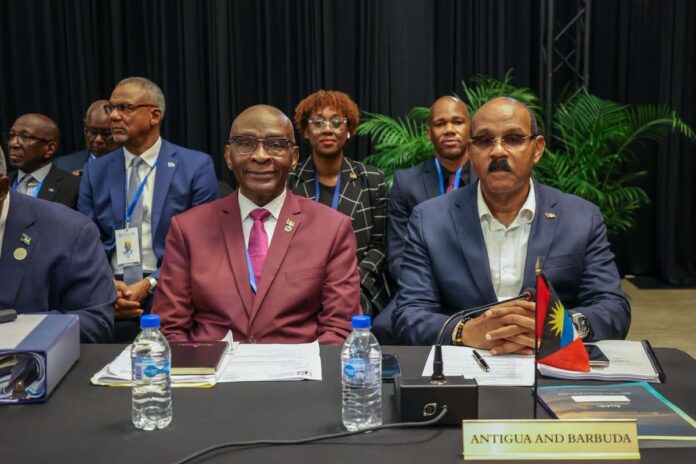

Heads of Government shared Wednesday (8 July) a range of national measures to ease the rising cost of living across the Region, driven up by geopolitical tensions and their impact on global prices. The approaches range from tax reduction on the cost of fuel imports; adjustments to the cost of freight; reducing the cost of intra-regional cargo trade; stabilising energy in the Region through the expanded use of renewable energy; and accelerating the introduction of a regional ferry service.
The issue was among those addressed at a media conference following the conclusion of the 51st Regular Meeting of the Conference of Heads of Government, which was held in Gros Islet, Saint Lucia, from 5 to 8 July under the theme ‘CARICOM: From Resilience to Renewal in a Changing World’.
In his opening statement to the media, Prime Minister Philip J. Pierre of Saint Lucia, Chairman of CARICOM, said the Meeting was anchored in a single concern – the everyday lives of the Region’s people.
“Our discussions over the past four days were guided by one central objective – ensuring that CARICOM delivers results that people can see and feel in their everyday lives,” he said. “During our deliberations, Heads of Government focused on the issues that matter most to the people of the Region. We agreed to strengthen regional cooperation to protect consumers, improve affordability, and explore additional measures that can provide relief to vulnerable households. We also agree to strengthen consumer protection and work together to address rising prices across the Community.”
Responding to a question about CARICOM’s response to the rising cost of living, Prime Minister Pierre said the burden was being felt across the Community and his colleagues who were with him for the media engagement would share their individual policy responses.
“Every island is suffering from an increase in the cost of living,” he said. “We decided to share the experience among ourselves. Several islands have taken certain measures to reduce the cost of living in their various islands. But there is one factor we have no control over, which is the price of fuel.”
In the case of Saint Lucia, he said the value-added tax has been removed from certain items.
The Honourable Mia Amor Mottley, Prime Minister of Barbados, highlighted measures being implemented in her country, including a cost-of-living allowance for all pensioners, and a 30 per cent increase in welfare rates. She said countries are also working to give consumers real-time access to prices, including through apps that allow shoppers to compare stores.
She also identified the introduction of the inter-island ferry as a major initiative to reduce the cost of moving cargo in the Region, pointing to Trinidad and Tobago’s experience operating ferries.
“We are now about to enter discussions, Prime Minister [Godwin] Friday from Saint Vincent and the Grenadines, Prime Minister [Kamla] Persad-Bissessar, and myself as lead on CSME (CARICOM Single Market and Economy), to see how best we can utilise one of the Trinidad vessels as a proof of concept while the private sector procures,” she said, adding the aim is to complete the regulatory work within the next three months, while private-sector arrangements to source vessels could take up to a year.
Prime Minister Mottley added that she had undertaken “the responsibility of working with colleagues to be able to get the treaty arrangements for mutual recognition of licenses, insurance, so that cargo vehicles can literally go on and come off where possible”. She said the proof of concept would also require an assessment of the infrastructure needed at ports, including where ramps can be used.
Mrs. Persad-Bissessar framed Trinidad and Tobago’s contribution around lowering the cost of healthcare for CARICOM citizens by offering access, at affordable prices, to its national prosthetic centre and its specialised children’s hospital, along with the provision of trained doctors to other Member States.
“We’re talking about cost of living. And in this respect, in the medical field, if we partner together, again, we can bring down the cost of living,” she said.
Outgoing Chair of the Conference, the Honourable Dr. Terrance Drew, Prime Minister of Saint Kitts and Nevis, addressed the “fundamental issue” of energy, calling for an acceleration in the use of renewable energy. He said stabilising the Region’s energy supply, by harnessing its wind, solar, geothermal and wave resources, is key to stabilising its economies.
Renewable energy, he underscored, “can really help, from our perspective, to transform the Caribbean, to transform the Region, and help us to get on a sustainable path of really managing the cost of living of all of our people here in the Region”.
This article was originally published by Antigua News Room. Read the original article here: CARICOM Heads of Government Taking Measures to Ease Rising Cost of Living.