

Eastern Caribbean Central Bank
Issued: 10 July 2026
OPENING
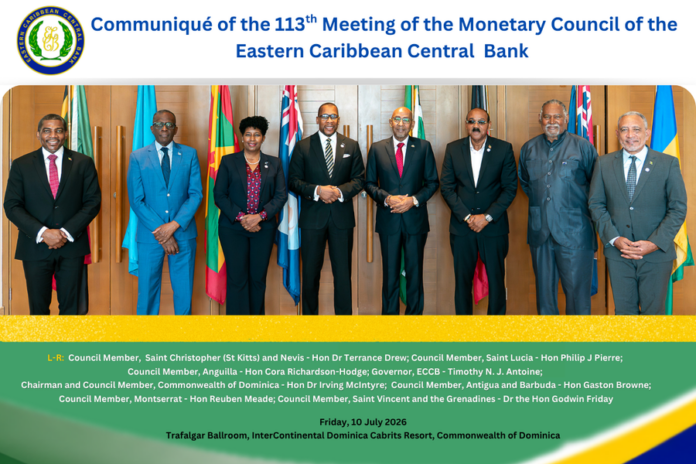
The Monetary Council of the Eastern Caribbean Central Bank (ECCB) convened its One Hundred and Thirteenth (113th) Meeting on 10 July 2026, at the InterContinental Dominica Cabrits Resort, under the chairmanship of the Honourable Dr Irving McIntyre, Minister for Finance, Commonwealth of Dominica.
Building on five decades of monetary stability, the Monetary Council reaffirmed its commitment to safeguarding the EC dollar while advancing policies that strengthen resilience, competitiveness and shared prosperity across the Eastern Caribbean Currency Union (ECCU).
1.0 A RELIABLE ANCHOR FOR STABILITY AND GROWTH
The Monetary Council met against a backdrop of heightened global uncertainty, as energy-related supply shocks continued to fuel inflationary pressures and moderate global growth. Despite these challenges, the ECCU’s financial system remains resilient, while the EC dollar continues to provide a strong and stable anchor for the economies of the ECCU. In this environment, the Council focused on safeguarding monetary and financial stability and supporting stronger and more resilient growth, in keeping with the ECCB’s Strategic Plan 2026-31 titled: The Big Push: Collective Action for Shared Prosperity in the ECCU.
The Council reaffirmed that sound policies and coordinated regional action are essential to cushioning external shocks and supporting growth across the ECCU. The meeting also coincided with the 50thanniversary of the EC dollar’s fixed exchange rate of EC$2.70 to US$1.00 —a milestone that underscores five decades of monetary stability, confidence and regional cooperation.
The Council acknowledged the vision and stewardship of successive Monetary Councils, Boards of Directors, Governors, Member Governments and the people of the Eastern Caribbean, whose collective commitment to prudent monetary and fiscal policies has sustained one of the world’s longest-standing and most successful fixed exchange rate arrangements.
2.0 A STRONG FOUNDATION FOR GROWTH AND RESILIENCE
The Council reviewed the Governor’s Report on Monetary, Credit and Financial Conditions in the Eastern Caribbean Currency Union titled: “From Stability to Resilience: The Next Chapter for the Eastern Caribbean Currency Union.”
The Council reaffirmed that the foundation of the ECCB’s monetary policy is the maintenance of the EC dollar’s fixed exchange rate against the United States dollar. This policy supports monetary stability and helps create the conditions for sustainable economic growth and rising living standards across the ECCU.
The strength of the EC dollar continues to be reflected in a reserve backing ratio of 97.6 per cent and foreign reserves of EC$5.9 billion.
Under the ECCB Agreement, the Bank is required to maintain external reserves equal to at least 60.0 per cent of currency in circulation and other demand liabilities. The current reserve backing ratio of 97.6 per cent significantly exceeds this statutory requirement, reinforcing confidence in the EC dollar and its fixed exchange rate.
The Council recognised that the stability of the EC dollar and the maintenance of its fixed exchange rate require more than strong reserve holdings. The credibility of the peg is underpinned by a broader policy framework that promotes competitiveness, fiscal and debt sustainability, and financial system stability. Together, these policies safeguard foreign reserves, preserve confidence in the EC dollar and support the long-term sustainability of the fixed exchange rate.
Accordingly, the Monetary Council agreed to:
• Maintain the Minimum Savings Rate at 2.0 per cent ; and
• Maintain the Discount Rate at 3.0 per cent (short-term) and 4.5 per cent (long-term).
The Council reaffirmed its unwavering commitment to preserving the fixed exchange rate, recognising it as the cornerstone of monetary stability, investor confidence and sustainable economic development across the Currency Union.
3.0 MANAGING RISKS TO GROWTH AND RESILIENCE
The Council observed that global uncertainty continues to weigh on the economic outlook. Volatility in oil prices, trade uncertainties and geopolitical conflicts pose significant risks to growth.
Consequently, the ECCU’s growth outlook is tilted to the downside, as external conditions could weaken tourism demand and slow economic growth.
The Council welcomed continued investments in strategic development projects and renewable energy to strengthen economic resilience and support sustainable development. It reaffirmed that energy resilience is central to accelerating economic expansion and underscored the need to expedite the operationalisation of the Caribbean Resilient Renewable Energy Infrastructure Investment Facility (RREIIF) within the Eastern Caribbean Partial Credit Guarantee Corporation (ECPCGC), as the region cannot afford further delays if it is to achieve greater energy security, lower electricity costs and stronger long-term competitiveness. The Council further agreed that the ECCU must accelerate both the pace and scale of collective action to advance The Big Push.
Recognising the strategic importance of food and nutrition security to The Big Push, the Monetary Council approved an additional grant of EC$25 million to support member governments’ ongoing efforts in this strategic priority area. This builds on the EC$25 million grant approved in February 2025 and underscores the Council’s continued commitment to advancing The Big Push by enhancing food and nutrition security, reducing import dependence, and strengthening the resilience of the Eastern Caribbean Currency Union.
4.0 FINANCIAL STABILITY
The Council noted that the ECCU banking sector continues to demonstrate resilience, supported by strong liquidity, higher capital adequacy and lower non-performing loans.
The Council received an update on the implementation of the ECCU Credit Bureau. To date, 25 of the 30 Licensed Financial Institutions (83.0 per cent) and 13 of the 49 Credit Unions (27.0 per cent) have been onboarded. The Council reaffirmed that full participation is essential to the Credit Bureau’s effectiveness and the provision of comprehensive, reliable credit information.
The Council also received an update on preparations for the establishment of the Office of Financial Conduct (OFC), which is scheduled to commence operations in September 2026. Stakeholder consultations with the Bankers’ Association and Licensed Financial Institutions are continuing ahead of the launch.
5.0 PAYMENT MODERNISATION AND FINANCIAL INCLUSION
The Council welcomed continued progress in advancing financial inclusion across the ECCU. It noted that the ECCU First Step Savings Account is expanding access to simple, affordable banking services for first-time account holders and other eligible individuals, with at least 17 Licensed Financial Institutions offering the account.
The Council also received updates on the CARICOM Payments and Settlement System (CAPSS) Pilot and the Fast Payment System, two flagship initiatives under The Big Push. CAPSS will facilitate instant cross-border payments in local currencies, reducing transaction costs and reliance on correspondent banking. The Fast Payment System will enable real-time, 24/7 electronic payments across the ECCU.
Together, these initiatives will strengthen regional financial integration, improve payment efficiency and enhance financial inclusion.
The Council also reaffirmed the importance of retail bond issuances in broadening access to investment opportunities for citizens and advancing the Strategic Priority of Financial Inclusion and Wealth Creation under The Big Push.
6.0 CITIZENSHIP BY INVESTMENT REFORM AND GOVERNANCE
The Monetary Council received an update on the establishment of the Eastern Caribbean Citizenship by Investment Regulatory Authority (ECCIRA) and noted that the Authority remains on track for launch in September 2026. The Council reaffirmed its commitment to the timely operationalisation of ECCIRA as a critical pillar of the region’s efforts to strengthen governance, transparency, integrity and regulatory oversight of Citizenship by Investment programmes. The Council further underscored the importance of continued constructive engagement with international partners to ensure that the region’s programmes continue to meet the highest international standards and sustain strong economic and diplomatic ties that are vital to the economies of the Eastern Caribbean Currency Union.
7.0 FISCAL AND DEBT SUSTAINABILITY
The Council also acknowledged the fiscal measures implemented by Member Governments to help cushion the impact of higher living costs on households and businesses. It noted that maintaining fiscal sustainability requires ECCU Governments to strengthen sustainable domestic revenue mobilisation while managing expenditure growth responsibly.
The Council further noted that where ECCU Governments have implemented measures to cushion vulnerable households from adverse price shocks, they should be targeted and fiscally sustainable. It emphasised that such measures should include a clear sunset clause so that they remain temporary and are subject to regular review.
8.0 GROWTH AND COMPETITIVENESS
The Council welcomed the continued strong performance of the tourism sector despite heightened global uncertainty. Total visitor arrivals increased by 9.0 per cent, from 2.3 million in the first quarter of 2025 to 2.5 million in the first quarter of 2026. Visitor spending also increased by 4.0 per cent from EC$2.7 billion to EC$2.8 billion over the same period, reflecting sustained demand for the ECCU as a destination.
The Council noted, however, that sub-optimal air connectivity arrangements and high transportation costs continue to constrain intraregional travel. It therefore welcomed continued discussions on the establishment of a regional airline, OECS Air, recognising that improved connectivity is essential for trade, tourism and labour mobility.
The Council reaffirmed that sustained prosperity will require stronger productivity, deeper regional integration, improved connectivity, affordable energy, greater private investment and continued policy coordination across the Currency Union.
9.0 DATE AND VENUE OF 114TH MEETING OF THE MONETARY COUNCIL
The Council agreed that the 114th Meeting of the Monetary Council will be held via videoconference from the Eastern Caribbean Central Bank (ECCB) Headquarters in Saint Christopher (St Kitts) and Nevis on Friday, 30 October 2026.
10.0 PARTICIPATION
The following Council Members participated in the meeting:
1. Honourable Dr Irving McIntyre, Minister for Finance, Commonwealth of Dominica (Chairman)
2. Honourable Cora Richardson-Hodge, Premier and Minister for Finance, Anguilla
3. Honourable Gaston Browne, Prime Minister and Minister for Finance, Antigua and Barbuda
4. Honourable Dennis Cornwall, Minister for Finance, Grenada (virtual participation)
5. Honourable Reuben Meade, Premier and Minister for Finance, Montserrat
6. Honourable Dr Terrance Drew, Prime Minister and Minister for Finance, Saint Christopher (St Kitts) and Nevis
7. Honourable Philip J Pierre, Prime Minister and Minister for Finance, Saint Lucia
8. Dr the Honourable Godwin Friday, Prime Minister and Minister for Finance, Saint Vincent and the Grenadines
Closing
The Council reaffirmed that the stability achieved over the past five decades provides a strong platform from which the ECCU can pursue faster, more inclusive and more resilient economic growth through collective regional action. It expressed confidence that, through sound policies, strong institutions and closer regional collaboration, the Currency Union is well positioned to navigate global uncertainty while advancing shared prosperity for the people of the Eastern Caribbean Currency Union.
About the Eastern Caribbean Central Bank
The Eastern Caribbean Central Bank (ECCB) was established in October 1983. The ECCB is the Monetary Authority for: Anguilla, Antigua and Barbuda, Commonwealth of Dominica, Grenada, Montserrat, Saint Christopher (St Kitts) and Nevis, Saint Lucia and Saint Vincent and the Grenadines.
Media Contact: Shermalon Kirby, Director, Corporate Relations Department
Phone: (869) 467-3943 | Mobile: (869) 662-8639
E-mail: info@eccb-centralbank.org | Website: https://www.eccb-centralbank.org/
This article was originally published by Antigua News Room. Read the original article here: Communiqué of the 113th Meeting of the Monetary Council.