
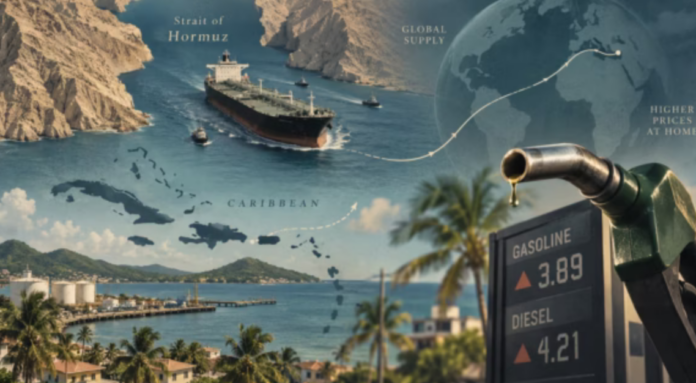

From the Strait of Hormuz to Caribbean fuel stations: an illustration of the connection between global supply disruptions and local gasoline and diesel costs. Displayed prices are illustrative.
BY- Dario Item
Dear Editor,
For motorists in Antigua and Barbuda, September’s fuel shock arrived as an extra EC$2 a gallon. The adjustment that took effect on 1 September raised gasoline from EC$14.50 to EC$16.50 and diesel from EC$14.25 to EC$16.25 — increases of roughly 14 per cent.
That was not, however, a measurement of what the Strait of Hormuz disruption alone had added to the price. It also reflected the government’s decision to reduce the support cushioning consumers from higher import costs.
The distinction goes to the centre of a question facing Caribbean households and businesses: how much of the fuel bill is genuinely being driven by a shipping passage thousands of miles away?
The evidence points to a substantial international supply shock, with particular pressure on diesel. It does not provide a single percentage that can credibly be applied to every island’s pump prices. Between an interrupted cargo and a motorist’s receipt lie separate markets, contracts and fiscal decisions.
Why Hormuz affects fuel bought outside the Gulf
In 2024, about 20 million barrels of petroleum liquids passed through Hormuz each day, equivalent to roughly one-fifth of global consumption, according to the US Energy Information Administration. Alternative pipelines can replace only part of that traffic.
“Closure” needs qualification: it does not mean that every vessel has stopped.
Reuters reported on 22 September that traffic remained far below pre-conflict levels. The International Energy Agency’s September report estimated that more than 10 million barrels a day of Gulf production remained shut in during August.
A Caribbean importer does not have to buy a cargo that passes through Hormuz to feel the effect. The EIA’s September analysis of fuel markets describes how tighter international gasoline supplies have increased both the cost of US imports and demand for US exports.
The implication is that buyers seeking replacement supplies compete with existing customers of Atlantic Basin refineries. A cargo can become more expensive because of that competition even though its own voyage avoids the Gulf.
This also explains why the share of oil passing through a chokepoint cannot be read as a percentage increase in fuel prices. The result depends on how much supply is actually lost, what can replace it, available stocks and the response of demand.
Why diesel is under greater pressure than gasoline
The distinction between crude oil and usable fuel is especially important in this crisis. A barrel of Brent is not a barrel of diesel delivered to an island’s storage terminal.
The IEA estimated that Gulf net exports of diesel and gasoil averaged just 390,000 barrels a day in August, slightly more than a quarter of their pre-war level. Disruptions to Russian refineries compounded the shortage — a reminder that the entire increase cannot be assigned to Hormuz.
In trading terms, the gap between wholesale fuel and crude is a crack spread. The EIA reported that, since May, the New York Harbor gasoline spread had averaged about US$1 per US gallon above its 2025 level. Distillate and jet-fuel spreads faced still greater pressure because disrupted refineries supplied relatively more of those products.
That is evidence of a finished-fuel squeeze, not an additional charge automatically imposed on a Caribbean customer. Nor is the spread all net profit: refining has operating costs. The EIA’s breakdown of gasoline prices distinguishes those costs and profits from distribution, retailing and taxes.
There is a local counterpart. In a 9 March interview with antigua.news, West Indies Oil Company chief executive Gregory Georges said a recent shipment had arrived at significantly higher cost, with the sharpest increases in diesel and jet fuel. His account supports the transmission mechanism, but does not substitute for the underlying invoices.
What an extra US$20 a barrel means at the pump
A useful calculation starts with the product the importer actually purchases, rather than assuming the petrol station buys crude.
A petroleum barrel contains 42 US gallons, or approximately 159 litres. If the landed cost of finished gasoline or diesel rises by US$20 a barrel, that adds about 12.6 US cents per litre. On 50 litres, the additional import cost is approximately US$6.29.
At US$10 or US$30 a barrel, the equivalent increases are about 6.3 or 18.9 US cents per litre. These are illustrative conversions, not estimates of the Hormuz premium. They describe full pass-through before percentage-based taxes, with no change in domestic margins or fuel support. Such taxes could amplify the retail increase; additional support could absorb part of it.
The accounting matters. A landed finished-fuel price already incorporates the supplier’s product price and the agreed delivery costs. Adding a separate crude increase on top would double-count part of the bill. Domestic storage, distribution, retail margins and net fiscal charges then complete the route to the pump.
The same discipline applies to shipping. An insurance surcharge quoted for a vessel entering the Gulf cannot simply be assigned to a different Caribbean voyage. Establishing that charge requires the actual route, contract and insurance terms, not a reference to the conflict alone.
Why the same shock produces different Caribbean prices
Antigua’s September increase illustrates the difference between the economic cost of fuel and the amount collected immediately from motorists.
Explaining the decision to scale back fuel support, Prime Minister Gaston Browne said the government had forgone approximately EC$24 million in revenue over six months. That is an attributed government figure, not an independently audited finding. Revenue not collected should also be distinguished from a cash subsidy paid out.
Where rising import costs are absorbed through lower tax receipts or other support, a stable pump price does not mean the shock has disappeared. Reversing part of that support can raise the retail price without a fresh increase in the latest wholesale quotation. It changes who pays, and when.
Saint Lucia provides a documented example of a different transmission timetable. Its 14 September pricing notice set both gasoline and diesel at EC$3.79 a litre, up from EC$3.68, for the period ending 4 October. The calculation reflected international price movements between 17 August and 6 September; subsidies continued to apply to diesel.
A pump price set using that reference window cannot be judged against today’s oil quote alone. Nor do identical retail prices for gasoline and diesel establish identical underlying costs. The pricing formula and remaining support matter.
Cross-island comparisons therefore need more than a photograph of a forecourt sign. Purchase dates, fuel specifications, taxes, subsidies and units must be aligned — including whether a quoted gallon is US or imperial.
The cost extends beyond motorists
Diesel is also a business input. Its use in freight transport, agricultural machinery and construction equipment, described in the EIA’s account of diesel consumption, creates a route from fuel costs to the prices of goods and services. That does not imply a one-for-one increase in the final selling price: fuel is only part of the cost.
Electricity is a separate channel, with its own fuel purchases and tariff rules. In an official statement on 26 August, the Antigua Public Utilities Authority reported that its monthly fuel bill had nearly doubled between January and July, attributing the pressure to international prices.
That is a spending figure, not a fuel-price index. Volumes consumed and the generation mix would be needed to establish how much of the increase came from higher unit prices, let alone from Hormuz specifically.
Tourism adds another exposure. As antigua.news previously examined, higher jet-fuel costs can put pressure on the air routes bringing visitors to the region. The aircraft fuel market is distinct from roadside diesel, but both face the wider disruption in refined products.
The IMF’s April assessment put net energy imports for tourism-dependent Caribbean economies at roughly 6 per cent of GDP on average. That is a group estimate, not an Antigua-specific number. Energy exporters such as Guyana and Trinidad and Tobago have a different external-account exposure, although higher energy and food costs can still affect their households.
What would establish the real Hormuz cost?
The remaining question is not whether the disruption matters. It is how to distinguish its contribution from other pressures and domestic pricing decisions.
There is already a local dispute over one component. In an April statement published by antigua.news, service-station operators sought a higher margin, citing longstanding operating-cost pressures, and requested publication of the fuel-price breakdown. Their statement is evidence of a demand for a change, not proof that an increase was approved or that existing margins were excessive.
A reconciliation would follow the appropriate wholesale gasoline or diesel benchmark, the contract’s pricing date, the actual purchase and delivery costs, inventory treatment, local margins, and taxes or support. Those records would explain the observed pump price. Isolating Hormuz would require an additional estimate of what the same fuel would have cost without that disruption, while accounting for other refinery outages and demand changes.
Duration also matters. The IEA recorded a 507 million-barrel decline in observed global oil stocks between February and August. Inventories have cushioned the supply loss, but drawing them down is not the same as restoring a continuing flow of fuel.
The public material reviewed for this article does not provide a cargo-by-cargo reconciliation for Antigua sufficient to assign a precise share of its pump-price increase to Hormuz. That limitation supports neither a claim that every cent is unavoidable nor a claim that the disruption is merely an excuse.
For Caribbean consumers, the most defensible conclusion is that Hormuz is creating real upward pressure on fuel costs, especially diesel. How much reaches a particular pump depends on the finished product bought, the terms on which it arrives and who absorbs the bill. The global shortage is documented. The local attribution still requires the accounts.
This article was originally published by Antigua News Room. Read the original article here: LETTER: How much is Hormuz really adding to Caribbean fuel prices?.