

A corporate income tax rate is the share of its profits a company pays to the government. It is one of the first figures investors compare when choosing where to set up.
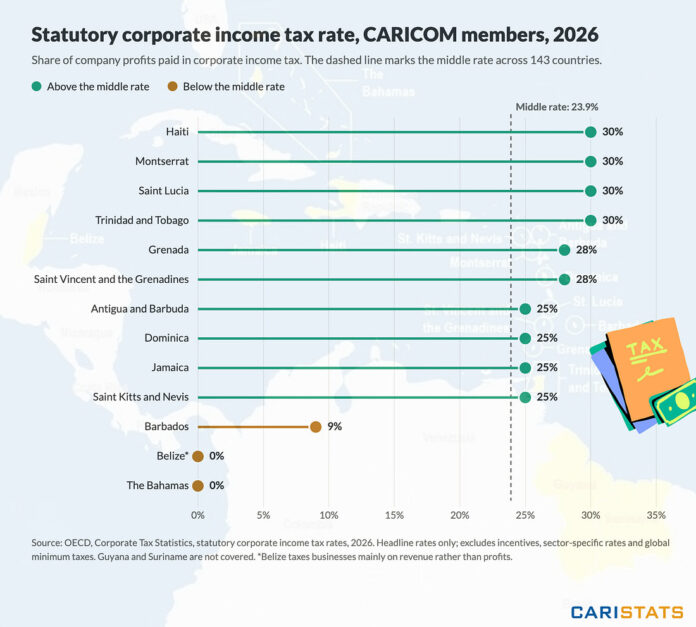
According to data from The Organisation for Economic Co-operation and Development (OECD) data for 2026, ten CARICOM members charge between 25% and 30% on company profits. Across 143 countries, the middle rate is 23.9%, so most CARICOM members tax profits more heavily than the typical country.
Three members charge far less. The Bahamas has no corporate income tax. Belize records none either, as it taxes businesses mainly on their revenue rather than their profits. Barbados charges 9%, after cutting its rate from 25% in 2019.
Under a new global minimum tax, the largest multinational companies are meant to pay at least 15% of their profits in tax wherever they operate. In 2024, Barbados raised its rate to 9% and introduced a 15% minimum for these companies. The Bahamas introduced its own 15% minimum from 2025. In both, most businesses still pay the low rates, while many large multinational companies now face a 15% minimum.
Source: OECD, Corporate Tax Statistics, statutory corporate income tax rates, 2026.
These are headline rates on profits and exclude incentives, sector-specific rates and global minimum taxes. Covers 13 CARICOM members; Guyana and Suriname are not included.
This article was originally published by Antigua News Room. Read the original article here: Most of CARICOM Taxes Company Profits at 25% or More.