
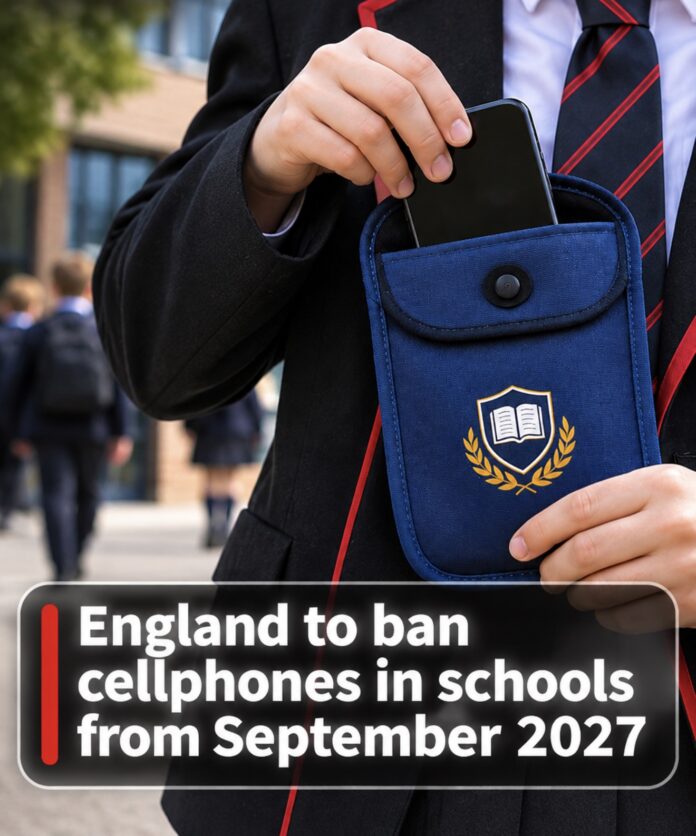

Pupils in England will be prohibited from accessing their mobile phones at any point during the school day under stricter government guidance scheduled to take effect in September 2027, according to the BBC.
The new measures will go beyond existing “no see, no hear” policies, which allow students to keep phones in their bags provided the devices are neither seen nor heard.
The government says the tougher restrictions are intended to reduce classroom distractions, improve academic performance and encourage greater face-to-face interaction among students.
Education Secretary Lucy Powell said the government’s message to parents and pupils was clear: “School is for learning and friendship, not scrolling.”
The changes build on statutory guidance introduced in June, which made schools and academy trusts legally responsible for maintaining phone-free environments throughout the school day.
Under the revised rules, individual schools will retain flexibility in deciding how to enforce the restrictions. Options include collecting phones at the beginning of the day, providing secure lockers or requiring students to place their devices in lockable pouches.
Some schools have already adopted such measures.
Karl Harrison, head teacher at Burnage Academy for Boys in Manchester, told BBC Breakfast that his school spent £20,000 installing metal detectors and introducing phone pouches to prevent students from accessing their devices.
He said the restrictions had encouraged students to socialise more, improved concentration during lessons and contributed to better academic results.
“People now can talk to each other, instead of scrolling on a device,” Harrison said.
However, education unions have warned that implementing the tougher restrictions could place significant financial pressure on schools.
Paul Whiteman, general secretary of the NAHT school leaders union, acknowledged that mobile phones could create safety concerns and disrupt learning but warned that stronger enforcement measures would come at a cost.
Pepe Di’Iasio, general secretary of the Association of School and College Leaders, said schools could not simply make mobile phones disappear.
He warned that requiring every school to provide lockable pouches or secure storage facilities for students would involve substantial expenditure.
“This is not feasible unless the government puts in the funding required to meet these costs,” he said.
Powell responded that school leaders would have the freedom to choose enforcement methods best suited to their institutions.
The proposed changes have received support from children’s advocates, including Dame Rachel de Souza, Children’s Commissioner for England, who welcomed stronger action to prevent phones from disrupting education.
Charlotte Ashton, co-founder of the campaign group Generation Focus, argued that existing restrictions were ineffective because some students continued using social media platforms, including TikTok, in school toilets.
The opposition Conservative Party also welcomed the move.
Shadow Education Secretary Laura Trott said she was pleased the Labour government had agreed to introduce stronger restrictions, although she questioned its wider approach to technology in classrooms.
The announcement comes as other parts of the United Kingdom consider their own approaches to mobile phone use in schools.
Scotland has proposed legislation restricting personal phone use in schools, while Wales has launched consultations on developing appropriate policies.
Because education policy is devolved across the United Kingdom, the new restrictions will apply specifically to schools in England.
Source: BBC
This article was originally published by Antigua News Room. Read the original article here: England to Ban Students From Using Cellphones During School Hours Starting September 2027.