

When a hurricane passes, the immediate danger may subside within hours, but for farmers who lose their crops, recovery can take months. Recognising that reality, Antigua and Barbuda has launched a new initiative designed to bring agricultural recovery closer to the people and communities that need it most.
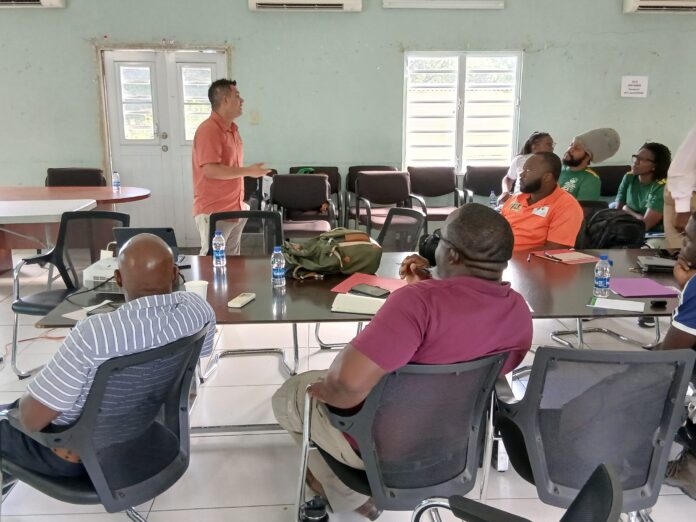
The Mobile Seed Bank and AGRI-FIRST Responders Initiative, launched Monday at the Department of Environment Conference Room, brings together seed preservation, agricultural technology and specialised emergency-response training in a coordinated approach to protecting the country’s productive capacity.
The programme is being advanced through collaboration involving the Ministry of Agriculture, the Inter-American Institute for Cooperation on Agriculture (IICA), CARDI, CCRAF SPC, CARICOM and other national and regional partners.
Addressing the launch, the Minister of State within the Ministry of Agriculture underscored that agricultural recovery extends well beyond the farm, affecting national food supplies, livelihoods and economic stability.
The Minister described the initiative as an important investment in the country’s ability to respond when extreme weather disrupts agricultural production, noting that while storms cannot always be prevented, the speed and effectiveness of recovery can be improved.
At the centre of the initiative is a mobile seed storage and distribution system designed to protect essential planting materials and make them available to farmers following disasters. Supported by protected seed reserves, agricultural drones and coordinated logistics, the system is intended to reduce delays in getting farmers back into production, particularly where damaged infrastructure makes access difficult.
Director of Agriculture, Mr. Gregory E. Bailey, described the concept as an integrated last-mile agricultural response system, addressing longstanding challenges associated with fragmented damage assessments and logistical bottlenecks.
“A farmer cannot plant a forecast,” Bailey observed, making the case for moving beyond early warnings towards practical recovery support.
The system will incorporate heavy-lift agricultural drones and LiDAR-enabled assessments to improve the identification and verification of agricultural losses. The technology is expected to support more precise assessments and help coordinate the delivery of resilient planting materials, including in communities where conventional road access may be compromised. Importantly, its application will not be limited to disaster response.
Bailey outlined the potential for year-round use across the agricultural sector, including precision pest and disease management, soil and water mapping, land preparation, livestock monitoring and expanded agricultural extension services. The mobile seed caravans are also envisaged as community-based hubs for farmer training, seed multiplication and outreach across agricultural districts.
The AGRI-FIRST Responders component complements this infrastructure by developing the personnel and procedures required to put it into operation. Specialised training, standard operating procedures, digital reporting and practical simulations will help establish a coordinated response capability involving agricultural officers and relevant emergency-management agencies.
The Minister captured the relationship between the two components clearly: “One initiative provides the tools. The other develops the people and systems needed to put those tools into action.”
The programme also has a regional outlook. Bailey confirmed that Antigua and Barbuda and Dominica are included in the proposed operationalisation of the Mobile Seed Bank system, creating opportunities to strengthen national response capabilities while contributing to a wider Caribbean approach.
The launch signals the beginning of a week-long programme of technical training and capacity building. Agricultural technicians will participate in drone training sessions through Thursday, November 19, when a disaster-response simulation at Bendals will demonstrate the practical application of the equipment and coordinated response procedures.
Activities will conclude on Friday, November 20, with the official handover of the Mobile Seed Bank to the Ministry of Agriculture, followed by First Aid and CPR training for participating technicians at Red Cross Headquarters.
In his remarks, Bailey acknowledged the contribution of IICA, CARDI, CCRAF SPC and CARICOM, emphasising that equipment and infrastructure must be matched by operational readiness, trained personnel and sustained institutional cooperation.
That principle will ultimately determine the initiative’s value. Its success will not simply be reflected in the technology deployed or the number of officers trained, but in whether farmers receive timely assistance, agricultural losses are assessed accurately and production can resume sooner.
For Antigua and Barbuda and its regional partners, the objective is straightforward: build a system that does more than anticipate agricultural emergencies – one that is equipped to respond, support recovery and keep food production moving.
This article was originally published by Antigua News Room. Read the original article here: Antigua and Barbuda Launches Mobile Seed Bank to Help Farmers Recover After Disasters.