
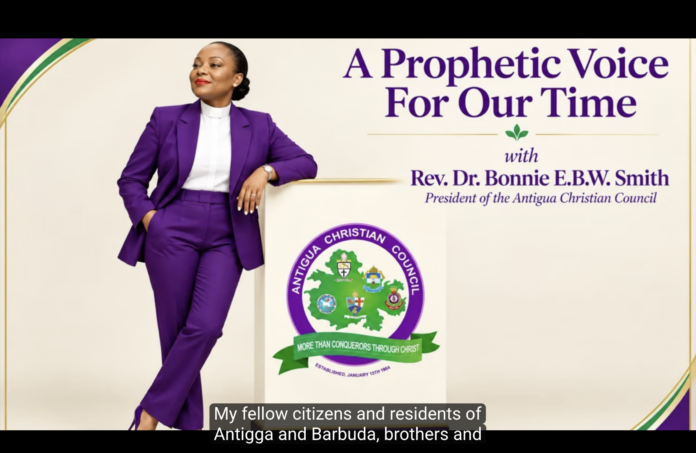

Rev. Dr. Bonnie E.B.W. Smith, President of the Antigua Christian Council
Christian Council backs call for greater family support in Antigua and Barbuda
The Antigua Christian Council has proposed a joint meeting with education officials, social agencies, churches, parents and young people to develop a practical plan to support struggling families and safeguard children in Antigua and Barbuda.
In a statement dated Nov. 17, the council welcomed Education Minister Daryll Matthew’s call for churches and service organizations to provide greater assistance to families facing difficult circumstances. It also cautioned against equating financial hardship with poor parenting or placing blame on struggling households.
The statement, signed by council President the Rev. Dr. Bonnie E.B.W. Smith, called for a coordinated response with clear responsibilities, resources, timelines and a process for reviewing progress.
“Families facing hardship deserve dignity, not suspicion,” the council said.
It said parents must be encouraged to meet their responsibilities, but accountability should come with accessible support rather than public humiliation.
The council described every young life lost to violence as a profound tragedy, saying families living in fear, parents struggling to guide their children and young people who feel abandoned all require attention.
“Behind the public discussion are people who need more than condemnation. They need protection, guidance, opportunity, accountability, and hope,” it said.
The council said practical assistance is central to the church’s spiritual mission, arguing that prayer and action should work together. It urged churches to examine whether their resources, buildings, programs and ministries adequately respond to community needs.
That assessment, it said, should include whether families most in need feel welcome and whether churches engage with young people consistently enough to build trust.
At the same time, the council called for mutual respect in the discussion. It said existing work by congregations and community organizations should be recognized, and warned against assuming that every church has the same funding, facilities or professional capacity.
The priority, it said, should be to identify services already available, recognize gaps and determine how organizations can work together more effectively.
To advance that effort, the council proposed a working meeting involving the Ministry of Education, the council, other faith communities, relevant social-service agencies, educators, service organizations, and representatives of parents and young people.
The proposed meeting would seek to establish an achievable plan, beginning with an assessment of existing assistance and the communities needing additional support.
The council also recommended clear referral arrangements so schools, churches and social agencies can connect families with appropriate help.
Other areas for consideration include coordinated mentoring, homework assistance, parenting support and safe after-school activities. Programs involving children, it said, must include appropriate safeguarding measures, training and professional oversight.
Participants should also agree on who will carry out each responsibility, what resources are available, when commitments should be fulfilled and how progress will be assessed.
“We should begin with commitments that we can sustain and evaluate, rather than promises whose scale exceeds our capacity,” the council said.
The statement emphasized that protecting children and supporting families are shared responsibilities, with distinct duties for churches, households, schools, government and the wider community.
Churches, it said, have a responsibility to nurture faith, character, belonging and compassionate service. Families are responsible for care, guidance and supervision, while schools need support to educate and safeguard students.
The government, the council said, must fulfill its responsibilities for education, social protection, security and access to appropriate professional services. Businesses and service organizations also have contributions to make.
“No institution should use the responsibilities of another as a reason to retreat from its own,” it said.
The council said it welcomed constructive discussions about what its member churches could contribute, while stressing that collective commitments must be developed through consultation and an honest assessment of their willingness and capacity to serve.
It also urged adults to ensure that young people hear more than concern about their behavior. They should experience a clear commitment to the value of their lives and investment in their futures, the statement said.
The council called for the discussion to lead to agreed action, coordinated services and sustained care for children.
“The measure of our response will not be the strength of our statements, but the consistency of our care,” it said.
This article was originally published by Antigua News Room. Read the original article here: Christian Council welcomes Matthew’s appeal, proposes coordinated response.