
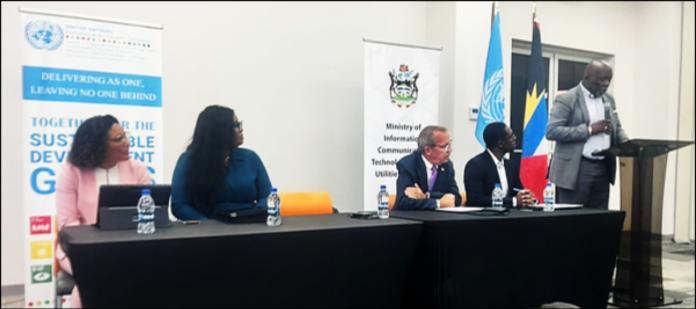

The Government of Antigua and Barbuda, in partnership with the United Nations Development System, has launched a new Digital Transformation Strategy and Webpage, setting out a roadmap for the country’s digital development through 2030.
The launch marks the culmination of work that began in 2022 and brings together the Government and UN partners, including the UN Resident Coordinator’s Office, UNESCO, UNDP, PAHO, ITU, UNICEF and UN Women.
Speaking at the hybrid launch, Minister of Information and Communication Technologies and Energy, Hon. Melford Nicholas, formally committed to implementing the strategy by 2030, while expressing “profound appreciation to the UN Development System for their strong partnership over the last five years.”
The strategy includes a three-phase implementation roadmap centred on 10 priority projects, intended to support Antigua and Barbuda’s drive to become a more digitally modern and resilient state.
Digital transformation requires everyone
Delivering the welcome address, Andrea Andrew, Country Coordinator for Antigua and Barbuda, underscored that achieving the country’s digital ambitions will depend on more than government action.
“Digital transformation is not solely the responsibility of government. It requires partnership across sectors, including the private sector, academia, civil society, development partners, and citizens themselves,” she said.
This partnership approach was reinforced by Simon Springett, UN Resident Coordinator for Barbados and the Eastern Caribbean, who said UN agencies have worked alongside the Government and national stakeholders to position digital transformation as an important enabler of sustainable development.
“Today’s launch is not the end of a process; in many ways it is the beginning,” Mr. Springett maintained.
To this end, he committed to the UN Development System’s continued support during implementation, including technical assistance, partnership-building and access to international networks, innovation and expertise.
Improving public access to information
The launch also introduced Antigua and Barbuda’s Digital Transformation Webpage, with remarks by Eric Falt, Regional Director of the UNESCO Regional Office for the Caribbean.
Mr. Falt highlighted the connection between digital transformation, access to information and public participation.
“When people can find clear, timely and reliable information about government services and decisions, they are better equipped to exercise their rights and engage with public institutions,” he said.
He added that the webpage could help advance those objectives while supporting the principles underpinning Antigua and Barbuda’s Freedom of Information Act.
The webpage includes accessibility features, and a video navigation guide was presented during the launch to help users explore the platform.
From strategy to implementation
Isoke Perry, National Digital Transformation Focal Point and Director of E-Government, welcomed the strategy’s implementation focus.
“We welcome the 3-Phase Implementation Roadmap that focuses on the 10 Priority Projects that will guide our twin island nation to being digitally modern and resilient,” Ms. Perry said, while also launching the Antigua and Barbuda Digital Transformation Journey, a timeline charting the country’s digital transformation milestones. The initiative was led by UNESCO in collaboration with the Ministry of ICTs and Energy and the UN Resident Coordinator’s Office.
Mr. Don Charles presented the Digital Transformation Strategy and its 10-project implementation plan through 2030. His presentation was followed by perspectives from youth, the private sector, persons with vulnerabilities and civil society, bringing different stakeholder voices into the discussion on how digital transformation should move forward.
The launch also looked ahead to the partnerships needed during implementation. Ms. Jordanna Straker, Caribbean Subregional Coordinator for UN Volunteers, outlined UN Volunteers’ digital transformation agenda and areas in which the organization could support the Government.
Ms. Arita Phillip, Associate Programme Specialist for Communication and Information at UNESCO, led a review of the Strategy and Webpage, while Kenroy Roach of the UN Resident Coordinator’s Office for Barbados and the Eastern Caribbean delivered closing remarks.
The launch included national, United Nations and intergovernmental participation, both online and in person.
With the Strategy, 10 priority projects, implementation roadmap and public-facing webpage now launched, attention turns to translating Antigua and Barbuda’s digital ambitions into action through 2030.
This article was originally published by Antigua News Room. Read the original article here: Antigua and Barbuda Unveils Plan to Improve Government Services and Access to Information Online by 2030.