
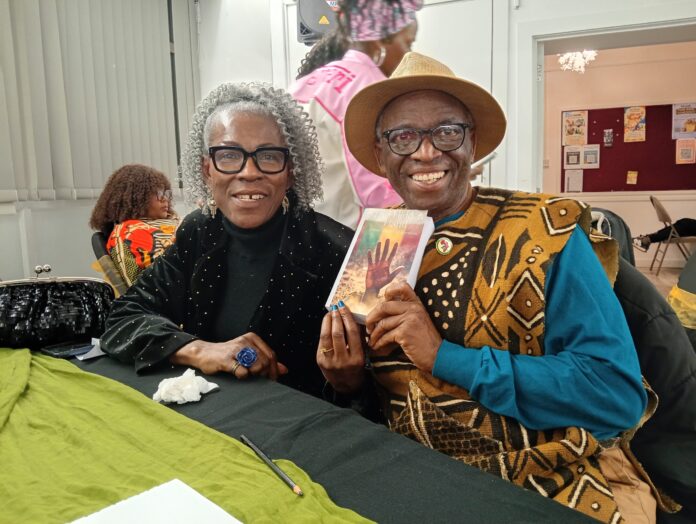

Two Antiguans (Ms Sharon Wallock-Lewis and William Henry) attended the Barawak charity organisation to celebrate Black History Month.
Additionally, the organisation promoted William Henry new book: The Hidden Hand: Africa’s Second Liberation.
Black History Month is more than a date on the calendar.
It is an opportunity to remember, to question, to celebrate and, perhaps most importantly, to keep the conversation about Black history, identity and liberation alive.
That spirit was very much present at a recent Black History celebration hosted by Barawak Charity, where Antigua’s established writer William Henry was welcomed as a special guest.
For Henry, whose writing frequently explores African history, Caribbean identity, colonialism and the enduring journey towards self-determination, the occasion provided an ideal platform to engage with an audience passionate about Black history and the continuing struggle for African sovereignty.
Henry also used the celebration to introduce readers to his latest book, The Hidden Hand: Africa’s Second Liberation—a thought-provoking work that turns its attention to the dramatic developments taking place in Burkina Faso and the wider question of Africa’s unfinished liberation.
The book challenges readers to look beyond the headlines.
At its heart is a question that remains deeply relevant: What does genuine independence mean when political sovereignty does not necessarily translate into economic, military or cultural independence?
Through The Hidden Hand, Henry examines the emergence of Burkina Faso as a powerful symbol of resistance and renewed African self-determination.
The country, under the leadership of Captain Ibrahim Traoré, has attracted international attention for its increasingly assertive approach to sovereignty, foreign influence and control over its own resources.
But Henry’s message goes beyond one leader or one country.
He encourages readers to consider Burkina Faso within the much larger historical story of Africa—a continent whose political independence was often achieved without the complete dismantling of the structures created during colonial rule.
That perspective gave particular resonance to the Black History celebration.
The event brought together people from African and Caribbean backgrounds, creating a space where history was not simply something to be remembered, but something to be discussed, challenged and interpreted through contemporary eyes.
For Henry, the connection between Africa and the Caribbean is especially personal.
Born in Antigua, he has spent more than five decades in Britain while maintaining a strong connection to his Antiguan roots. His writing reflects the experiences of a Caribbean man navigating the complex relationships among Africa, the Caribbean, and Britain.
His latest work continues that tradition, asking readers to look beyond conventional narratives and consider whose interests have shaped the telling of African history—and whose voices have too often been absent.
The atmosphere at the celebration reflected the importance of that conversation.
Henry was able to meet members of the community, discuss his work and promote The Hidden Hand, while reminding those present that Black history does not end with emancipation, independence or the lowering of a colonial flag.
The struggle for dignity, sovereignty and self-determination continues.
That is one of the central messages running through The Hidden Hand: Africa’s Second Liberation.
For those attending the celebration, Henry’s presence was therefore more than an opportunity to meet an Antiguan author.
It was an opportunity to engage with a writer who uses his voice to connect the historical experiences of Africa and the Caribbean with today’s political realities.
And perhaps that is precisely what Black History Month should encourage us to do: not simply look backwards at where we have come from, but look forward and ask where we are going.
William Henry’s The Hidden Hand invites readers to do exactly that.
This article was originally published by Antigua News Room. Read the original article here: Antiguans celebrating Black History Month at the Barawak Charity.