
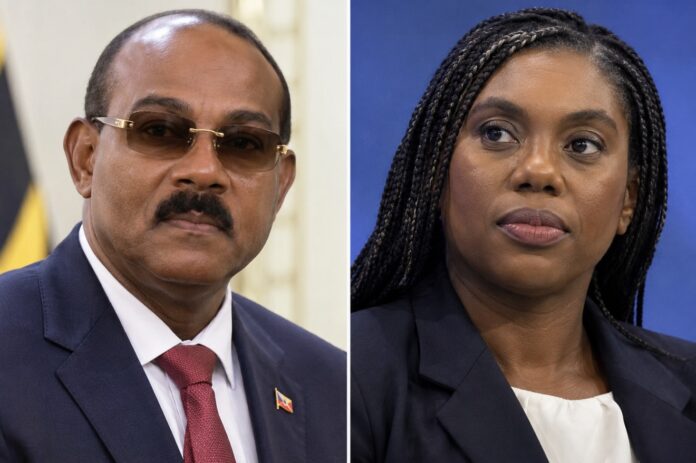

Prime Minister Gaston Browne has sharply criticized British opposition leader Kemi Badenoch over her rejection of slavery reparations and a formal apology from Britain, questioning her judgment and suggesting that her position helps explain why she is not the country’s prime minister.
Browne’s remarks, made during an interview with ITV News in St. John’s on Sunday, have attracted attention in the British media, including coverage by HuffPost UK, as Antigua and Barbuda hosts the 2026 Commonwealth Heads of Government Meeting (CHOGM).
The exchange follows Badenoch’s criticism of proposals for Britain to formally apologize for its role in the transatlantic slave trade, with the Conservative Party leader arguing that such an apology could open the door to demands for financial compensation from Caribbean nations.
Asked about Badenoch’s position, Browne responded: “Well, I think she’s misguided. And no wonder she is the leader of the opposition and not the Prime Minister. Right?”
When pressed on whether Badenoch should reconsider her stance, Browne said that was a matter for her but made clear that Antigua and Barbuda did not agree with her position.
“Well, that’s up to her. But we do not share her sentiments,” he told ITV News.
Badenoch had criticized British Prime Minister Andy Burnham’s willingness to consider a formal apology for Britain’s involvement in the slave trade, arguing that the Commonwealth should concentrate on future cooperation rather than historical grievances.
Speaking to Sky News, she expressed concern that the Commonwealth summit in Antigua and Barbuda could become another occasion for Caribbean countries to seek financial compensation from Britain.
She argued that Britain should not pay compensation for slavery and warned that a formal apology could be used to support demands for money.
Badenoch also described the debate over an apology as a distraction from the Commonwealth’s future, maintaining that Britain’s role in abolishing the slave trade should form part of any discussion about its historical involvement.
Her comments drew a forceful response from Browne, who has consistently advocated reparatory justice for Caribbean countries affected by slavery and colonial exploitation.
The Antigua and Barbuda leader argued that Britain’s acknowledgment of historical wrongdoing must extend beyond expressions of regret to include meaningful compensation.
Browne acknowledged the political difficulties Burnham could face in securing support for reparations within Britain but insisted that those challenges did not diminish the legitimacy of the Caribbean’s demands.
“I understand the politics in the UK, in which it may be a difficult proposition for him to agree to any form of reparations, but that does not negate the need for reparations,” Browne said.
He emphasized that Caribbean governments were not seeking payments beyond Britain’s financial capacity and suggested that resources could be allocated through the country’s overseas development budget.
Browne also linked reparations to the broader principle of accountability, arguing that governments must recognize the consequences of historical atrocities to discourage similar abuses in the future.
“If there is no compensation, there’s likely to be a repeat of those atrocities sometime in the future. And you can see what is happening globally already,” he said.
The prime minister maintained that financial accountability could serve as a deterrent by demonstrating that the consequences of serious human rights abuses can extend across generations.
The dispute comes amid a significant shift in the British government’s approach to discussing its involvement in the transatlantic slave trade.
Burnham has indicated that his government is prepared to engage Commonwealth countries in structured discussions about a possible formal apology, moving beyond the position taken by previous British administrations.
However, he has ruled out direct financial reparations, arguing that present-day British citizens should not be held financially responsible for historical actions in which they had no personal involvement.
Instead, Burnham has proposed international cooperation to restructure debt owed by poorer Commonwealth countries, allowing them to repay loans over longer periods and at more favorable interest rates.
His proposal includes involving former British Prime Minister Gordon Brown in efforts to develop the debt restructuring initiative.
The distinction between an apology and financial compensation has emerged as a central point of disagreement between Britain and Caribbean governments ahead of the Commonwealth summit.
The Caribbean Community, or CARICOM, has cautiously welcomed Britain’s willingness to discuss an apology but maintains that acknowledgment of historical wrongdoing cannot be separated from efforts to address its lasting consequences.
Saint Lucia Prime Minister Philip J. Pierre, who chairs CARICOM, welcomed Burnham’s offer of structured dialogue while emphasizing that reparations must remain part of those discussions.
Pierre argued that negotiations would be incomplete if Britain excluded reparations before talks had begun.
CARICOM’s reparations agenda extends beyond direct financial compensation to include investment in education and public health, support for Indigenous communities, debt cancellation, cultural initiatives and measures addressing the continuing effects of slavery and colonialism.
Caribbean leaders have also maintained that debt relief, while potentially beneficial to developing countries, should not be treated as a substitute for reparatory justice.
The regional position reflects longstanding demands that former colonial powers acknowledge the economic and social consequences of slavery, which helped generate substantial wealth in Europe while leaving lasting inequalities across Caribbean societies.
Browne’s comments came shortly after he attended a Sunday church service alongside King Charles III and Queen Camilla during their visit to Antigua and Barbuda for CHOGM and the country’s 45th anniversary of independence.
The visit has placed renewed international attention on the historical relationship between Britain and its former Caribbean colonies, particularly as Commonwealth leaders prepare to discuss slavery, reparations and the future of the organization.
King Charles, who remains Antigua and Barbuda’s head of state, is expected to address the legacy of slavery during his speech to Commonwealth leaders on Tuesday.
Buckingham Palace has indicated that the monarch will confront the painful history of the transatlantic slave trade with sincerity and acknowledgment of its continuing consequences, although he is not expected to announce a formal apology or financial reparations.
The issue has become one of the most closely watched subjects surrounding the summit, with Caribbean governments seeking meaningful engagement from Britain and other European countries that benefited from slavery.
During the same ITV News interview, Browne also reiterated his personal support for Antigua and Barbuda becoming a republic, while emphasizing that the decision ultimately rests with the country’s citizens.
He said he respects King Charles and recognizes his constitutional position as head of state, notwithstanding his own preference for an Antiguan to occupy that role.
Browne acknowledged that constitutional procedures would have to be followed before any transition to republican status could occur, including securing the necessary public support.
He emphasized that, until such a change is approved, King Charles would continue to receive the respect and courtesies associated with his position as the country’s monarch.
The comments underscored Browne’s distinction between maintaining respectful relations with the British monarchy and advocating constitutional change and reparatory justice.
Britain’s historical involvement in the transatlantic slave trade remains central to the debate. British traders transported more than 3 million enslaved Africans across the Atlantic, with many forced to work on plantations throughout the Caribbean and the Americas.
Although Britain abolished its slave trade in 1807 and slavery across most of its empire in 1833, Caribbean governments have argued that the economic and social consequences of that system remain evident generations later.
For Antigua and Barbuda, which gained independence from Britain on Nov. 1, 1981, the issue carries particular significance as the country marks 45 years of independence while hosting leaders from across the Commonwealth.
Browne’s public confrontation with Badenoch highlights the continuing divide between Caribbean governments seeking reparatory justice and British political figures who oppose financial compensation for slavery.
It also places Antigua and Barbuda at the center of an international debate over whether acknowledgment of historical wrongdoing should be accompanied by concrete measures to address its consequences.
With Commonwealth leaders gathering in St. John’s, the disagreement is likely to remain a prominent issue during discussions on the organization’s future and its relationship with countries shaped by Britain’s colonial past.
Sources: ITV News, Nov. 1, 2026; The Guardian, Nov. 1, 2026; The Associated Press, Nov. 1-2, 2026; Press Association reporting. Quotes attributed to the original interviews.
This article was originally published by Antigua News Room. Read the original article here: PM Browne Rebukes UK Conservative Leader Over Opposition to Slavery Reparations.