
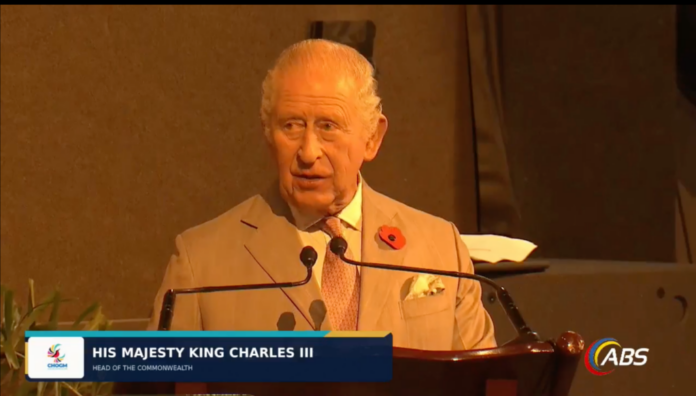

King Charles III expressed profound personal sorrow over the transatlantic slave trade during his address to Commonwealth leaders in Antigua and Barbuda on Tuesday but stopped short of issuing a formal apology or committing to financial reparations for slavery.
Speaking at the opening ceremony of the 28th Commonwealth Heads of Government Meeting (CHOGM) at the National Performing Arts Centre in St. John’s, the British monarch acknowledged the lasting consequences of slavery across the Caribbean and other Commonwealth countries.
“The transatlantic trade in enslaved persons still casts a shadow over these islands and other members of our Commonwealth,” Charles told the gathering of heads of government and other dignitaries.
“As I have said before, that shameful chapter of history is one that fills my heart with horror and my soul with the most profound personal sorrow.”
His remarks came amid renewed pressure from Caribbean governments and reparations advocates for Britain and other former colonial powers to formally acknowledge their responsibility for slavery and address its continuing economic and social consequences.
Although Charles used strong language to condemn the slave trade, he did not explicitly apologize on behalf of the British monarchy or government, nor did he announce support for financial compensation.
Instead, the King emphasized the importance of learning from history and pursuing practical measures to address historical injustices.
“History is not ours to choose or to change,” he said, explaining that the Commonwealth had inherited both the achievements and failures of previous generations.
“We cannot change the actions of those who came before us. We can, however, learn from the past.”
Charles also referred to the role of the Royal Navy in efforts to end the international slave trade, describing the abolition movement as evidence that courage and determination could overcome injustice.
He said his growing understanding of the historical issues had strengthened his commitment to finding ways for Commonwealth countries to address past wrongs through modern partnerships.
“The more I have furthered my own understanding of the issues, the more committed I have become to finding ways for us to work in modern partnership to address the wrongs of the past with action for the future,” he said.
He identified improved access to education, investment in employment opportunities, expanded trade among Commonwealth countries and stronger climate resilience as areas where such cooperation could produce tangible benefits.
The distinction between expressing sorrow and issuing a formal apology is particularly significant as Commonwealth leaders consider how to advance discussions on reparatory justice.
A formal apology would represent an explicit acknowledgment of wrongdoing, while financial reparations would involve separate questions of responsibility, compensation and remedies for the enduring consequences of slavery and colonialism.
The King’s address followed recent comments by British Prime Minister Andy Burnham indicating that the United Kingdom was open to discussing a formal apology for its historical involvement in slavery but would not support financial reparations.
That position has drawn attention from Caribbean leaders, including Antigua and Barbuda Prime Minister Gaston Browne, who has welcomed Britain’s willingness to consider an apology while continuing to advocate broader discussions on reparatory justice.
The issue was also raised directly by Browne during his address to the Commonwealth summit on Tuesday.
“Fairness also requires an honest engagement with our shared history,” Browne told fellow leaders.
Referring to commitments made at the previous Commonwealth summit in Samoa in 2024, Browne said member countries had agreed on the need for a meaningful and respectful conversation about reparatory justice.
“We must now carry that commitment forward through structured, inclusive dialogue on the enduring consequences of slavery and colonialism with a determination to make progress and a willingness to build consensus,” he said.
The Caribbean Community has long advocated reparatory justice for the descendants of enslaved Africans, arguing that the effects of slavery and colonial exploitation remain evident in economic inequality, development challenges and other structural disadvantages.
CARICOM’s reparations agenda extends beyond direct financial compensation to include measures addressing education, health, cultural heritage and economic development.
For Caribbean governments, the debate is therefore not limited to whether former colonial powers should apologize, but also concerns what practical responsibilities should follow such an acknowledgment.
Charles’ remarks placed those questions within a broader appeal for Commonwealth unity and cooperation.
The King said the organization should not be defined solely by its historical origins but should demonstrate its relevance through its response to contemporary challenges.
His speech came as Antigua and Barbuda hosted the Commonwealth summit for the first time, bringing together representatives of the organization’s 56 member countries.
The gathering also coincides with the country’s 45th anniversary of independence, celebrated on November 1.
While Charles’ acknowledgment of the suffering caused by slavery added to the international discussion, his address left unanswered whether the British monarchy would eventually support a formal apology or any financial reparations.
Those questions remain central to the continuing dialogue between Caribbean nations, Britain and other Commonwealth members over how to confront the legacy of slavery and colonialism.
This article was originally published by Antigua News Room. Read the original article here: King Charles stops short of formal slavery apology in Antigua CHOGM speech.