
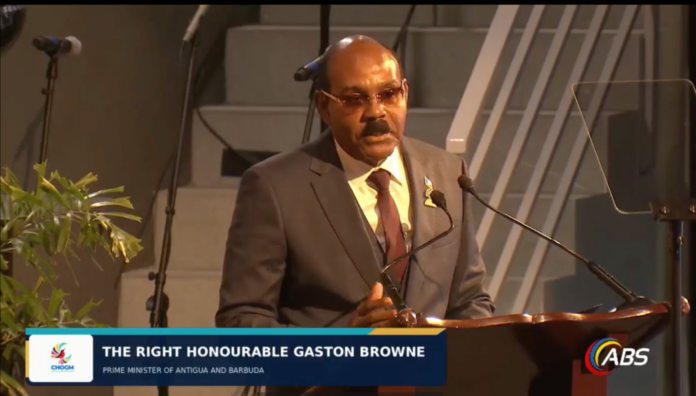

PM Browne at the CHOGM Opening ceremony
— Prime Minister Gaston Browne has called on Commonwealth leaders to move forward with structured discussions on reparatory justice, urging the 56-member organization to build on its previous commitment to address the enduring consequences of slavery and colonialism.
Speaking at the opening of the 28th Commonwealth Heads of Government Meeting (CHOGM) in Antigua and Barbuda, Browne placed reparations within a broader appeal for fairness, international cooperation and a more equitable global order.
The prime minister said the Commonwealth must now translate the understanding reached at its previous summit in Samoa into meaningful engagement among member states.
“Fairness also requires an honest engagement with our shared history,” Browne told the gathering, attended by King Charles III, Queen Camilla and Commonwealth leaders.
“In Samoa, we agreed that the time had come for a meaningful, truthful and respectful conversation on reparatory justice.”
He added: “We must now carry that commitment forward through structured, inclusive dialogue on the enduring consequences of slavery and colonialism, with a determination to make progress and a willingness to build consensus.”
The remarks placed the sensitive issue of historical accountability before Commonwealth leaders meeting in a Caribbean country whose history, like that of several other member states, was profoundly shaped by European colonization and the transatlantic slave trade.
Browne’s appeal emphasized dialogue and consensus rather than confrontation, reflecting his wider argument that the Commonwealth must confront difficult questions while preserving cooperation among countries with different histories, interests and economic circumstances.
The call follows a significant development in relations between Caribbean governments and Britain, with British Prime Minister Andy Burnham indicating a willingness to consider a formal apology for the United Kingdom’s role in the transatlantic slave trade.
Burnham’s government has proposed structured discussions with countries and communities affected by slavery, including consultations on what a possible apology should contain. However, the British government has maintained its opposition to financial reparations, leaving a major difference between London and Caribbean governments unresolved.
Browne had welcomed the British government’s position in an Oct. 31 statement, describing its openness to a formal apology as a significant development ahead of the Commonwealth summit.
He said recognition of historical responsibility, accompanied by a formal apology, would contribute to healing and stronger relations between Britain and the countries and peoples affected by slavery.
The Antigua and Barbuda leader also made clear that the Caribbean’s longstanding position on reparatory justice had not changed. He argued that disagreements over financial compensation should not prevent discussions or cooperation in areas where common ground could be found.
Browne called for the proposed engagement with Britain to have a defined timetable and to produce meaningful outcomes, rather than becoming an open-ended diplomatic exercise.
The issue gained formal recognition at the October 2024 Commonwealth summit in Apia, Samoa, where leaders agreed that the time had come for meaningful discussions on reparatory justice.
The Samoa communiqué acknowledged the historical experiences shared by many Commonwealth countries, including the transatlantic trafficking of enslaved Africans, chattel slavery, the dispossession of Indigenous peoples, indentureship and colonialism.
It also recognized the continuing consequences of those practices and committed Commonwealth leaders to supporting inclusive discussions about the harms they caused, with particular attention to the experiences of women and girls.
The agreement was an important diplomatic step for Caribbean governments, which had long sought greater international recognition of the historical injustices associated with slavery and colonialism.
However, the Samoa declaration did not establish a reparations payment mechanism, determine financial liability or commit Britain and other former colonial powers to compensation. Instead, it created a basis for further dialogue among Commonwealth members.
The Caribbean Community has pursued reparatory justice through a coordinated regional initiative since establishing the CARICOM Reparations Commission in 2013.
Its campaign goes beyond demands for monetary compensation, encompassing formal apologies, education, public health, cultural restoration, historical research and development initiatives intended to address the lasting effects of enslavement and colonial exploitation.
The commission’s chairman, University of the West Indies Vice Chancellor Sir Hilary Beckles, renewed that appeal ahead of the Antigua and Barbuda summit, welcoming Britain’s willingness to engage in structured discussions while emphasizing the Caribbean’s continuing demands for historical accountability.
Beckles said Caribbean governments remained committed to constructive engagement with Britain and other European governments over the consequences of chattel slavery.
The debate has also brought renewed attention to King Charles III, who attended the opening of the summit as head of the Commonwealth.
In his address to leaders, the king expressed sorrow over the transatlantic slave trade and acknowledged its painful legacy, but stopped short of issuing a formal apology.
His remarks came amid continuing calls from Caribbean reparations advocates for acknowledgment, apology and concrete measures to address the historical consequences of slavery.
Browne’s intervention also connected reparatory justice to the wider economic inequalities confronting developing Commonwealth nations.
Throughout his address, he argued that smaller countries continue to face disadvantages within international economic and political systems, particularly in accessing financing, managing debt and responding to climate-related disasters.
He warned that international decisions made by more powerful countries can have far-reaching consequences for nations with limited influence over those decisions.
The prime minister urged Commonwealth members to support financing reforms that recognize vulnerability rather than relying solely on national income, as well as debt arrangements that allow disaster-affected countries to recover without undermining future development.
Those concerns have also featured in the emerging discussions with Britain, whose government has proposed improved debt arrangements and development assistance for vulnerable Commonwealth countries.
Browne has welcomed those proposals while maintaining that cooperation on present-day development challenges should not replace discussions about historical responsibility.
The prime minister’s wider message was that the Commonwealth must demonstrate its relevance by addressing difficult issues and producing practical benefits for its members.
He argued that the organization, which brings together countries of vastly different sizes, histories and levels of economic development, has an opportunity to promote a more balanced international system through cooperation.
As the incoming Commonwealth Chair-in-Office, Browne pledged to work with member governments, Secretary-General Shirley Ayorkor Botchwey and the Commonwealth Secretariat to advance shared priorities and deliver measurable results.
His call for reparatory justice therefore forms part of a broader agenda aimed at strengthening cooperation while ensuring that the concerns of smaller and historically disadvantaged nations receive meaningful consideration.
Although Britain’s willingness to discuss a possible apology represents an opening, substantial questions remain about the scope of the proposed dialogue, who will participate, what remedies may be considered and whether discussions will produce commitments acceptable to the countries seeking reparatory justice.
For Caribbean governments, the Antigua and Barbuda summit presents an opportunity to move beyond the acknowledgment secured in Samoa toward a more defined process for addressing the legacy of slavery and colonialism.
Browne’s message to Commonwealth leaders was that confronting that history should be part of building a fairer relationship among member states, rather than an obstacle to cooperation.
He closed his address by urging leaders to ensure the Commonwealth becomes an institution whose value is demonstrated through its actions and its willingness to address the challenges facing its people.
The central question now is whether the commitment to dialogue will produce concrete progress after the leaders leave Antigua and Barbuda.
This article was originally published by Antigua News Room. Read the original article here: PM Browne urges Commonwealth to advance reparations talks over slavery and colonialism.