
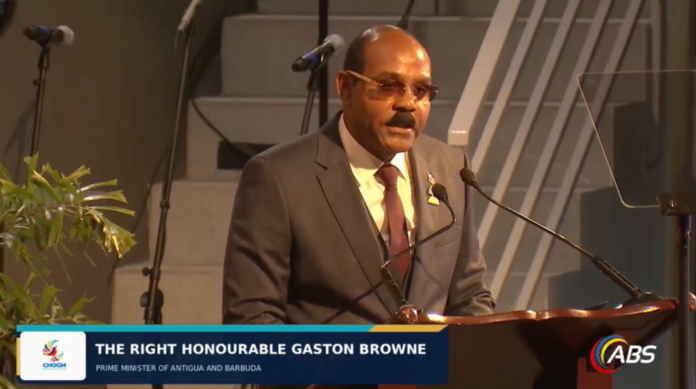

PM Brown at the CHOGM opening Ceremony
Prime Minister Gaston Browne has challenged Commonwealth leaders to move beyond diplomatic declarations and turn the organization’s vast economic potential into businesses, jobs and tangible improvements in people’s lives.
Addressing the opening of the 28th Commonwealth Heads of Government Meeting (CHOGM) in Antigua and Barbuda, Browne called for a more results-driven Commonwealth, arguing that the 56-member association must demonstrate its relevance through practical economic achievements rather than relying on historical ties and shared traditions.
The prime minister placed trade, investment and employment creation at the centre of his address, urging member countries to establish stronger commercial partnerships, remove barriers to trade and create conditions that allow businesses to expand across Commonwealth markets.
“A Commonwealth connection must do more than open doors. It must create opportunities; and those opportunities must translate into livelihoods,” Browne declared.
His remarks reflected the central theme of the Antigua and Barbuda summit, “Accelerating Partnerships and Investment for a Prosperous Commonwealth,” which seeks to strengthen economic cooperation among countries representing different regions, levels of development and economic capabilities.
Browne said the Commonwealth already possesses the resources needed to generate greater prosperity, but its members must demonstrate the political will to connect investors, businesses, markets and workers.
“Across our 56 member nations lie immense opportunities: capital, markets, productive capacity, scientific knowledge and human talent. The resources are there. The needs are there. What is required is the collective will to connect them,” he said.
The prime minister outlined several measures he believes could help transform those resources into economic activity, including expanding trade among Commonwealth countries, simplifying customs procedures, strengthening transport connections and improving access to financing.
He placed particular emphasis on small and medium-sized enterprises, which often face greater obstacles in securing capital and entering international markets.
“Let us expand trade among ourselves, simplify customs procedures, strengthen transport links and improve access to trade finance, particularly for small and medium-sized enterprises,” Browne told fellow leaders.
He also urged governments to establish predictable investment frameworks that would give businesses greater confidence to commit capital, introduce innovations and create employment.
Browne argued that stronger economic integration could benefit both developed and developing Commonwealth members, provided that cooperation produces meaningful opportunities across the organization.
Larger economies, he explained, could benefit from access to dependable suppliers and new investment destinations, while smaller countries could gain access to larger markets, productive investment and opportunities to diversify their economies.
“Commonwealth cooperation must deliver meaningful benefits for every member, regardless of size or economic strength,” he said.
A central element of Browne’s proposals was the Commonwealth Secretariat’s investment platform, which is designed to connect development projects in member countries with investors capable of financing them.
The Secretariat announced ahead of the summit that the platform featured more than 60 projects submitted by 20 Commonwealth countries, representing approximately US$30 billion in potential investment opportunities.
The projects span sectors including energy, transportation, agriculture, manufacturing and the green economy, with the objective of mobilizing private capital, supporting industrial development and creating employment.
The Commonwealth has a combined population of approximately 2.7 billion people, while its combined gross domestic product was estimated at US$15.9 trillion in 2025, according to figures released by the Secretariat.
Those figures illustrate the economic scale of the association, but Browne’s argument was that the existence of substantial markets and investment opportunities does not automatically guarantee prosperity for its members.
“The Secretariat’s investment platform provides an opportunity to connect viable projects with willing investors,” Browne said.
He called for those connections to produce enterprises, decent employment and lasting economic benefits, rather than remaining proposals discussed at international meetings.
Importantly, the prime minister also demanded greater accountability for commitments made by Commonwealth governments.
He proposed establishing clear responsibilities, realistic timelines and measurable outcomes, along with reporting arrangements to monitor progress between Commonwealth meetings.
The approach would place greater emphasis on what governments and institutions actually accomplish after summits conclude, rather than measuring success primarily through declarations and agreements.
Browne’s challenge comes as Commonwealth leaders and business representatives gather in Antigua and Barbuda for the Commonwealth Business Forum, being held alongside CHOGM from Nov. 2-4.
The forum brings together heads of government, policymakers, investors and business executives to examine trade financing, emerging technologies, climate resilience, entrepreneurship and opportunities for economic cooperation.
Its agenda includes discussions on strengthening regional integration, financing development and expanding investment opportunities for smaller Commonwealth economies.
The prime minister’s emphasis on employment and enterprise also extends to the Commonwealth’s younger population.
He urged governments to expand scholarships, research partnerships, professional exchanges and access to digital technology, arguing that such initiatives could equip young people to establish businesses, contribute to scientific advancement and strengthen public institutions.
Browne said women must have equal access to those opportunities and called for the removal of barriers that continue to limit their participation.
He identified cooperation among governments, universities, businesses and civil society as essential to converting those ambitions into practical achievements.
The prime minister also acknowledged that economic development cannot be separated from the vulnerabilities confronting many smaller Commonwealth countries, including Antigua and Barbuda.
He warned that hurricanes and other climate-related disasters can destroy infrastructure and livelihoods while forcing governments to divert resources away from education, healthcare and long-term economic development.
Browne consequently called for greater access to climate financing, reforms to international lending criteria and debt arrangements that give vulnerable countries sufficient financial flexibility to recover from disasters.
He argued that investments in renewable energy and resilient infrastructure could simultaneously strengthen economic security, reduce dependence on imported fossil fuels and create additional opportunities for businesses.
These proposals formed part of his wider appeal for a Commonwealth capable of responding to the economic pressures confronting its members, particularly smaller and developing nations.
Browne also questioned whether the organization could continue to justify its relevance through historical connections and shared values without demonstrating practical results.
He acknowledged the Commonwealth’s contributions to democratic institutions, the rule of law, technical assistance and advocacy for smaller states, but argued that its future importance would depend on what it delivers.
The prime minister’s message was especially significant as Antigua and Barbuda assumes the Commonwealth Chair-in-Office role, placing Browne in a position to help coordinate the organization’s priorities over the next two years.
He pledged to work with Commonwealth Secretary-General Shirley Ayorkor Botchwey, the Secretariat and member governments to advance cooperation and ensure that commitments produce lasting benefits.
The central test will be whether the investment opportunities being promoted in Antigua and Barbuda lead to financed projects, operating businesses and employment, particularly in countries that have historically struggled to attract international capital.
Browne concluded by calling on Commonwealth leaders to make the organization an active force for economic opportunity and international cooperation rather than an institution defined primarily by its past.
“Let history remember that, at this moment of global uncertainty, we chose cooperation over division, solidarity over indifference, and action over empty promises,” he said.
The prime minister’s appeal leaves Commonwealth governments with a clear challenge: to demonstrate that their collective economic strength can translate into jobs, businesses and improved living standards for the people they represent.
This article was originally published by Antigua News Room. Read the original article here: Commonwealth must deliver jobs, not just promises, PM Browne declares.